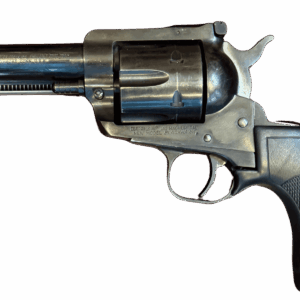
Elmer Keith (1899-1984) was an Idaho rancher, hunting guide and gun writer who, by his own count, spent thirty years pressing for a heavier factory revolver cartridge. The result, in the winter of 1955-56, was the .44 Magnum. He also designed the Lyman cast bullet that still carries his name, took part in the .357 Magnum story in the 1930s, and asked for the .41 Magnum in the 1960s.
Most of what is known about him comes from his own books, chiefly Sixguns (second edition, Stackpole, 1961) and his autobiography Hell, I Was There! (Petersen, 1979). American Rifleman’s account of the factory side (Dave Campbell, 2013) shows where his memory and that account differ.
Elmer Keith’s Early Life: Missouri and Montana
Keith wrote that he “was born at Hardin, Ray County, Missouri, March the 8th, 1899, the son of Forrest Everett and Linnie Neal Keith” (Hell, I Was There!, page 1). The family moved west to Montana while he was a boy, first to Helena.
In the fall of 1911 the family moved from Helena to Missoula. With most hotel rooms taken, they rented rooms in a rooming house near the courthouse, and Keith, then twelve, was badly burned when it caught fire. He described months on his back and a left hand left “turned upside down and back on my wrist.” A year after the fire he was back at school and selling the Missoula Sentinel (Hell, I Was There!, pages 19-22; John Taffin’s tribute quotes the same passage).
He grew up shooting in Montana’s ranch country. His autobiography records his first deer with a Model 1894 Winchester in .25-35 that his father gave him, and his decision afterward that the .25-35 was too light for big game. As a boy he won a place in a local rifle club by qualifying expert, after practicing over the course with a Krag bought through the NRA and shooting the full course with a borrowed Springfield.
Cowboy, Guide and Gun Writer
Keith punched cows, broke horses and guided hunters in Montana, eastern Oregon and Idaho. He shot at Camp Perry in the mid-1920s and wrote that his first pistol articles came out after he and J. H. Fitzgerald demonstrated the quick draw there (Sixguns, preface). His autobiography credits Major Charles Askins with buying his first article for Outdoor Life in 1926 (page 124).
In 1927 Harold Croft, a Philadelphia shooter, spent a month with Keith and his wife Lorraine on their small ranch at Durkee, Oregon, to see for himself whether long-range sixgun shooting was real. The two became lifelong friends and worked together on single-action improvements for years afterward (Hell, I Was There!, pages 124-125).
In the 1930s and 1940s Keith ranched on the North Fork of the Salmon River in Idaho. During World War II he served as a civilian “inspector and head of small-arms testing at Ogden Arsenal” in Utah (Hell, I Was There!, page 186). At about fifty he quit guiding, rented out the ranch, and in the winter of 1948 moved into the town of Salmon to write full time (page 201).
He spent eight years on the technical staff of The American Rifleman, then lost the job in a dispute over writing a monthly column for Guns magazine as well (pages 201-202). Craig Boddington, a later Guns & Ammo editor, called him that magazine’s “brightest star” from its early days until his death. The dust jacket of his 1979 autobiography lists him as Executive Editor of Guns & Ammo and “the recipient of the first Outstanding Handgunner of the Year Award.” Keith also wrote in his Sixguns preface that “for twenty years I custom-loaded pistol ammunition” for other shooters.
The .45 Colt Blowups and the Move to the .44 Special
Keith’s cowboy sixgun was a Colt Single Action Army in .45 Colt. He loaded it with heavy bullets and black powder, and in Sixguns he recorded what happened next: “Finally a weak .45 Colt case head blew off with this load. The gas blew the loading gate off the gun, breaking its shank and cutting through the flesh of my trigger finger” (page 129). He also ruined a barrel with a batch of loads made up by F. C. Ness of Belding & Mull, and the barrel “cracked in three places.” A different old .45 Single Action blew up in his hand, losing its top strap and the tops of three chambers; the gunsmith J. D. O’Meara rebuilt it as a flat-top target frame (page 223).
From these failures Keith decided the .45 Colt case and the single action’s thin chamber walls of his day were the weak point. In his autobiography he put it this way: “I found out by then that I could load a .44 Special much heavier and to give more power, more velocity and energy, than anything possible out of a thin-cylinder .45 Colt” (page 125). For the rest of his life the .44 Special, in the heavy Smith & Wesson and Colt frames, was his working cartridge. For the cartridge itself see our history of the .45 Colt, and for the revolver see the Colt Single Action Army.
The Keith Bullet: Lyman (Ideal) No. 429421
Keith’s first bullet designs were for Belding & Mull: a .45 Colt bullet he dated to 1925, then 260 and 280-grain .44 Special versions. All had blunt, round noses. He found them good at short range but not accurate far out, and he did not like the hole they made in game, which he said “punched a hole rather than cutting full caliber” (Sixguns, page 129).
During Croft’s 1927 visit he drew a new design for the Lyman Gun Sight Company, sold under Lyman’s Ideal line as No. 429421, a 250-grain .44 Special bullet (Sixguns, pages 110 and 229; Hell, I Was There!, page 125, where he wrote “in 1927 I believe it was”). Lyman’s Mr. Pickering had the steel model turned and sent to him. Hollow-point and hollow-base versions weighed 230 to 235 grains (Sixguns, pages 229 and 282).
Keith explained the design in Sixguns:
- a flat point;
- a wide, heavy front band of full groove diameter ahead of the crimp groove, to keep the cartridge aligned with the bore and to cut a full-caliber hole “in meat or target”;
- a bullet seated well out of the case, “as far as length of the cylinder would permit.”
The shape became known as the Keith semi-wadcutter. Keith later designed bullets in other calibers on the same lines, and he complained in Sixguns that the factories changed his design when they adopted it for the .357 Magnum (page 279). For cast-bullet basics see what you need to cast bullets and why cast bullets are lubricated.
Keith’s Heavy .44 Special Load, as He Printed It
Keith’s long-range work with the 429421 began with Du Pont No. 80, a powder no longer made (Sixguns, page 110). His best-known load came later, with Hercules 2400. In Sixguns he wrote that he wanted a magnum .44 built “to use my heavy loads with Keith 250 grain solid bullet or 235 grain hollow point backed by 18.5 grains 2400 powder” (page 42). His load table in the same book lists the bullets “#429421 and #429422, use 18.5 grains in old web cases and 17.5 grains in new solid head cases” (page 272). By “new” Keith meant the solid-head cases of the 1950s. In the same book he wrote that his heavy loads were not held to “the 15,000 pounds pressure limit arbitrarily imposed by the loading companies for most revolver loads” (page 269). These charges do not come from today’s published .44 Special data, which is worked up to industry pressure limits. The powder he called Hercules 2400 is now made by Alliant. In 1979 he wrote that he “had been loading 18½ grains of 2400 behind my 250-grain bullet a good many years in the .44 Special” (Hell, I Was There!, page 199).
Keith tied his loads to strong guns. In Sixguns he listed the heavy-frame revolvers he considered safe with them and warned that cheap revolvers “would blow these imitations to pieces at the first shot” (pages 267-268).
The .357 Magnum: Keith’s Part, in His Words and Others’
In 1930 Smith & Wesson put the .38 Special on its heavy .44 frame as the .38/44 Heavy Duty, with hotter Remington ammunition. Keith tested a .38/44 Outdoorsman with heavy handloads using his bullets. By his account he sent samples to Colonel Bill Tewes of Peters for pressure testing and wrote Major Douglas B. Wesson that the gun would take far more than the factory load, and “Doug wrote back that my experiments were the determining factor in his bringing out a gun to be called the .357 Magnum” (Sixguns, page 42). Keith said he sent Wesson quantities of his bullets, that Remington would not load them, and that Wesson went to Winchester’s Mert Robinson instead. Elsewhere he described a .357 Magnum “that Major Wesson had given me for helping him design that cartridge” (Hell, I Was There!, page 180).
Dave Campbell’s 2010 history of the cartridge in American Rifleman gives the main role to Phil Sharpe, the writer and NRA Technical Staff member. It says Sharpe and Keith “separately began working up hotter loads,” that Keith’s interest turned to the .44 Special, and that Sharpe kept “stumping” for a hot .38 with Wesson. The finished cartridge was 0.125 inch longer than the .38 Special and drove a 158-grain bullet at 1,515 fps from an 8 3/4-inch barrel. J. Edgar Hoover received the first revolver on April 8, 1935. Campbell’s 2013 Model 29 article in the same magazine credits Keith, Sharpe and Wesson together with developing the .357.
Both accounts put Keith’s .38/44 work among the experiments behind the .357. Keith also wrote that the factory .357 load used a version of his bullet that Wesson and Winchester’s Mert Robinson redesigned, which he called “a mistake” (Sixguns, page 279). Keith tested revolver No. 0362 for Smith & Wesson and wrote it up in The American Rifleman (Sixguns, page 42). See also our .38 Special history.
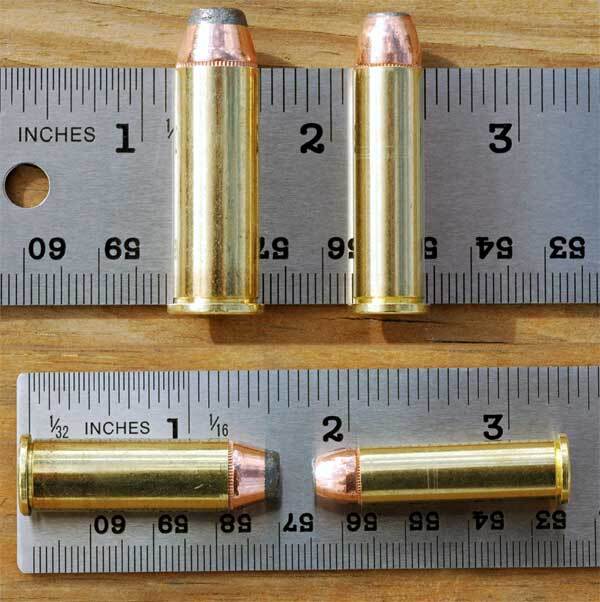
How Elmer Keith Got His .44 Magnum
Keith never stopped asking for a factory .44 to match his handloads. In Sixguns he complained that the loading companies “are afraid of the old type case with protruding primer pocket and thin head” and of the old Triple Lock (page 44). His autobiography gives his account of the turning point (pages 197-198):
- At Camp Perry he asked Remington’s head ballistician to load his heavy .44 Special, and he was invited to the Remington plant. There, with Remington wary of the old Triple Lock revolvers, Keith wrote: “So I told them why not make the case 1/10-inch longer and call it a .44 Magnum?”
- He then spent a week at Smith & Wesson. President Carl Hellstrom promised, “I’ll wrap a gun around any legitimate load that Remington will bring out.” Keith dated that meeting September 1953.
- More than two years later (Keith wrote “after a lapse of several months”; Sixguns dates the call to January 1956) the company called to say “The first .44 Magnum ever produced, the tool-room job, is on its way to you.” Keith remembered it arriving in February.
American Rifleman’s account (Dave Campbell, 2013) fills in the factory side. By the summer of 1954 Remington had sent Smith & Wesson a cartridge design 1/8 inch longer than the .44 Special. In mid-July 1954 Smith & Wesson made four specially heat-treated N-frame test revolvers. After testing, the barrel and frame were made heavier, adding about 7 1/2 ounces. The first production .44 Magnum came off the line on December 29, 1955, and went to R. H. Coleman of Remington. The second went to Major General Julian S. Hatcher of the NRA Technical Staff. The third, completed on January 27, 1956, went to Keith. The gun was simply the “.44 Magnum” until June 1957, when Smith & Wesson stamped model numbers on its revolvers and it became the Model 29.
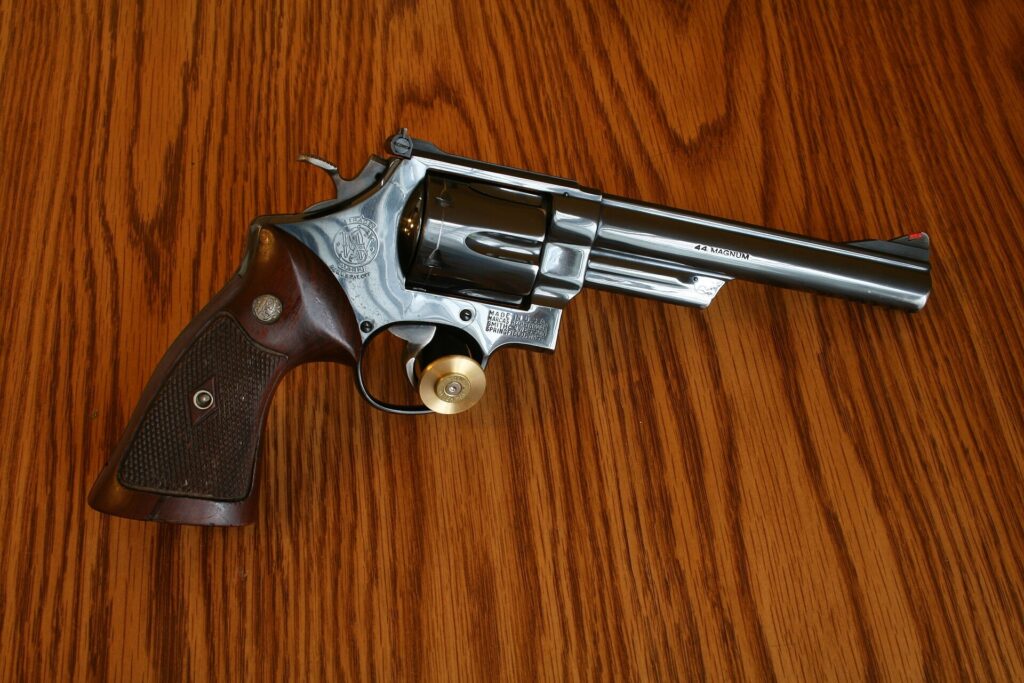
Keith wrote that Remington’s first ammunition came in plain boxes, with soft lead bullets that expanded well, and gave its velocity as about 1,400 fps and its pressure as about 34,000 to 35,000 psi. That summer he settled on “a load of 22 grains of 2400 behind my bullet as my favorite load,” which he said ran about 34,000 psi and 1,400 fps (Hell, I Was There!, page 199). The same warning applies: it is his historical figure. Do not copy it.
Keith was not the only writer with an early gun. Wiley Clapp, writing in Shooting Illustrated, recalls that a few samples were out to writers before the public release in 1956 and that few were in circulation before 1957. For the cartridge’s specifications and later guns see our .44 Magnum cartridge page and our .44 Russian history of the case family.
The 600-Yard Mule Deer
The most argued-over story about Elmer Keith is a mule deer he hit with the new .44 Magnum at long range. He told it twice in print.
In Sixguns (1961) he wrote that he killed three mule deer with the gun and load, “one of them running away from me at over 600 yards on three legs from a rifle hit,” with “two hits on that deer out of four shots,” and that “I had Paul Kriley spotting for me through his rifle scope” (page 310).
The longer version is in Hell, I Was There! (pages 199-201). Shortly before the season Keith and Judge Don Martin fired at a rock they estimated at 500 yards; Keith put five of six shots on it, and the two men paced the distance at about 500 yards. That fall, on the last day of the season, Keith and Paul Kriley found a band of mule deer on Clear Creek. Kriley took the .300 Magnum rifle around to get within about 500 yards and hit a big buck in the leg. Keith fired prone, holding up “all of the front sight” and some of the ramp. One of his bullets went in behind the jaw and out the top of the nose, and one went through the lungs broadside. Kriley finished the buck with his rifle. About ten days later Keith’s son Ted, skinning the buck, found “the part jacket of a Remington bullet” beside the exit hole on the left side of the ribs. Keith wrote: “Then I knew that I had hit him at that long range two out of four times… I wrote it up and I’ve been called a liar ever since, but Paul Kriley is still alive and able to vouch for the facts.”
Keith’s accounts and the later retellings differ on several points:
- The 500-yard rock was paced. The range to the deer was Keith’s estimate; neither account says it was measured.
- Keith never claimed a first-shot hit. He said he hit with two of four shots, and in his 1979 account the buck was finished by Kriley’s rifle.
- Keith himself said he fired prone. Later retellings put him reclining with his gun arm braced along his leg (David Petzal in Field & Stream, 2014, republished 2024) or describe the rifleman as a client who hit the deer in the jaw (Wiley Clapp in Shooting Illustrated, 2019). Keith’s own account has Kriley hitting a leg and Keith’s bullet making the jaw wound.
- Keith wrote that “one editor of a nationally circulated magazine” tried to discredit him and that General Hatcher, writing in the Gun Digest, gave him “full credit” (Sixguns, page 310).
The .41 Magnum
Keith’s autobiography says the .41 Magnum began when Bill Jordan, the Border Patrol officer and writer, came to him at an NRA convention in Washington, D.C., and suggested a .41 Magnum for police and sheriffs who did not want the .44’s recoil (Hell, I Was There!, page 239). Keith called a meeting that night with Doug Hellstrom and Bill Gunn of Smith & Wesson, Bill Ruger, Ted McCawley and Earl Larsen of Remington, and representatives of Winchester, Colt and Norma.
He wrote that he asked for a case the same length as the .44 Magnum’s and a .410-inch bullet, larger than the bullets of the old .38-40 and .41 Long Colt. The larger bullet meant no old gun could be rechambered for the new round. “I wanted a 220-grain bullet,” he added. Remington agreed to make the ammunition, and Smith & Wesson and Ruger the guns (pages 239-240). He contrasted the thirty years it took to get the .44 Magnum with the six months the .41 took (page 302).
The cartridge appeared in 1964 with 210-grain bullets. Keith remembered asking for 220 grains. American Hunter’s history of the round says Keith pictured two power levels, a 210-grain bullet at 1,300 to 1,400 fps and a lighter, slower police load, and that the commercial ammunition ended up faster than he had in mind. Smith & Wesson chambered it in the adjustable-sighted Model 57 (Wiley Clapp, American Rifleman, 2015). Skeeter Skelton, another Border Patrol veteran and writer, judged it right for police work. Our Ruger .41 Magnum Blackhawk article covers the Ruger side.
Books and Columns
The jacket of his autobiography credits him with hundreds of articles over more than fifty years. His main books on handguns are:
- Sixgun Cartridges and Loads (1936), commissioned by T. G. Samworth’s Small Arms Technical Publishing Company (Hell, I Was There!, page 170).
- Sixguns by Keith, published by Stackpole in October 1955 and revised in October 1961 (copyright page of the second edition). He wrote that General Stackpole asked him for “a big book on the subject.”
- Hell, I Was There! (1979), his autobiography.
He also wrote books on big-game rifles and on shotguns. His opinions were strong, and his feud with the rifle writer Jack O’Connor was well known. Craig Boddington, who edited Keith’s copy at Guns & Ammo from 1979, wrote that “he really did hate Jack O’Connor, although history suggests that O’Connor didn’t reciprocate,” and quoted a Keith line from the November 1961 Guns & Ammo: “I like one-shot kills where possible and prefer to do all my hunting before I shoot.”
Legend and Record
- “Keith invented the .44 Magnum.” Keith asked for it for decades and proposed a longer .44 Special case. Remington designed the cartridge and Smith & Wesson the revolver, at Carl Hellstrom’s direction. Keith himself wrote “many people tried to claim credit for the .44 Magnum, but those were the facts as I experienced them” (Hell, I Was There!, page 199).
- “Keith received the first .44 Magnum.” Keith was told his gun was the first tool-room revolver. In American Rifleman’s account (Dave Campbell, 2013), the first gun went to Remington’s R. H. Coleman and the third to Keith.
- “The .357 Magnum was Keith’s.” Keith said Wesson credited his experiments. Campbell’s 2010 American Rifleman history credits Phil Sharpe as the chief advocate, and his 2013 article credits Keith, Sharpe and Wesson together. Both accounts are given above.
- “The 600-yard shot was a one-shot kill.” Keith claimed two hits in four shots on a wounded buck that his partner then finished. The range was estimated.
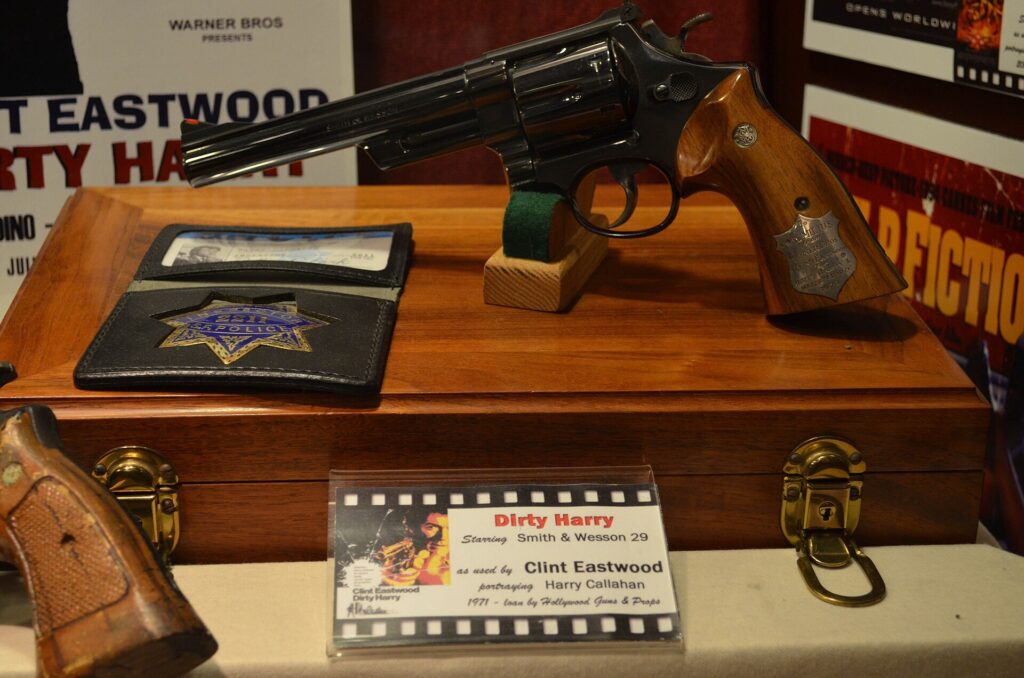
- “Dirty Harry made the Model 29.” The 1971 film created a buying rush, but Wiley Clapp, a police officer at the time, wrote that the .44 “was hard to find for years before the movie ever screened.”
- The death date. The Library of Congress name record and his grave marker give February 14, 1984. John Taffin’s tribute and Boise State University’s archive give February 12.
Death and Legacy
Keith had a stroke in December 1981 and fought it for more than two years. He died in Boise, Idaho, in February 1984, a few weeks before his 85th birthday, and is buried at Salmon. Taffin wrote that “the big Stetson and the Smith & Wesson .44 Magnum were set aside in December of 1981.”
Three of his ideas are still in production: the .44 Magnum, the .41 Magnum and the flat-pointed cast bullet. American Rifleman calls the .44 Magnum “Elmer Keith’s brainchild.” Smith & Wesson’s company history is covered in our Smith & Wesson article.
Elmer Keith’s Guns Today
Smith & Wesson still makes the three revolvers most tied to Keith’s cartridges:
- Smith & Wesson Model 29 in .44 Magnum, with the 6 1/2-inch barrel Keith’s first gun had.
- Smith & Wesson Model 57 in .41 Magnum, the gun that came out of the 1960s meeting.
- Smith & Wesson Model 27 Classic in .357 Magnum, the descendant of the 1935 revolver.
Further Reading
Keith’s own books are the place to start. Older editions are often sold used, a copy or two at a time.


- Sixguns by Keith: The Standard Reference Work by Elmer Keith. His main book on revolvers, cartridges and handgun hunting.
- Hell, I Was There! by Elmer Keith. The 1979 autobiography, his own account of his life.
- Sixgun Cartridges and Loads by Elmer Keith. The 1936 manual, reprinted. Its loads are historical.
- Gun Notes by Elmer Keith. Volume I of his “Gun Notes” columns from Guns & Ammo, 1961 to 1970.
- Elmer Keith: The Other Side of a Western Legend by Gene Brown. A biography.
For loading the cartridges Keith championed, use current published data:
-
Lyman 51st Reloading Handbook-Softcover
Purchase on Amazon -
Sale!

Lyman Cast Bullet Handbook, 4th Edition
Purchase on Amazon -
Sale!

The Complete Reloading Manual for the .44 Special
Purchase on Amazon -

The Complete Reloading Manual for the .44 Magnum
Shop at MidwayUSA -
Sale!

The Complete Reloading Manual for the .41 Magnum
Purchase on Amazon
Sources
- Elmer Keith, Sixguns by Keith, second edition (Stackpole, 1961). Pages cited in the text.
- Elmer Keith, Hell, I Was There! (Petersen Publishing, 1979). Pages cited in the text.
- American Rifleman, “A Look Back at the Smith & Wesson Model 29” (2013).
- Dave Campbell, American Rifleman, “The History of the .357 Magnum” (2010).
- American Hunter, “Behind the Bullet: .41 Remington Magnum” (2017).
- Wiley Clapp, Shooting Illustrated, “The .44 Magnum: A History” (2019).
- Wiley Clapp, American Rifleman, “Hangin’ In: The .41 Magnum” (2015).
- David E. Petzal, Field & Stream, “Ol’ Elmer’s 600-Yard Shot” (2014; republished 2024).
- Craig Boddington, Guns & Ammo, “Shooting Star: The Legend of Elmer Keith” (2013).
- John Taffin, “Elmer Keith: 1899-1984”.
- Library of Congress, name authority record for Keith, Elmer, 1899-1984.
- Boise State University Special Collections, Elmer Keith Papers, MSS 103.
- Shooting Illustrated, “Elmer Keith and the Golden Years of Gun-Writing” (2019), on Salmon as his resting place.
If you know of any forums or sites that should be referenced on this listing, please let us know here.