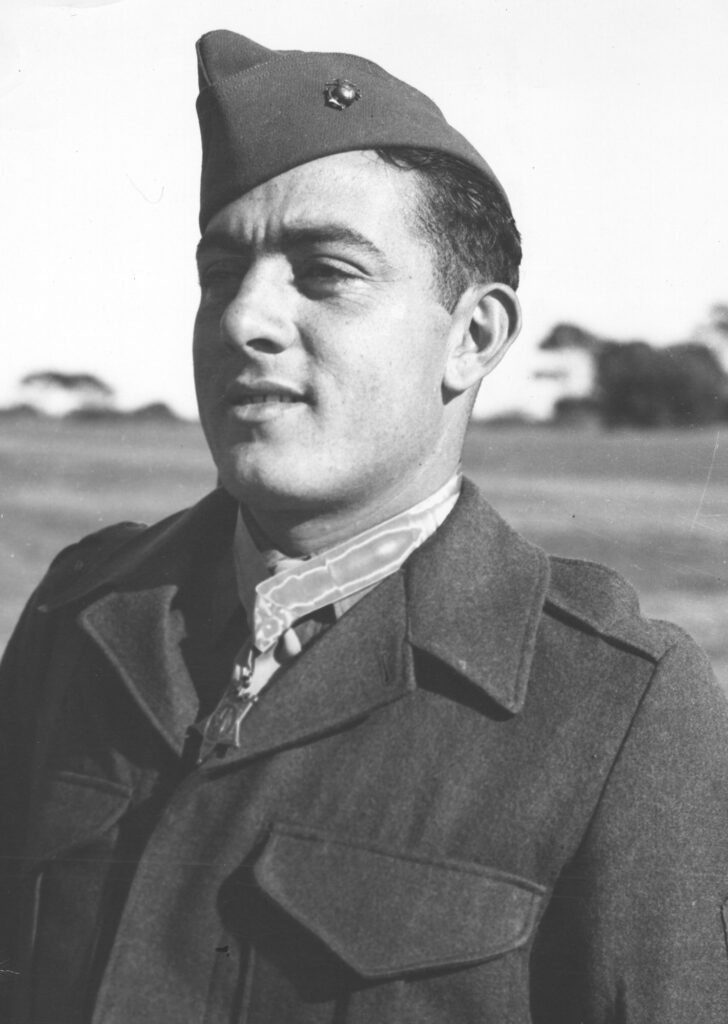
John Basilone earned the Medal of Honor with water-cooled heavy machine guns on Guadalcanal in October 1942. Twenty-eight months later he died on the first day at Iwo Jima, leading machine gunners again. The Marines knew him as “Manila John.” This article follows his service and the water-cooled M1917 Browning he fought with. It also sets out where the wartime records disagree with each other and with later accounts.
From Raritan to the Marine Corps
John Basilone was born in Buffalo, New York, on 4 November 1916 and grew up in Raritan, New Jersey, one of ten children of an Italian-born father, according to the Marine Corps History Division. He served first in the Army, much of it in the Philippines, which gave him his nickname.
His Marine Corps service record, now digitized by the National Archives, shows he was still carried in the Regular Army Reserve on 9 July 1940, when the Marine recruiting office in Baltimore asked the Army to release him to enlist. He joined the Corps that month.
By the fall of 1942 he was a sergeant in Company D, 1st Battalion, 7th Marines, commanded by Lieutenant Colonel L. B. Puller, and in charge of two sections of heavy machine guns. The records of the action call his guns heavy and water-cooled without naming the model. The only water-cooled .30 caliber Brownings in the Ordnance Department’s 1942 maintenance manual are the M1917 and its modified form, the M1917A1.
John Basilone and the water-cooled Browning
John Browning’s heavy machine gun went through Army tests in May 1917. The report of Benedict Crowell, Assistant Secretary of War, published as America’s Munitions 1917-1918, records that the test board pronounced the Browning heavy gun and the Browning automatic rifle “the most effective guns of their type known to the members.” With its water jacket filled, the heavy gun weighed 36.75 pounds.
Colt owned the Browning rights and drew up the plans, but most of the guns came from other plants. Crowell’s figures show about 42,000 heavy Brownings accepted by the government by 11 November 1918, roughly 30,000 of them from New England Westinghouse, 11,000 from Remington and about 1,000 from Colt. Of these, 30,582 were shipped to the American Expeditionary Forces. It is a different weapon from the M1917 Enfield rifle of the same year.
How the water-cooled system worked
The Army’s 1945 field manual, FM 23-55, describes the M1917A1 as “recoil operated, belt fed, and water cooled.”
The barrel sat inside a jacket holding about 7 pints of water. Prolonged fire turned that water to steam, and a steam tube along the inside top of the jacket let it escape. A sliding outer tube dropped by gravity to cover whichever end of the inner tube was lower. That kept water out of the tube and let steam out of the upper end, whether the muzzle was raised or lowered. From there the steam passed through a small tube to the steam condensing device, whose far end sat in the water chest.
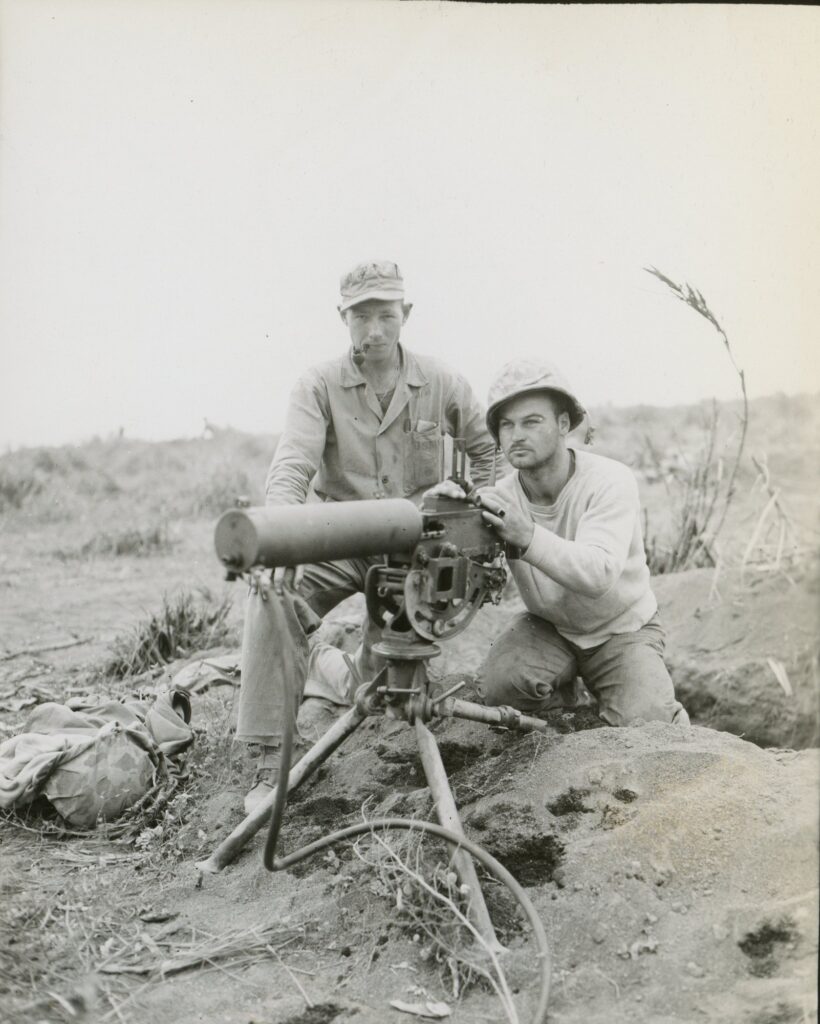
FM 23-55 gives these figures for the M1917A1:
- Gun and pintle, without water: 32.6 pounds
- Gun and pintle, with water: 41 pounds
- M1917A1 tripod: 53.2 pounds
- Barrel length: 23.9 inches
- Rear sight graduated to 2,600 yards
- Cyclic rate: 450 to 600 rounds per minute
By those figures a filled gun on its tripod came to about 94 pounds, before ammunition, water chest or condenser. The gun fired the U.S. service cartridge, the .30-06 Springfield. The Ordnance Department’s 1942 maintenance manual, TM 9-1205, notes that the original M1917 was designed around the Model 1906 cartridge, and that the M1917A1 sights were graduated for either M1 or M2 ball ammunition.
The same manual lists what changed when an M1917 became an M1917A1. The changes included a new bottom plate and mounting bracket, an improved cover latch, and a new belt feed lever and mounting of the M1919A4 type. The feed lever was needed because the ammunition chest had moved from the tripod to the ground, which left the gun more belt weight to lift.
The mechanism also served without its jacket. Crowell describes the Browning aircraft gun of 1918 as “essentially the heavy Browning with the water-jacket removed,” made lighter and speeded up. The air-cooled M1919A4 shares both manuals with the M1917A1, and the A1 took its belt feed lever from it.
Guadalcanal: the night of 24-25 October 1942
In late October the Japanese 2d (Sendai) Division under Lieutenant General Maruyama cut a trail through the jungle to strike the Henderson Field perimeter from the south. The official history, Pearl Harbor to Guadalcanal (Hough, Ludwig and Shaw), records that by 23 October Puller’s battalion alone held a 2,500-yard line across the southern slopes of Bloody Ridge. At about 0030 on 25 October, Major General Yumio Nasu’s 29th Infantry came out of the jungle against the left center of that line.
Puller’s recommendation for John Basilone’s medal, dated 31 October 1942 and held in the service record, says Basilone was “the noncommissioned officer in charge of two sections of heavy machine guns on the main defense line, Sector # 3, Lunga Area.” When one section was put out of action by grenades and mortar fire, and all but two men of both crews had been killed or wounded, he “did personally carry an extra machine gun to the scene of the casualties under heavy fire,” put it into action, then repaired one of the damaged guns and manned it until a replacement arrived.
Later, with the ammunition route cut, he “made his way across the front of his company” and came back with more ammunition.
Hough’s history describes the same moment from the battalion level: the Japanese “worked close to a water-cooled machine gun and knocked out all but two of its crew.” Hough credits Basilone with the rescue of that gun. The Army’s 3d Battalion, 164th Infantry, came forward through the rain in small groups and was fed into Puller’s line. By 0330 the reinforcement was complete. The Japanese attacked again the following night and were again repulsed.
The Medal of Honor
Major General A. A. Vandegrift endorsed Puller’s recommendation on 5 November 1942. The citation, printed in the Navy’s official Medal of Honor volume and reproduced by the Naval History and Heritage Command, follows the recommendation closely:
Moving an extra gun into position, he placed it in action, then, under continual fire, repaired another and personally manned it, gallantly holding his line until replacements arrived. A little later, with ammunition critically low and the supply lines cut off, Sergeant Basilone, at great risk of his life and in the face of continued enemy attack, battled his way through hostile lines with urgently needed shells for his gunners, thereby contributing in large measure to the virtual annihilation of a Japanese regiment.
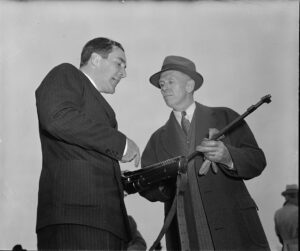
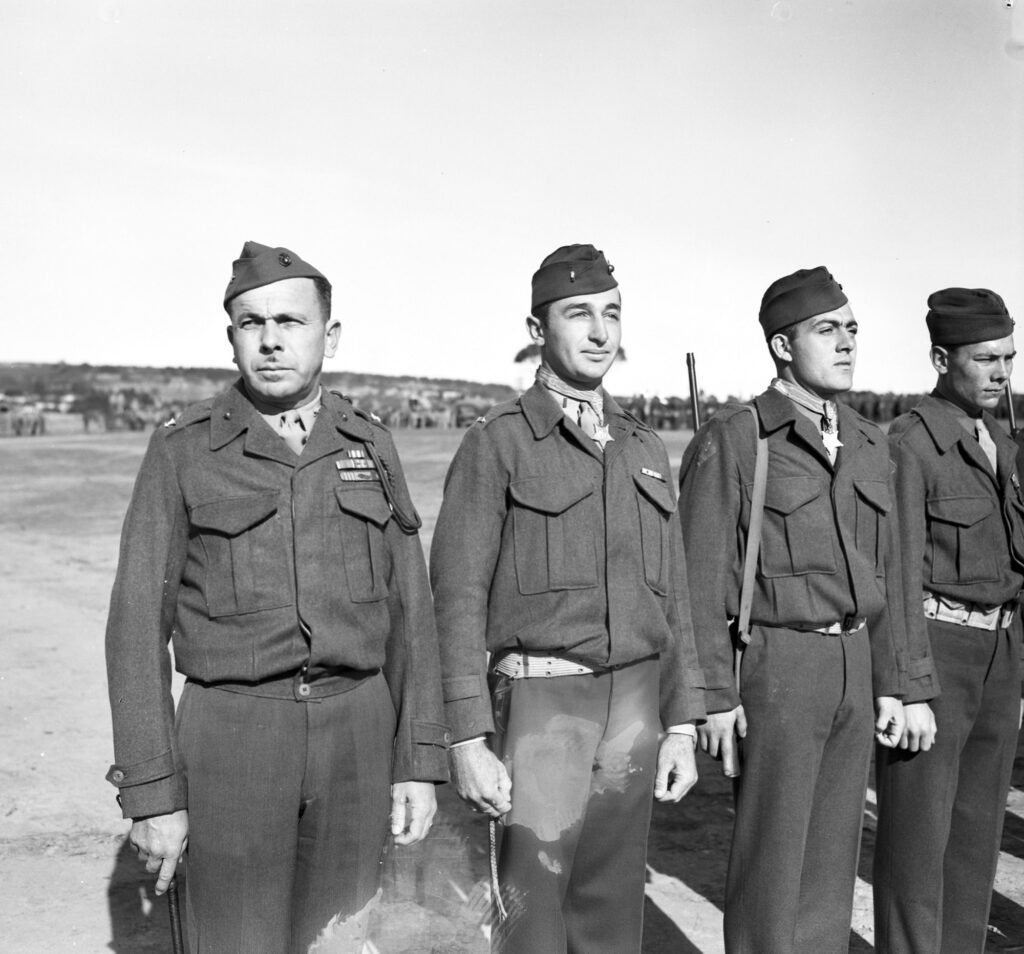
The citation was signed by President Franklin D. Roosevelt, according to the History Division. Hough’s history calls John Basilone the first enlisted Marine of World War II to receive the Medal of Honor. Vandegrift presented the decorations at a parade, and the National Archives dates the photographs of it 21 May 1943. One shows Basilone, by then a platoon sergeant, standing beside Second Lieutenant Mitchell Paige, who received the Medal of Honor the same day.
The war bond tour
John Basilone came home to sell war bonds. A Marine Corps memorandum of 2 September 1943 in his service record requests orders sending Platoon Sergeant Basilone to the Marine Corps Public Relations Office in New York for the Treasury Department’s Third War Loan Drive. From there he was to travel by government aircraft to Newark, Jersey City, New Haven, Providence, Manchester, Worcester, Albany, Syracuse, Rochester and Scranton. The same request sent him to Raritan on or about 18 September and back to New York on or about 20 September.
Raritan gave him a parade. Arlington National Cemetery notes that it was featured in Life magazine, and the National Museum of the Marine Corps cites the story as “Life Goes to a Hero’s Homecoming,” Life, 11 October 1943. A 2004 Marine Corps feature and a 2005 congressional tribute both put the tour’s pledges at $1.4 million. None of the service-record pages cited here gives a figure.
Back to the fighting
Headquarters Marine Corps preferred to keep Medal of Honor veterans like Basilone in the States for morale purposes, according to Joseph H. Alexander’s Marine Corps history Closing In: Marines in the Seizure of Iwo Jima. Basilone “wrangled” his way back overseas to lead a machine gun platoon. Arlington’s biography says he asked to return to combat, calling himself “a plain soldier” who belonged with his unit. Later accounts say he turned down a commission.
At Camp Pendleton he met Sergeant Lena Mae Riggi of the Marine Corps Women’s Reserve, and they married in Oceanside, according to a National Museum of the Marine Corps profile. That profile records his assignment to Company C, 1st Battalion, 27th Marines, 5th Marine Division, on 31 December 1944.
Iwo Jima, 19 February 1945
The 1st Battalion, 27th Marines landed on the Red Beaches with 2/27 on its left, according to Bartley’s monograph Iwo Jima: Amphibious Epic. Closing In describes the battalion’s attack as aimed at the southern portion of Airfield No. 1. John Basilone led a machine gun section of Company C.
His Navy Cross citation, signed for the President by Secretary of the Navy James Forrestal and filed in his service record, also reproduced by the Military Times Hall of Valor, describes three actions that day. When a fortified blockhouse held up his company, he worked around its flank to the top and “attacking with grenades and demolitions, singlehandedly destroyed the entire hostile strong point and its defending garrison.” Later, under mortar and artillery fire, he guided a Marine tank out of an enemy minefield. Then, “moving upon the edge of the airfield, he fell.”
His company commander’s recommendation of 2 April 1945 reports the same blockhouse and tank.
How he died: the records disagree
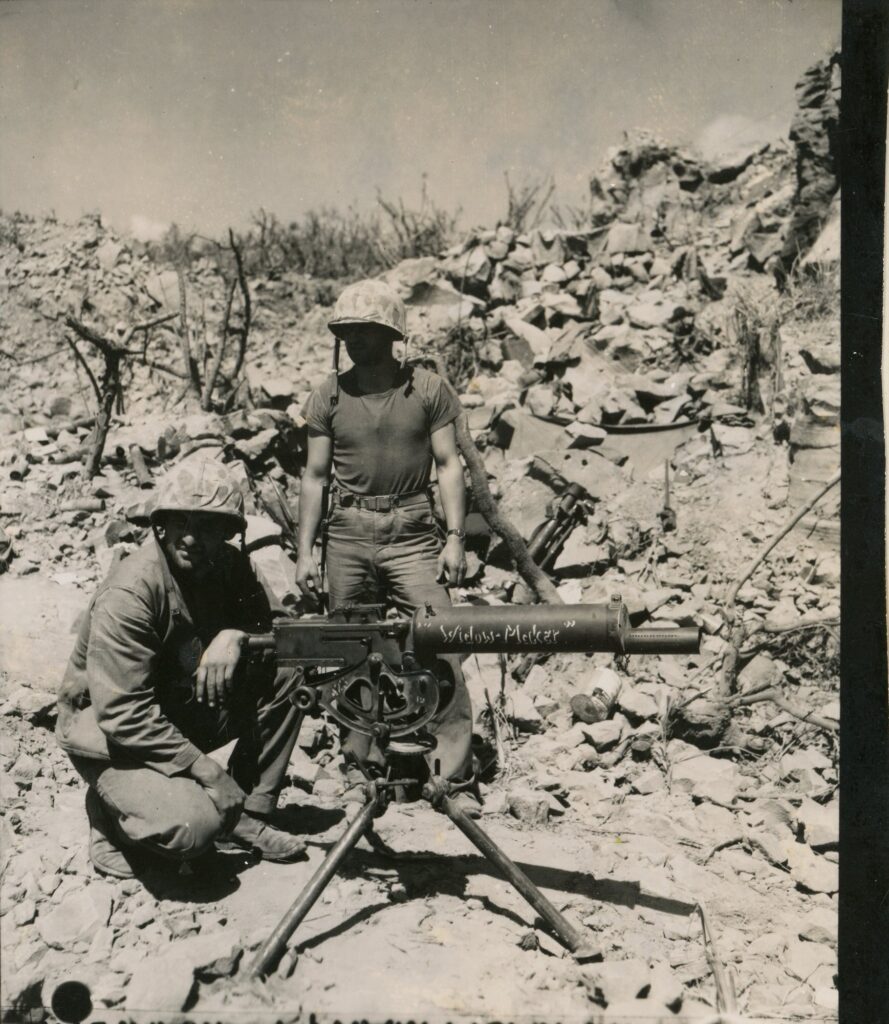
The records and later accounts give three different causes of death:
- The Navy Cross citation says he was “instantly killed by a bursting mortar shell.” His company commander’s recommendation says he was “killed at the edge of the airstrip by a mortar blast,” and Closing In also names a Japanese mortar shell.
- His certificate of death, submitted by the commanding officer of 1st Battalion, 27th Marines, gives the cause as “WOUNDS, Gunshot, Rt. Groin, Neck, Left Arm.” The National Museum of the Marine Corps profile also says small arms fire.
- A 2004 Marine Corps feature and the 2005 congressional tribute say an artillery round killed him along with four men of his platoon.
The same death certificate records his burial on 25 February 1945 in the 5th Marine Division Cemetery on Iwo Jima, Plot 1, Row 3, Grave 41. It also notes the tattoo on his left arm, a sword and the words “Death Before Dishonor.” After the war he was reburied at Arlington National Cemetery, Section 12, Grave 384.
The Navy Cross was awarded posthumously. The National Museum of the Marine Corps identifies him as the only enlisted Marine of World War II to receive both the Medal of Honor and the Navy Cross. The destroyer USS Basilone (DD-824) was commissioned at the Boston Naval Shipyard in July 1949, and his widow, Sergeant Lena Mae Basilone, christened her.
Where the John Basilone accounts differ
Much of what is repeated about John Basilone traces to postwar features rather than wartime records. Several of them conflict with the wartime records or are only one of several versions.
- The number of enemy killed. The Medal of Honor citation gives no number. The History Division states that he killed 38 and traces “the story about the 38 Japanese bodies” to PFC Nash W. Phillips, who served in the same unit. Arlington says “at least 38.” The 2004 Marine Corps feature says nearly 100 enemy dead lay around his position.
- The larger counts. Puller’s report covered the whole battalion front: some 1,000 Japanese dead buried in front of the lines and several hundred more unburied. Zimmerman’s 1949 monograph, The Guadalcanal Campaign, counts 1,462 dead in front of the sector after the 24-26 October attacks. Hough puts Japanese dead for the whole October counteroffensive at some 3,500. None of these figures applies to a single gun.
- Which regiment. Puller’s 1942 report names the “24th Regiment of the Imperial Japanese Army.” Hough identifies the main attacking unit as the 29th Infantry, with the 16th Infantry in reserve. Zimmerman adds that the 16th and 230th were also involved, and, citing enemy records, gives the 29th Infantry’s casualties as 1,050.
- Where. The 2004 feature places the fight at the Tenaru River. Puller’s recommendation and the citation place it in Sector 3 of the Lunga Area, and Hough’s list of sectors gives Sector Three to the 7th Marines, though his narrative once calls Puller’s line Sector Five. Zimmerman describes 1/7’s sector as running from Edson’s Ridge east to the Tenaru, but the attack struck its left center, and Hough puts the fighting south of the airfield on the slopes of Bloody Ridge.
- “A one-man army.” The 2004 feature and the 2005 congressional tribute both credit this phrase to General Douglas MacArthur. Neither gives a source, and the phrase appears in none of the wartime records cited here.
- His age and unit at Iwo Jima. Born 4 November 1916 and killed 19 February 1945, he was 28. The 2004 feature and the 2005 tribute say 27, and the tribute places him in the 1st Battalion, 7th Marines at Iwo Jima. The Navy Cross citation says Company C, 1st Battalion, 27th Marines, and the death certificate was issued by the commanding officer of the 1st Battalion, 27th Marines.
- His Army years. The National Museum of the Marine Corps says he enlisted in 1934 and served back-to-back two-year enlistments. The History Division says he enlisted at 18 and completed a three-year enlistment. The Naval History and Heritage Command says he enlisted in 1936. His Marine Corps insurance application gives 5 September 1939 as the end of his last tour of active duty.
- Television. HBO’s 2010 miniseries The Pacific cast Jon Seda as Basilone, according to HBO Max. It is a dramatization and is not used as a source here.
The wartime records of John Basilone’s action, without the later additions, show the following. A sergeant in charge of two sections of water-cooled guns, each about 94 pounds on its tripod by the 1945 figures for the M1917A1, kept his line firing through a night of close assault. He carried a gun to a position where only two men were left, repaired another, and crossed the front for ammunition. Puller’s recommendation recording these acts is dated 31 October 1942, six days later.
Twenty-eight months later he was killed on Iwo Jima, again leading machine gunners. The water-cooled Browning, which had passed its Army tests in 1917, was still in service there in 1945.
For the other American infantry weapons of the period, see the histories of John Browning’s M1918 Browning Automatic Rifle, the M1903 Springfield, the M1 Garand and the M1928A1 Thompson. For the company that carries his name, see the history of Browning Arms.
Further reading
The official Marine Corps histories cited above are free to read online. The books below cover the subject in more detail. Book links go to Amazon, and Powder & Lead earns a commission on qualifying purchases.
-

I’m Staying with My Boys: The Heroic Life of Sgt. John Basilone, USMC
Purchase on Amazon -

Red Blood, Black Sand: Fighting Alongside John Basilone from Boot Camp to Iwo Jima
Purchase on Amazon -

Guadalcanal: The Definitive Account of the Landmark Battle
Purchase on Amazon -

Browning .30-caliber Machine Guns (Weapon, 32)
Purchase on Amazon -

Browning Machinegun, Vol. I: Rifle Caliber Brownings in U.S. Service
Purchase on Amazon
Jim Proser with Jerry Cutter, I’m Staying with My Boys: The Heroic Life of Sgt. John Basilone, USMC. A full-length biography.
Chuck Tatum, Red Blood, Black Sand: Fighting Alongside John Basilone from Boot Camp to Iwo Jima. A memoir by a Marine who served alongside Basilone.
Richard B. Frank, Guadalcanal: The Definitive Account of the Landmark Battle. A one-volume history of the whole campaign.
Gordon L. Rottman, Browning .30-caliber Machine Guns (Osprey Weapon 32). An illustrated history of the Browning .30 caliber guns.
Dolf L. Goldsmith, The Browning Machine Gun, Volume I: Rifle Caliber Brownings in U.S. Service. A detailed reference on the rifle-caliber Brownings in U.S. service.
Sources
- Official Military Personnel File for John Basilone, Record Group 127, National Archives. Includes Puller’s recommendation of 31 October 1942, the 2 September 1943 request for Third War Loan orders, the Navy Cross recommendation of 2 April 1945, the Navy Cross citation and the certificate of death.
- Medal of Honor citation, Naval History and Heritage Command.
- “Sgt John Basilone,” Marine Corps History Division.
- Frank O. Hough, Verle E. Ludwig and Henry I. Shaw, Jr., Pearl Harbor to Guadalcanal, History of U.S. Marine Corps Operations in World War II, Vol. I.
- John L. Zimmerman, The Guadalcanal Campaign, USMC Historical Section, 1949.
- Whitman S. Bartley, Iwo Jima: Amphibious Epic, USMC Historical Section, 1954.
- Joseph H. Alexander, Closing In: Marines in the Seizure of Iwo Jima, Marine Corps Historical Center, 1994.
- Benedict Crowell, America’s Munitions 1917-1918, War Department, 1919.
- War Department, TM 9-1205, Browning Machine Gun, Caliber .30, All Types, 4 April 1942, and FM 23-55, Browning Machine Guns, Caliber .30, M1917A1, M1919A4, and M1919A6, 30 July 1945.
If you know of any forums or sites that should be referenced on this listing, please let us know here.