The rifle that became the M1941 Johnson rifle reached a Senate hearing in 1940, where a bill proposed adopting it as a standard arm alongside the M1 Garand. The bill did not pass, but the rifle still saw combat with Marine paratroopers in the Solomons, drawn from Dutch-contract stock that an American embargo had kept in the country. The Johnson light machine gun was praised by Marine paratroopers and Raiders and by the Army’s First Special Service Force, which carried it in Italy. Both guns were designed by Melvin Maynard Johnson Jr., a Boston lawyer who held a captain’s commission in the Marine Corps Reserve.
Melvin Johnson: Boston lawyer, Marine reservist, rifleman
Johnson’s own company put his record into the Senate’s printed hearing in May 1940. He was 30 years old, a captain in the U.S. Marine Corps Reserve, and a Harvard man twice over: a B.S. in 1931 and a law degree from Harvard Law School in 1934. He had captained the Harvard rifle team, come through Field Artillery ROTC, and transferred to the Marine Corps Reserve in 1933, making first lieutenant in 1936 and captain in 1938. He was a member of the Massachusetts bar and an instructor in law at Boston University. The same statement said he had written more than a dozen articles for the Marine Corps Gazette and five for Army Ordnance, and had fired over 80,000 rounds testing his rifles.
Bruce N. Canfield, author of a book-length history of Johnson and his guns, describes him as coming from “a prosperous and politically connected New England family” and as a vocal critic of the newly adopted Garand. Johnson believed a recoil-operated rifle would beat the Garand’s gas system, and he set out to build one.
How the Johnson works: short recoil and a rotary magazine
“It is of the short-recoil type,” Johnson told the senators. His rifle used a rotary bolt that locked into the barrel, and the barrel itself moved rearward when the rifle fired. Johnson called it “a unique high-powered, short-recoil action” and conceded that it “isn’t technically pure short recoil at that.” The first working action, he testified, fired in 1936, built around a Springfield barrel. His account of the first shot: “This was put together with a certain amount of praying, a string was tied to the trigger, and the speaker retreated behind a corner and pulled the string. The rifle fired and for some reason the empty shell came out.”
Three features set the rifle apart:
- A rotary magazine holding “ten cartridges and one in the chamber,” loaded with the same five-round Springfield clips used by the roughly two million M1903 and M1917 rifles the Army held in reserve, by Johnson’s count. It could be topped up with the bolt closed and a round chambered, something the Garand’s en-bloc clip could not do.
- A quickly removable barrel. At the hearing Johnson pulled the barrel out of his rifle, showed a Springfield barrel adapted to fit, and showed a 20-inch barrel made by Winchester from a Model 70 to make the point that carbine and rifle lengths could share one action.
- A light bayonet. A heavy bayonet on a moving barrel slows the recoil stroke. Johnson’s answer, in Canfield’s description, was a lightweight triangular-blade, all-metal bayonet that let the rifle function with the blade fixed but had “little utility on, or off, the rifle.” The Army’s observer at Aberdeen testified that even with the small Johnson bayonet fixed, the rifle did not function reliably when fired at downward angles.
The rifle fired the standard .30 caliber service cartridge, the .30-06 Springfield.
Before the M1941 Johnson rifle: the fight with the M1 Garand, 1938 to 1940
The Army had already standardized the M1 Garand on January 9, 1936, after 20 years of development, according to the Infantry Board’s history read into the 1940 record. Johnson testified that his rifle was demonstrated to the Infantry Board at Fort Benning in 1938 (Canfield dates an informal Ordnance test to June 1938), and the Ordnance Department tested it at Aberdeen Proving Ground from December 19 to 30, 1939.
Maj. Grant A. Schlieker, the Chief of Infantry’s liaison officer at Aberdeen, watched that test and reported the results to the Senate. He found the rifle “reasonably accurate” but a “tool-maker model rather than production model,” and listed where it fell short of the Infantry’s requirements:
- Loading from clips took enough pressure that clips often broke and spilled cartridges, worse in dust and mud.
- The trigger had a single pull rather than the two-stage pull the service wanted, and the setting of the safety could not readily be told in the dark.
- The two samples averaged slightly over 10.1 pounds against a 9.5-pound limit.
- Its kick against the shoulder equaled the M1903’s, and it did not function reliably with the service bayonet attached.
His conclusion: “While the Johnson semiautomatic rifle satisfactorily performed as a machine, it did not fulfill all necessary military requirements and did not have any advantages over the present standard rifle which might make it necessary to consider it as a substitute for that weapon.”
The Garand still had critics in 1940. The House Appropriations Committee had written that its “accuracy, range, and type of ammunition remain as the chief controversial issues” and asked the General Staff to investigate. Johnson took his case to the Senate.
The Senate hearing of May 29, 1940
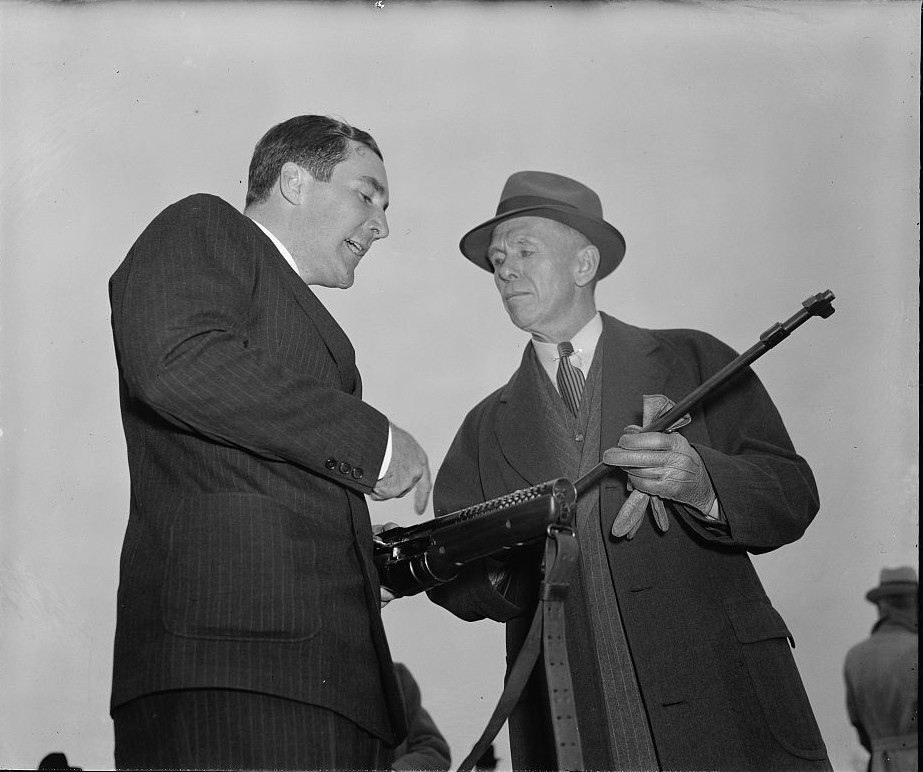
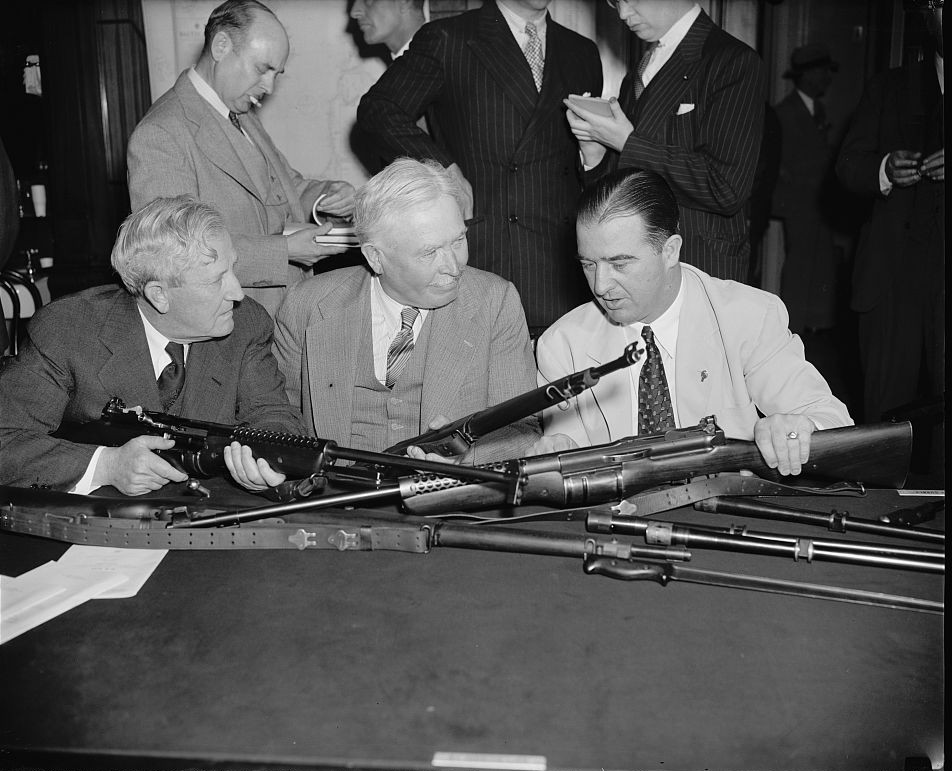
The Senate Committee on Military Affairs took up S. 3983 on May 29, 1940, with Senator Morris Sheppard of Texas in the chair. The bill would have adopted “the Johnson semiautomatic rifle, caliber .30” as a standard arm of the military and naval forces, “to be known as the United States semiautomatic rifle, M2, caliber .30.” The printed hearing is public domain and online.
Johnson argued for quantity. With war in Europe, he said, the country should have enough rifles first, even at the cost of more than one model, and his rifle was well suited to mass production. Witnesses from manufacturers, among them Taft-Peirce and the Hupp Motor Car Corporation, spoke to that point. The Marine witnesses were more cautious. Lt. Col. Merritt A. Edson, then in charge of target practice at Marine Corps headquarters, said the Corps depended on the Army to develop and standardize its small arms. He credited the Johnson with “several very good features,” including the standard barrel, the use of Springfield clips and a recoil action that might hold up better in landing operations, but added: “We have not adopted as yet any semiautomatic rifle nor are we yet convinced that there is an urgent requirement for a semiautomatic rifle.” Capt. George O. Van Orden, commanding the rifle range at Quantico, described firing the Johnson extensively from September 1939 onward.
The Army witnesses backed the Garand. Lt. Col. Guy H. Drewry of the Ordnance Office said about 41,000 had been produced, 109,000 were on order, and Springfield Armory was making 200 a day on one shift. Maj. Gen. George A. Lynch, Chief of Infantry, said his office had pushed the Garand’s development and that any new rifle “would have to pass through a long series of tests before it could be accepted as standard.” Brig. Gen. R. C. Moore read the War Department’s position, a letter Gen. George C. Marshall had sent Johnson on May 22, 1940:
“Two types of rifles would multiply training problems, increase the costs, multiply problems of manufacture, replacement, and field maintenance… While unwilling to accept the Johnson rifle as a weapon, the War Department does not question the value of that gun.”
Congress, in Canfield’s account, “declined to force the U.S. Army to accept the Johnson.” The Garand stayed the standard rifle, the bolt-action M1903 Springfield stayed the substitute standard, and Johnson went looking for other customers.
The Dutch KNIL contract and the Model of 1941
The Netherlands needed modern arms for the Royal Netherlands East Indies Army (KNIL). On August 19, 1940, according to Canfield, the Netherlands Purchasing Commission ordered 10,200 Johnson rifles and 515 Johnson light machine guns, both in .30-06. A second order for 10,200 rifles brought the Dutch total to 20,400. Johnson Automatics had no factory of its own. It took over an idle textile plant in Cranston, Rhode Island, and formed the Cranston Arms Company. Both guns made there were designated the Model of 1941.
The Dutch East Indies fell to Japan before most of the order could ship, and the rest was embargoed in the United States. Canfield puts the number shipped at about 3,000; other accounts give different figures. Production totaled 21,988 rifles, per Canfield, including about 1,000 in 7x57mm Mauser sold to Chile. Most Johnsons that went to war with Americans came from that embargoed stock.
Marine paratroopers and the Raider question
The quickly removable barrel interested the Marine Corps, which was forming parachute battalions. The Marines bought Johnson light machine guns from the Dutch stock first. When the 1st Parachute Battalion went to the Solomons in 1942, Canfield writes, Johnson “unofficially donated” 23 of his rifles to it. At Gavutu in August 1942, the Marine Corps’ official history of the parachute units records, “Platoon Sergeant Harry M. Tully used his marksmanship skill and Johnson rifle to pick off a number of Japanese snipers.” A Look magazine article of December 1, 1942, cited by Canfield, credited Tully with 42 kills at ranges up to 800 yards; he received the Silver Star.
On October 7, 1942, with Dutch permission, 650 Johnson rifles were shipped to San Diego for the 2nd Parachute Battalion. When the three battalions became the 1st Parachute Regiment on April 1, 1943, its table of organization allowed 242 Johnson rifles. The Corps’ history of the parachute units describes the 1943 rifle squad of 11 men as meant to carry three Johnson machine guns, three Johnson rifles and five Reising submachine guns. Johnson light machine guns had been planned for the squads since 1942, and the same history notes they took a long time to reach the field. Marine documentation, Canfield found, shows 750 rifles procured in all.
Lt. Col. Victor Krulak, who led the 2nd Parachute Battalion on the Choiseul raid in late 1943, reported: “Johnson Rifle, caliber .30. Performed similarly with the M-1. Found little difference between the two.”
The Raider myth. The Johnson rifle is often described as a Marine Raider weapon. Canfield says that claim “is not correct”: the 1st Parachute Regiment was the only U.S. unit with Johnson rifles officially issued, though a rifle could have passed informally to another unit. A few Marine Raider units did receive Johnson LMGs, and one Raider after-action report from New Georgia said the men armed with them “wouldn’t trade them for any other.” The paratroopers and Raiders also fought side by side on Guadalcanal. After Gavutu, the depleted parachute battalion was attached to Edson’s 1st Raider Battalion, and in September 1942 the combined force held the ridge that took his name. In 1940 Edson had told the Senate that the Marines were not convinced they needed a semi-automatic rifle. In September 1942 his line on the ridge included Johnson light machine guns.
The Marines’ use of the Johnson rifle ended with the parachute units. The Marine Corps disbanded them in early 1944, and the regiment turned in its Johnsons. Paratrooper Clifford Goodin later recalled that his outfit was told to gather its Johnson rifles, “about 16 as I recall,” and that they took off the barrels and buried them on the beach at Bougainville. The rest went back to the Dutch, who issued them to their marines and navy.
The Johnson light machine gun: M1941 and M1944
Johnson showed an early version to the Senate in 1940. “The Johnson light machine gun weighs but 12 pounds,” he testified, and at least 75 percent of its components were rifle parts. Strictly it was an automatic rifle, the same class as the Browning Automatic Rifle, which weighed about 20 pounds. Canfield lists its design points:
- Semi-automatic fire from a closed bolt for accuracy, full-automatic fire from an open bolt to help cooling, at roughly 450 rounds a minute.
- A 20-round single-column magazine on the left side, with the feed lips machined into the receiver instead of the magazine, and topping up from the right with M1903 chargers.
- A quick-change barrel and a straight-line stock. The First Special Service Force noted that it broke down into three pieces no longer than about 22 inches and could be parachuted the same way as an M1 rifle.
Krulak, after Choiseul, wrote of the Johnson light machine gun: “The most praiseworthy single weapon. It showed no weaknesses.” The Army’s First Special Service Force, the joint American-Canadian unit trained for winter and airborne operations, asked for 125 of them, by transfer from the Marine Corps, in a memo of February 15, 1943, calling the Johnson “the weapon most nearly meeting these special qualifications.” The Marines approved on April 20, 1943, and the guns reached the Force on June 29, 1943. Forcemen carried them in Italy, including the Anzio beachhead.
Johnson kept improving the design. According to Forgotten Weapons, ten M1944 guns went to Aberdeen in December 1943, where they had trouble in sand, rain, mud and cold, then did well before the Marine Corps Equipment Board at Quantico. The M1944 swapped the bipod for a folding monopod and the wooden stock for a pair of tubes with a metal buttplate. The Marine Corps Commandant rejected a recommendation to replace the BAR with it, largely because the Army had not adopted it. A gas-assisted M1944E1 followed in 1945, and testing ended in October 1945.
Johnson after the war
Johnson also wrote several books. With Charles T. Haven he published Automatic Arms: Their History, Development and Use (1941), For Permanent Victory: The Case for an American Arsenal of Peace (1942) and Ammunition: Its History, Development and Use (1943), and later Rifles and Machine Guns (1944) and Practical Marksmanship (1945). His American Rifleman obituary says Winchester employed him in 1949, the year he moved from the Marine Corps Reserve to the Army Ordnance Corps Reserve, and that in 1951 he was appointed a weapons consultant to the Secretary of Defense.
The NRA’s National Firearms Museum dates ArmaLite’s AR-10 work to 1953, when Johnson was employed as a consultant, and notes that the cam-controlled rotary bolt of the Johnson rifle and LMG was a feature incorporated into the AR-10. The AR-10 led in turn to the AR-15 and M16. In 1962 he started a new company of his own, and his last projects included the Spitfire carbine, based on the M1 carbine. He died in New York on January 9, 1965, at 55, according to his American Rifleman obituary.
Seeing one and reading more
Springfield Armory National Historic Site holds an M1941 Johnson rifle and shows it in its World War II arms exhibit. Original rifles appear regularly at major firearms auctions, where documented Marine provenance is rare: Canfield notes there is no known comprehensive serial number roster of the Marine rifles.
Book links go to Amazon, and Powder & Lead earns a commission on qualifying purchases.


Johnson Rifles and Machine Guns: The Story of Melvin Maynard Johnson, Jr. and His Guns by Bruce N. Canfield, with Robert L. Lamoreaux and Edward R. Johnson (Andrew Mowbray, 2002). Canfield’s book-length history of the man and his guns, from the prototypes to the Spitfire carbines.
Silk Chutes and Hard Fighting: U.S. Marine Corps Parachute Units in World War II by Lt. Col. Jon T. Hoffman. The Marine Corps’ own history of the paratroopers who carried the Johnson, from Gavutu to Bougainville.
U.S. Small Arms of World War II by Bruce N. Canfield. Canfield’s survey of the small arms American forces used in the Second World War.
If you know of any forums or sites that should be referenced on this listing, please let us know here.