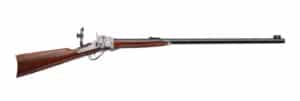
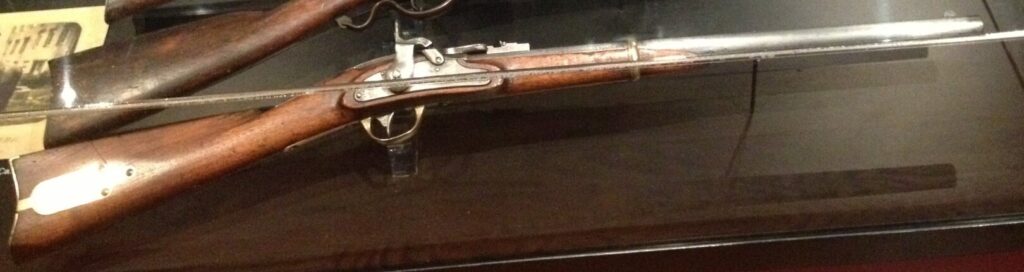
The Merrill carbine was a .54 caliber breechloader made in Baltimore and bought by the Union Ordnance Department from November 1861 to July 1864. Chief of Ordnance Alexander B. Dyer’s purchase list of 1866 counts 14,495 of them, the ninth largest total among the carbines the Union bought. It fired a paper or linen cartridge set off by an ordinary percussion cap, and it went to cavalry regiments from New Jersey to Kansas. The sources here are Merrill’s patent, the orders the Ordnance Office printed for Congress in 1868, Dyer’s purchase list, and John D. McAulay’s unit research as summarized by Jeff Goodson. For the Merrill alongside the other makes on Dyer’s list, see our guide to Civil War carbines.
James H. Merrill and the Jenks conversion
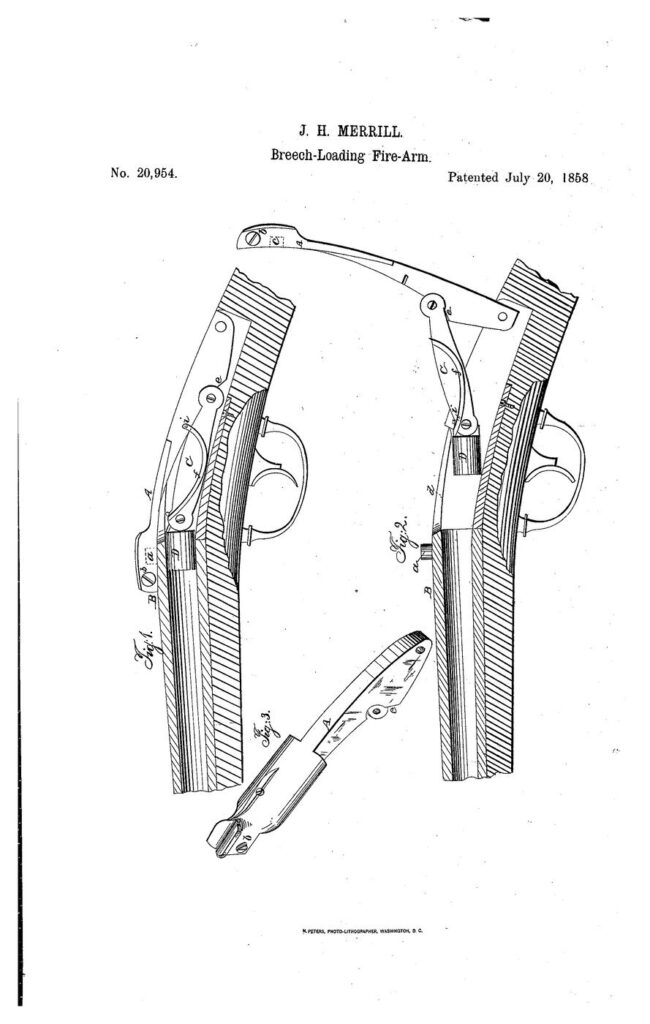
James H. Merrill of Baltimore received U.S. Patent No. 20,954 on July 20, 1858, for an “Improvement in Breech-Loading Fire-Arms.” The patent describes a conversion. Its claim covers changing the Jenks gun, an older breechloader filled with loose powder and ball through an opening on top of the breech, into a gun that took a cartridge.
The conversion had four parts. Merrill plugged the old vertical loading hole. He cut away the frame behind the barrel, which let the gun load at the rear of the bore. He lengthened the travel of the lever, toggle and piston, leaving room for a cartridge between the face of the piston and the barrel. And he added a groove and pin to guide the toggle, because cutting away the frame had removed the piston’s old guide. The top of the plug was left standing above the barrel to act as a catch for the closed lever.
The Ordnance Department knew Merrill’s name before the war. A list of pre-war breechloader purchases printed by the Centennial Commission in 1876 shows 170 “Merrill’s carbines” against 1855, and 100 Merrill carbines, 100 Merrill muskets and 100 Merrill rifles against 1859. The 1855 entry is one of the points where the records disagree, covered below.
How the Merrill carbine works
The action is worked by a long lever lying along the top of the breech. To load, the soldier freed the end of the lever from its catch and swung it up and back. The lever pulled a toggle link, and the toggle drew a piston back from the rear of the barrel. That opened the breech behind the barrel. He put a cartridge in the opening and closed the lever. Closing it drove the piston forward, which ran the cartridge into the chamber and sealed the breech behind it. A percussion cap on the nipple fired the charge through the cartridge envelope.
Goodson describes the wartime Merrill as a .54 caliber percussion breechloader firing a nitre-treated paper or linen cartridge. These are the period cartridge specifications as Goodson reports them, given for history only. The envelope was combustible and burned away on firing. It left no case to extract. The Ordnance Department’s first order, in October 1861, bought the cartridges and the caps together, specifying “Hicks’s caps, adapted to the carbine.”
Merrill carbine contracts and deliveries
The orders to Merrill’s firm are printed in House Executive Document No. 99, 40th Congress, 2nd Session (1868), pages 270 to 275, under “Contracts with Merrill, Thomas & Co.” and “Contracts with Merrill’s Arms Company.” They show a run of short orders.
- October 25, 1861. Chief of Ordnance James W. Ripley agreed to buy 600 carbines, with cartridge boxes, belts, cap boxes, slings, 60,000 cartridges and 80,000 “Hicks’s caps, adapted to the carbine.” The purchase followed a letter of October 17 “from Colonel Dichell and others to General Stoneman,” as the printed text spells it. The government’s statement of purchases records those 600 carbines as delivered on November 5, 1861 (Ex. Doc. 99, p. 841).
- December 24, 1861. Ripley offered an order for 5,000 carbines, “all to be of the same pattern and calibre,” at 500 within thirty days, 500 more within sixty days, and 1,000 a month after that. Any shortfall in a month forfeited the right to deliver that number.
- February 25 and 28 and March 21, 1862. Ripley told the firm to send 200, 200 and then 800 carbines, with cartridges, to Colonel W. A. Barstow of the 3rd Wisconsin Cavalry at Janesville, Wisconsin.
- March 22, 1862. The firm was to furnish the 21st Indiana Volunteers with 566 Merrill rifles “in place of the same number of Merrill’s carbines” it had contracted to deliver.
- November 17, 1862. Ripley asked for 1,400 Merrill carbines and 280,000 cartridges.
- March 30, 1863. The department would take as many carbines as were ready for inspection, up to 2,800, with 200 cartridges for each gun.
- June 8, July 1 and July 11, 1863. Ripley accepted 1,000, then 200, then 800 more, all to go to Major F. D. Callender at the St. Louis arsenal. On July 11 he wrote that “no cartridges are wanted.” The firm had also offered a “new model carbine.” Ripley answered that he had not seen it.
- August 11, 1863. Ripley ordered all the Merrill carbines the company could make during 1863, on the condition that every one be “of the model heretofore furnished, called the ‘old model.'” The letter went to the president of Merrill’s Patent Fire-arms Company.
- June 8, 1864. Chief of Ordnance George D. Ramsay signed a contract with P. E. Thomas, treasurer of Merrill’s Patent Fire-arms Company, for 1,200 “Merrill’s improved breech-loading carbines,” to be delivered by July 1, 1864.
Goodson, using McAulay’s tally of the deliveries, puts the first in November 1861 and the last in July 1864. Dyer’s statement of purchases from January 1, 1861, to June 30, 1866, counts 14,495 Merrill carbines (Report of the Secretary of War, 1866, p. 663).
Merrill carbines in the field
Goodson, drawing on McAulay, lists the Union units known to have carried the Merrill. They were the 27th Kentucky; the 1st, 4th, 5th and 18th New York; the 1st New Jersey; the 7th Indiana; the 1st and 3rd Wisconsin; the 11th, 17th and 18th Pennsylvania; the 1st Delaware; and the 6th Kansas. Some infantry had them too, among them the 1st and 2nd Tennessee (U.S.) Mounted Infantry. Goodson’s list of their service runs from the Shenandoah Valley, Second Manassas and Gettysburg to northern Arkansas, Brice’s Crossroads and City Point, Virginia. The 3rd Wisconsin shipments in the 1862 orders match his list.
The reports on the carbine were mixed. Goodson summarizes the regimental reports this way:
- Units rated it acceptable overall in the summer of 1862, a superior arm in the fall of 1863, and the favorite arm of the regiment in 1864.
- In March 1864 the 7th Indiana reported fouling and broken stocks. The 2nd U.S. Colored Cavalry reported the same problems, but it still rated the Merrill an excellent arm, one that carried well and did not get out of order easily.
- Hundreds were unserviceable by September 1864.
Four reports printed in the Official Records name the Merrill carbine. Three are critical, and the earliest records Merrills being replaced.
- June 20, 1863. Major General Julius Stahel, writing from Fairfax Court-House, Virginia, reported that he had “distributed the Burnside carbines, in place of Merrill carbines, to the Eighteenth Pennsylvania Cavalry” (Series I, vol. 27, part 3, p. 225).
- July 1864. Brigadier General August V. Kautz, chief of cavalry in the Department of Virginia and North Carolina, wrote that “the issue of Merrill’s carbine, made in this command just before commencing the campaign, seems to have been a very defective arm in the manufacture. The Eleventh Pennsylvania Cavalry started on the 1st of May with 280 carbines; they are now reduced to 117, and this reduction is due almost entirely to defects in the arm itself. The officers report that many burst in the barrel, and other parts give way” (Series I, vol. 40, part 3, p. 250).
- October 1864. Captain Francis I. D. Webb, acting assistant inspector-general, reported from Relay House, Maryland, on the First Separate Brigade, Eighth Army Corps: “The First Delaware Cavalry are armed with Merrill’s carbines. These pieces are very defective. The cones are frequently blown out, and in many cases they will not explode a cap” (Series I, vol. 43, part 2, p. 430).
- January 21, 1865. Lieutenant Colonel John M. Wilson, assistant inspector-general, reported from New Orleans on the cavalry in Arkansas: “The Eleventh Missouri Cavalry is reported in tolerable condition. They complain bitterly of their arms (the Merrill carbine), and state Merrill’s cartridge-box to be a nuisance that the service should be rid of. They are now being armed with the Sharps carbines” (Series I, vol. 48, part 1, p. 600).
Kautz’s report matches the manufacturing defects in Pennsylvania units that Goodson cites, and Wilson’s matches the 11th Missouri’s exchange of its Merrills for Sharps. Goodson reads the record as a carbine whose faults showed more the longer it stayed in the field. The review of cavalry arms made for Brigadier General James H. Wilson in 1864 put the Merrill in its middle class, “useful but not superior,” alongside the Ballard, Sharps, Smith, Hall and Cosmopolitan.
Merrill carbines in Confederate hands
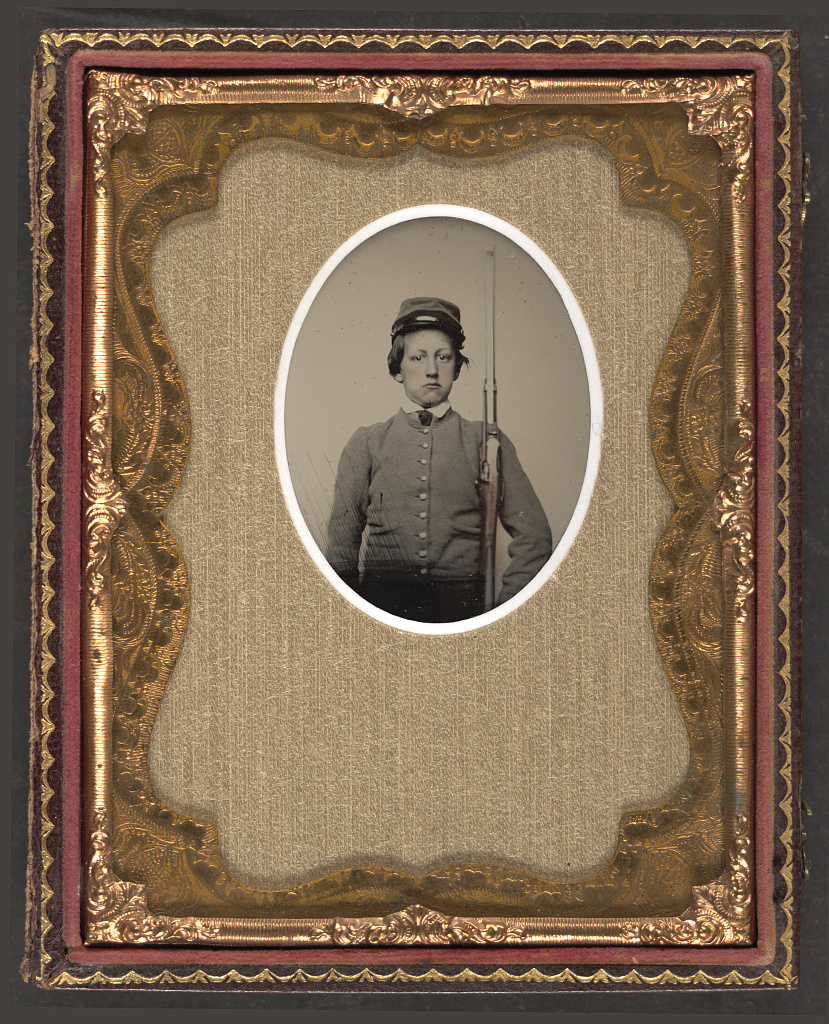
Goodson judges the percussion carbines of special use to the Confederacy, because they did not depend on captured metallic cartridges. McAulay counts eighteen Confederate cavalry regiments, from Georgia, North Carolina, Texas, Tennessee and Virginia, known to have used the Merrill. Goodson notes that a small number were bought before the war, but that most of those in Southern service were captured. He also records that the Confederate field manual for ordnance officers of 1862 mentions the Merrill. In McAulay’s counts only the Sharps, with forty-seven regiments, and the Burnside, with twenty-four, were used by more.
After the war
Goodson counts 7,100 government Merrills as known survivors of the war, 46.5 percent of the 15,255 he uses as the total bought. Of those, 7,016 were in storage on June 30, 1866, and none were still in the hands of troops. Fifty-nine had been sold, and twenty-five had been bought by the soldiers who carried them, under the June 1865 order that let men mustering out buy their arms. That is 0.4 percent of the survivors, one of the lowest take-home rates of any carbine on Goodson’s list. The Spencer’s was 12.9 percent.
The government sold the stored Merrills off over the next thirty-five years. Goodson records 6,161 sold from July 1866 through December 1901. The largest lots were 1,165 in October 1871, 1,571 in October 1876, and two sales in June 1901: 1,935 to Marcus Hartley and 1,414 to Francis Bannerman.
Where the Merrill carbine record and the legend disagree
How many were bought. Dyer’s printed list gives 14,495. McAulay found thirty-two separate deliveries in Ex. Doc. 99 adding up to 15,255, and Goodson uses that figure. Goodson also cites totals of 14,255 and 14,695 from other references. We use Dyer’s number because it is the department’s own printed total, and give McAulay’s beside it.
The pre-war Merrills. The 1876 Centennial list shows 170 Merrill’s carbines among the purchases of 1855. Goodson’s table lists a Merrill, Latrobe & Thomas carbine for one squadron of the 1st Cavalry: “170 ordered; none accepted.” The 1876 list’s 170 appear to be that order, counted although it was never filled. Neither source describes what the 1859 Merrill carbines, muskets and rifles were.
“Merrill’s Horse.” The 2nd Missouri Cavalry was known as Merrill’s Horse, and the Official Records use that name. It came from the regiment’s colonel, Lewis Merrill, who is indexed in Series III, volume 1, as “Merrill’s (L.) Cav., 2d Mo.” The name says nothing about the regiment’s carbines, and the 2nd Missouri is not on Goodson’s list of Merrill units.
Old model and improved model. Collectors sort Merrill carbines into first and second types by their features. The wartime orders use other words. In July 1863 the firm offered a “new model carbine” that Ripley had not seen, and in August he ordered only the “old model.” The June 1864 contract called for “Merrill’s improved” carbines. The records do not describe the differences between the two.
Good gun or bad gun. Either verdict can be supported with a quotation. The 2nd U.S. Colored Cavalry rated the Merrill excellent in the same season that the 7th Indiana complained about it. The favorable reports Goodson cites run from 1862 into the spring of 1864. The four reports in the Official Records, from June 1863 to January 1865, record one regiment’s Merrills replaced and three regiments’ complaints, all three of those from July 1864 or later.
More Civil War carbines on Powder & Lead
The Merrill shared the Wilson review’s middle class with the Sharps, the Smith, the Ballard, the Hall and the Cosmopolitan. The Smith was also sold by a Baltimore firm, Poultney & Trimble. Two other percussion carbines bought in large numbers were the Burnside and the Starr. For the arms the Confederacy made and captured, see Confederate firearms, and for the whole Union purchase list see our guide to Civil War carbines.
Further reading
The government documents cited below are free to read online. The books below cover the Civil War carbines in more detail. Book links go to Amazon, and Powder & Lead earns a commission on qualifying purchases.
-

Carbines of the Civil War, 1861-1865
Purchase on Amazon -

Civil War carbines
Purchase on Amazon -

Civil War Carbines Myth vs Reality by Peter Schiffers
Purchase on Amazon -
Sale!

Flayderman's Guide to Antique American Firearms and Their Values
Original price was: $49.99.$39.98Current price is: $39.98. Purchase on Amazon -

Standard Catalog of Civil War Firearms
Purchase on Amazon
John D. McAulay, Carbines of the Civil War, 1861-1865. The delivery research that Goodson’s figures rest on.
John D. McAulay, Civil War Carbines.
Peter Schiffers, Civil War Carbines: Myth vs. Reality.
Norm Flayderman, Flayderman’s Guide to Antique American Firearms and Their Values. The standard reference for variations and markings.
John F. Graf, Standard Catalog of Civil War Firearms.
Sources
- James H. Merrill, “Improvement in Breech-Loading Fire-Arms,” U.S. Patent No. 20,954, July 20, 1858.
- Ordnance Department: Message from the President of the United States, January 14, 1868, House Executive Document No. 99, 40th Congress, 2nd Session: orders and contracts with Merrill, Thomas & Co. and Merrill’s Arms Company, pp. 270 to 275; statement of purchases, pp. 841 and 842.
- A. B. Dyer, “Statement of ordnance and ordnance stores purchased by the Ordnance Department from January 1, 1861, to June 30, 1866,” in Report of the Secretary of War (Washington, 1866), p. 663.
- United States Centennial Commission, General Report of the Judges of Group XVI (Philadelphia, 1876), p. 17: breech-loading arms bought before the war.
- The War of the Rebellion: A Compilation of the Official Records of the Union and Confederate Armies, Series I, vol. 45, part 2, p. 56 (“Merrill’s Horse”); Series III, vol. 1, index (“Merrill’s (L.) Cav., 2d Mo.”).
- Official Records, Series I: vol. 27, part 3, p. 225 (Stahel, June 20, 1863); vol. 40, part 3, p. 250 (Kautz, July 1864); vol. 43, part 2, p. 430 (Webb, October 1864); vol. 48, part 1, p. 600 (Wilson, January 21, 1865).
- Jeff Goodson, “U.S. Civil War Carbines: Service and Survival,” American Society of Arms Collectors Bulletin 126, pp. 18 to 49: Merrill entry on p. 35, Tables 2 and 3, and the Wilson classification, drawing on John D. McAulay’s compilations of the Ordnance records.
If you know of any forums or sites that should be referenced on this listing, please let us know here.