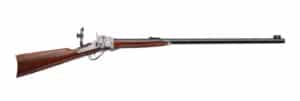
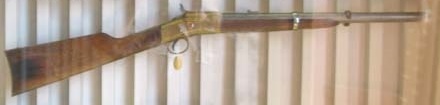
The Warner carbine was the only brass-framed carbine the Union Ordnance Department bought during the Civil War. James Warner of Springfield, Massachusetts, delivered 4,001 of them between January 1864 and March 1865, and they fired self-primed rimfire cartridges, first his own and then the Spencer’s. The contracts and the letters over price and chambering are printed in House Executive Document No. 99 of 1868, and the regiments that tried the Warner wrote down what they thought of it. For the Warner alongside the other makes the Union bought, see our guide to Civil War carbines.
James Warner of Springfield
Warner was already an experienced gunmaker when he took his carbine contract. Robert Howard, writing in the American Society of Arms Collectors Bulletin in 1981, identifies his career with the Springfield Arms Company, which he managed and which made percussion revolvers and revolving rifles from the 1850s. One of Warner’s own letters to the Ordnance Office, dated October 22, 1864, is headed “Springfield Arms Company” (Ex. Doc. 99, p. 693). Howard calls the carbine the only arm designed or made by Warner that the government bought for issue to troops.
How the Warner carbine works
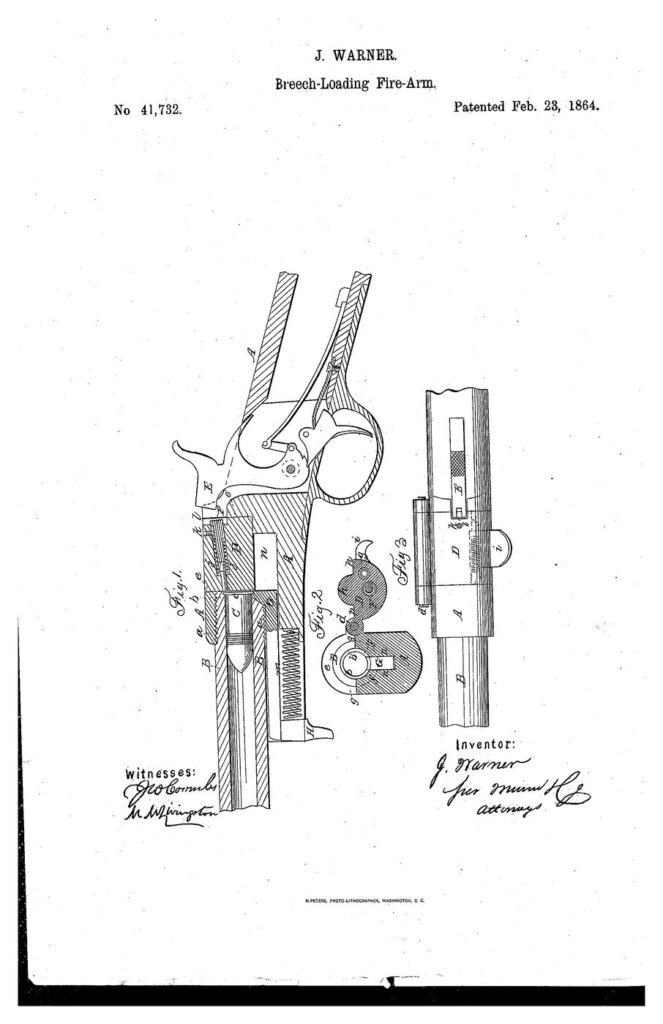
Warner’s first carbine patent, No. 41,732, was granted on February 23, 1864. The breechblock is hinged to the right side of the frame and swings open sideways, on an axis parallel to the bore. The bottom of the opening in the frame is a half-round channel. It guides the rim of the cartridge into the chamber as it goes in and keeps the case lined up as it comes out. A sliding firing pin runs through the breechblock, and the hammer strikes it to fire the cartridge. When the hammer is down, its nose sits in a recess at the back of the breechblock and holds the block shut. A slide under the barrel pulls the empty case out of the chamber.
The claim names the danger it was meant to meet. With the hammer down on a closed breech, a case that burst to the rear could not blow the breechblock open.
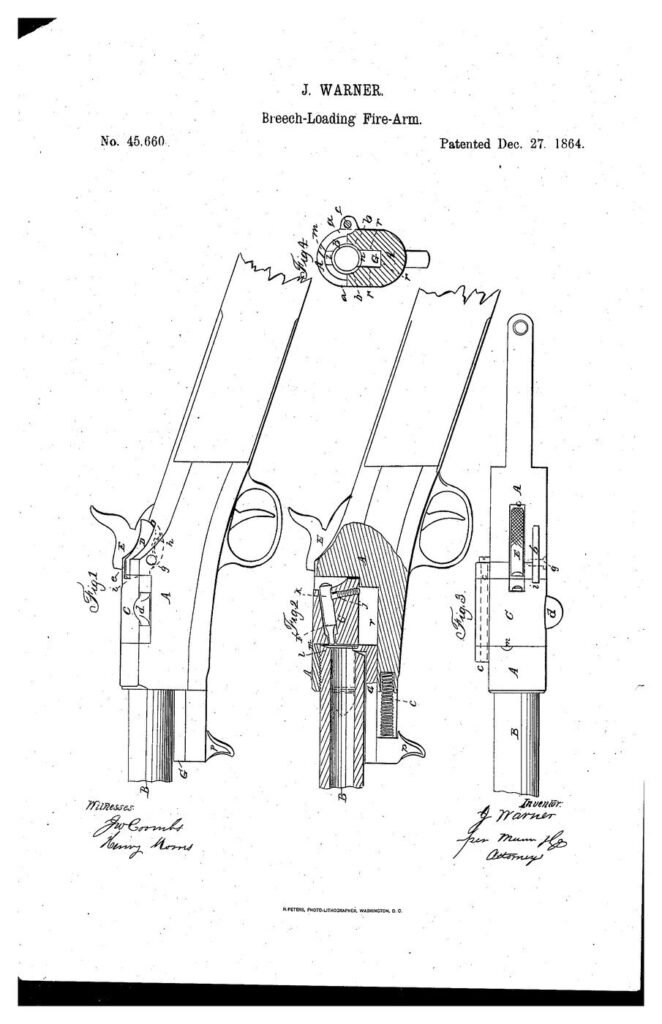
The second patent, No. 45,660, was granted on December 27, 1864, the day after Warner signed his second contract. In this version a spring-loaded lever locks the breechblock shut, and a thumb piece on the block helps start it open. The firing pin has no spring. A beveled groove in the barrel pushes the pin flush with the face of the block as it opens, and a second groove in the frame pushes it back as the block closes. The specification says this removed a spring and the trouble that came with it. The extractor is again a slide below the barrel.
Warner carbine contracts and the Spencer cartridge
The Ordnance file on Warner shows a contract signed before the patent, a delivery outside the first contract, and a second contract that changed the cartridge.
- January 13, 1864. Chief of Ordnance George D. Ramsay contracted with James Warner for 1,000 “Warner’s breech-loading carbines,” to be delivered by May 1, 1864. The War Department approved it on February 12 (Ex. Doc. 99, pp. 691 and 692). The patent was granted eleven days later.
- January 24, 1864. The statement of purchases records one Warner carbine and appendages bought on that date (Ex. Doc. 99, p. 995). Goodson identifies it as the Ordnance inspection gun.
- October 22, 1864. Warner wrote that he would “in a few days, have 500 carbines packed for shipment,” and asked for instructions to the inspector. The Ordnance Office treated them as part of the first contract and sent them to the New York arsenal (p. 693).
- December 3 and 7, 1864. Warner claimed a higher price for the 500 under an order for 2,000 more carbines. Brigadier General A. B. Dyer, now Chief of Ordnance, could find no record of that order, and on December 3 he held that the inspector could pay only the price in the January contract. On November 5 the office had asked Warner to name a price for 2,000, and his reply of November 8 had been mislaid. On December 7 Dyer found that the inspector had not been told to receive the 500 until after that reply arrived, and he agreed to pay Warner’s higher price for them. The payment, he wrote, was not “to be understood as an acceptance of the offer to furnish 2,000.” Instead he made an offer: “if you will ream the chambers of 2,500 of your carbines to receive the cartridge now used in the Spencer carbine, giving one-hundredth of an inch taper to it, this department will give you an order for that number” (p. 694).
- December 26, 1864. Dyer signed the second contract, for 2,500 carbines. They were to “conform in every respect” with those of the January contract, “with the exception that the chambers are to be reamed up so as to receive the cartridge now used in the Spencer carbine.” The War Department approved it on December 31 (pp. 694 and 695).
The arithmetic matches Dyer’s printed total: 1,000 on the first contract, 500 delivered in late 1864, 2,500 on the second contract and the single inspection gun make 4,001 (Report of the Secretary of War, 1866, p. 663). The statement of purchases dates every delivery (Ex. Doc. 99, p. 995). The first contract was filled with 200 carbines on March 31, 300 on April 25 and 500 on June 23, 1864, which agrees with Goodson’s first delivery in March and Howard’s first 1,000 by the end of June. The extra 500 came on November 15, 1864. The 2,500 of the second contract arrived on February 2, February 18, February 27 and March 15, 1865.
The Warner and the Spencer cartridge
The first Warners fired Warner’s own cartridge. Goodson describes them as chambered for a .515 caliber Warner rimfire cartridge. Howard describes the round as a special Warner cartridge with a metal case .52 inch in diameter and .85 inch long, and adds that “some doubt exists” about the caliber. These are period cartridge specifications, given for history only.
By late 1864 the Ordnance Department was moving its carbines toward a single cartridge, the Spencer. Dyer’s December offer to Warner was one step. The 1865 contracts that required the Spencer round for the Gallager and the Starr were others. Goodson records that many of the first-contract Warners were rechambered for the .52 caliber (.56-56) Spencer cartridge at the Washington Arsenal. Howard quotes an arsenal report of November 18, 1864, on a Warner reamed from .52 to .564 inch to take the Spencer cartridge with the bore left as it was. Its result at 300 yards was “very inferior.”
Howard also quotes an earlier warning. In a letter of April 16, 1864, Dyer wrote that in firing Warner’s carbine “when the copper case burst that the escape of gas at the Breech frequently threw open the breech piece with great violence,” and that two carbines were made unserviceable after a few rounds. Warner drilled a gas escape hole in the receiver, and Dyer recommended that every carbine be altered the same way before issue.
Warner carbines in the field
The Warner went to few units. Goodson names three, and Howard two.
1st Wisconsin Cavalry. It was the first regiment to receive the Warner, and it reported 200 on hand in September 1864 and 341 in February 1865. A report of the 1st Cavalry Division dated February 25, 1865, quoted by Howard, found that “the Warner Carbine works well and shoots accurately, but the springs and the small of the stock of the gun are too weak, and it frequently breaks where the wood and metal joins, there being but a screw to support the strongest strain upon that part of the carbine.” The regiment exchanged its Warners for Spencers in March 1865. All thirty-six Warners that soldiers bought when they mustered out went to men of the 1st Wisconsin.
3rd Massachusetts Cavalry. In January 1865 the regiment received 500 first-contract Warners for field trials. The reports Howard quotes from its companies are hard on the gun. In a letter of January 31, 1865, an officer of Company C listed the faults he found:
- Cartridges had to be pushed into the chamber with a screwdriver.
- The plunger had to be knocked back by striking the butt on a log before the chamber would open.
- Opening the chamber after firing took a severe blow with a stick.
- The extractor stuck, and cases had to be removed with a screwdriver.
- Chambers and stocks were blown off, and breech pins broke.
The same officer wrote that “the accuracy with which these pieces can be fired is astounding and is comparable to the old Sharps Carbines.” Company F could not find “a single carbine that could be fired 20 times without fault.” The ammunition was part of the trouble. In February 1865 an inspector at the Washington Arsenal reported that the regiment’s Warner cartridges, made by Crittenden and Tibbals, were “not reliable,” and that many “contained no fulminate.” Goodson records that 493 of the 500 were condemned in March 1865 and that the regiment drew Sharps carbines for the spring campaign in the Shenandoah Valley.
1st Colorado Volunteer Mounted Militia. Goodson records Warners sent to Colorado Territory early in 1865 for this unit, raised against Indian attacks. The number is not recorded. He notes a call for 365 volunteers, and 324,000 rounds of Warner ammunition shipped to St. Louis in June 1865.
The 2,500 second-contract carbines were never issued. They went straight into storage. The Wilson review of cavalry arms in 1864 had already placed the Warner among the worst carbines it assessed, with the Burnside, Maynard, Joslyn, Starr, Gallager, Gibbs and Colt.
After the war
Goodson counts 2,860 Warners surviving the war: 2,824 in storage on June 30, 1866, and the thirty-six taken home. More than 1,100 first-contract carbines are missing from those returns, and Goodson offers the condemned Massachusetts guns and underreporting in Wisconsin and Colorado as possible explanations. McAulay lists no Confederate regiments armed with the Warner. Goodson notes that a rimfire carbine picked up on a battlefield was of little use to the Confederacy without captured ammunition for it.
The largest postwar sale took the second-contract guns abroad. In October 1870 the government sold 2,500 “new” Warner carbines to Schuyler, Hartley & Graham for the Franco-Prussian War. Andrew Lustyik gives the number as 2,492. Howard reports, from Pierre Lorain’s history of the American arms France bought in 1870 and 1871, that much of the ammunition shipped with them was the old Warner cartridge, which the reamed and Spencer-chambered guns could not use. Lorain called the arms “perfectly useless.” Goodson counts 2,710 Warners sold by the government from July 1866 through December 1901.
Warner kept working on the design. Howard records a shorter-framed experimental Warner chambered for the Spencer cartridge, entered in the carbine trials of 1865, which fired thirteen shots a minute and was rejected.
Where the Warner carbine record and the legend disagree
The “1,501-gun first contract.” Goodson writes that the first contract was for 1,501 carbines, and dealers’ listings repeat the figure. The contract printed in Ex. Doc. 99 is for 1,000. The other 500 were delivered on November 15, 1864. No contract for them is printed, and the statement of purchases books them to an order of November 11. The extra gun is the inspection carbine bought in January 1864. The 1,501 total is correct and came from three separate transactions.
The contract came before the patent. Warner signed his first contract on January 13, 1864, and the patent was granted on February 23. His second contract was signed one day before his second patent.
Which variant came first. Warner carbines exist with two frame markings, “Greene Rifle Works, Worcester, Mass.” and “James Warner, Springfield, Mass., Warner’s Patent.” Howard writes that most authorities had assumed the Springfield-marked gun came first. He argued the reverse: the Greene-marked guns follow the February 1864 patent, the Springfield-marked guns follow the December patent, and the first 1,501 were therefore of the Greene type. That is Howard’s reading of the guns and the patents. The Ordnance documents name only James Warner as contractor.
The calibers. For the first guns Goodson gives .515 Warner rimfire, while Howard gives a case .52 inch in diameter and writes that “some doubt exists.” For the second contract Goodson gives the .52 caliber (.56-56) Spencer cartridge, and Howard the .56-50. The contract itself says only “the cartridge now used in the Spencer carbine,” as of December 1864.
The Warner in Wilson’s raid. Goodson lists the 1st Wisconsin’s service at Hopkinsville, in Wilson’s raid and at Fort Tyler. The same entry says the regiment gave up its Warners for Spencers in March 1865, the month Wilson’s raid began. The record does not place Warner carbines in the raid.
More Civil War carbines on Powder & Lead
In the two regiments that reported on the Warner, its replacement was a better-known gun: the Spencer in Wisconsin and the Sharps in Massachusetts. The Wilson review grouped it with the Burnside, Maynard, Joslyn, Starr, Gallager and Gibbs. For the full Union purchase list, see our guide to Civil War carbines.
Further reading
The government documents cited below are free to read online. The books below cover the Warner and the other Civil War carbines in more detail. Book links go to Amazon, and Powder & Lead earns a commission on qualifying purchases.
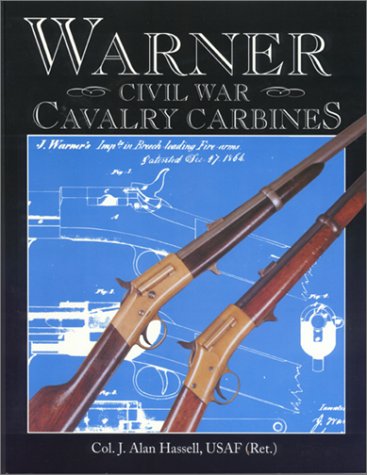


J. Alan Hassell, Warner Civil War Cavalry Carbines (Thomas Publications, 2000). A book-length study of the Warner.
John D. McAulay, Carbines of the Civil War, 1861-1865.
John D. McAulay, Civil War Carbines.
Norm Flayderman, Flayderman’s Guide to Antique American Firearms and Their Values.
Sources
- James Warner, “Improvement in Breech-Loading Fire-Arms,” U.S. Patent No. 41,732, February 23, 1864, and U.S. Patent No. 45,660, December 27, 1864.
- Ordnance Department: Message from the President of the United States, January 14, 1868, House Executive Document No. 99, 40th Congress, 2nd Session: contracts and correspondence with James Warner, pp. 691 to 696; statement of purchases, p. 995.
- A. B. Dyer, “Statement of ordnance and ordnance stores purchased by the Ordnance Department from January 1, 1861, to June 30, 1866,” in Report of the Secretary of War (Washington, 1866), p. 663.
- Robert Howard, “The Warner Carbine,” American Society of Arms Collectors Bulletin 45 (1981), pp. 24 to 30, quoting Ordnance and regimental correspondence of 1864 and 1865 and Pierre Lorain, Les Armes Américaines de la Défense Nationale, 1870-1871.
- Jeff Goodson, “U.S. Civil War Carbines: Service and Survival,” American Society of Arms Collectors Bulletin 126, pp. 18 to 49: Warner entry on p. 43, Tables 2 and 3, and the Wilson classification, drawing on John D. McAulay’s compilations of the Ordnance records.
If you know of any forums or sites that should be referenced on this listing, please let us know here.