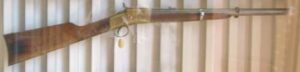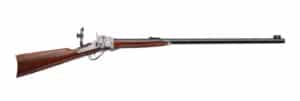
The Remington split-breech carbine was the Civil War forerunner of the Remington rolling block, built on the same idea of a breech locked shut by the falling hammer. The Union Ordnance Department contracted for 20,000 of them in October 1864 and January 1865, in two sizes: a small-frame carbine in .44 rimfire and a large-frame carbine for the Spencer cartridge. Chief of Ordnance Alexander B. Dyer’s purchase list counts all 20,000. None are known to have reached Union troops before the war ended. The sources here are the patents, the two contracts and the delivery record printed for Congress in 1868, Dyer’s list, and Jeff Goodson’s study of what became of each make. For the Remington alongside the other carbines the Union bought, see our guide to Civil War carbines.
The patents: Geiger and Rider
Two inventors patented the idea within a year of each other.
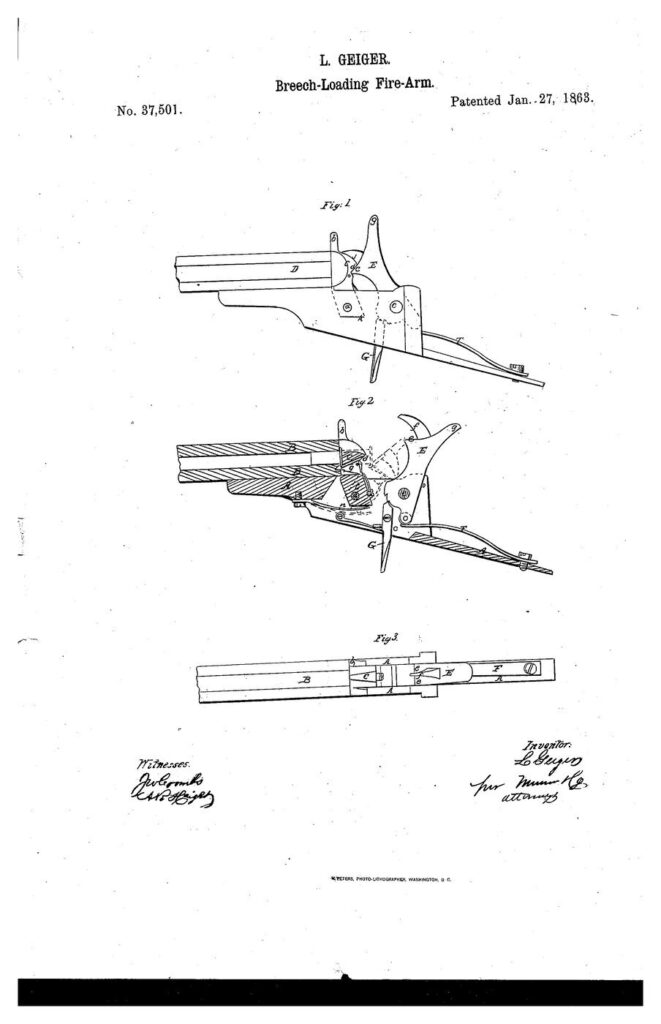
Leonard Geiger of Hudson, New York, received U.S. Patent No. 37,501 on January 27, 1863. His breech is a block hinged on a cross pin below and behind the barrel, swung open by a thumb piece. The hammer pivots on its own pin a short way behind it. Each part has a shoulder. When the hammer falls on a closed breech, its shoulder bears against the shoulder on the back of the block, and the hammer becomes a brace holding the breech shut against the force of the shot. Cocking the hammer frees the block to swing open. A hook on the block draws the empty case out of the barrel.
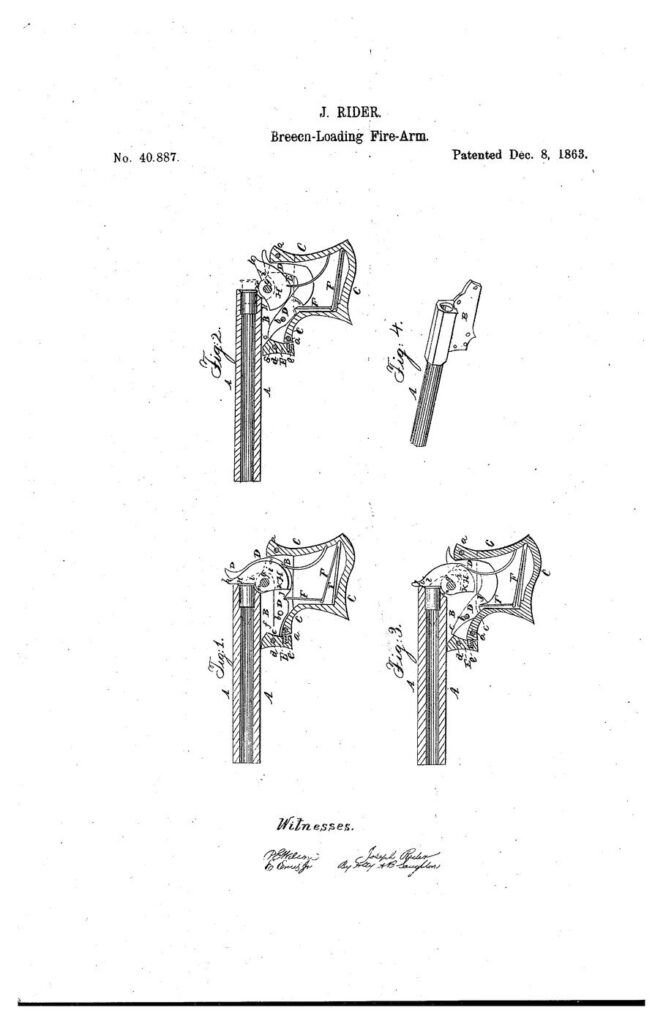
Joseph Rider of Newark, Ohio, received U.S. Patent No. 40,887 on December 8, 1863. He assigned it to himself and E. Remington & Sons of Ilion, New York. Rider’s barrel is bored straight through to take a metallic cartridge, and the barrel and the lock plate are made as one piece. The patent’s drawings show the action on a pistol. The breech plate is pivoted beneath the rear of the barrel. It is grooved, and when the breech and the hammer are both closed the hammer lies in that groove. That slotted, or split, breech gave the carbine its collectors’ name. Shoulders on the hammer lock the breech plate against the explosion, and the plate cannot be opened until the hammer is cocked. The hammer strikes the rim of the cartridge directly. A pin on the plate catches the rim of the cartridge. Closing the plate pushes the cartridge home, and opening it pulls the fired case partway out.
Rider’s later patents refined the same lock. No. 45,123, of November 15, 1864, also assigned in part to Remington, locks the trigger while the breech is open, which keeps the hammer from falling on an open breech. No. 45,797, of January 3, 1865, put the locking tumbler on the hammer’s own shaft. Our history of the Remington M1867 rolling block follows the patents from there to the production rifle.
How the Remington split-breech carbine works
The soldier drew the hammer back to full cock. That freed the breechblock, and he swung it back to open the chamber. He pushed a rimfire cartridge partway in and closed the block, which seated the cartridge. Pulling the trigger let the hammer fall. It fired the cartridge and, in the same movement, its shoulders came to rest behind the block. When the shot drove the block back, the hammer held it. To reload he cocked the hammer again and swung the block back, and the block drew the empty case partway out for him to pull free.
Goodson describes two sizes. The early small-frame carbines, which collectors call Type I, were .44 caliber and fired the No. 46 long rimfire cartridge. The later large-frame carbines, Type II, were .50 caliber and fired the .56-50 Spencer rimfire cartridge. These are the period cartridge designations, given for history only.
Remington carbine contracts and deliveries
House Executive Document No. 99 of 1868 prints two contracts for “Remington carbines.”
- October 24, 1864. Brigadier General A. B. Dyer, Chief of Ordnance, contracted with E. Remington & Sons of Ilion for 15,000 Remington carbines and appendages. They were to match a standard model approved by the Chief of Ordnance and interchange in all their parts. The schedule called for 100 by June 1, 1865, 1,000 by July 1, 2,000 by August 1, 3,000 by September 1, and 3,500 a month after that until all 15,000 were delivered. The War Department approved it on October 31, 1864 (Ex. Doc. 99, pp. 457 and 458).
- January 19, 1865. Dyer contracted with Samuel Norris of Springfield, Massachusetts, for 5,000 Remington carbines and appendages: 1,250 by February 28, 1,500 by March 31 and 2,250 by April 30, 1865. Deliveries were to be made “at the place of fabrication,” which the contract does not name. It was approved on January 27, 1865 (pp. 286 to 288).
An earlier Remington carbine order is on record. On August 9, 1864, Chief of Ordnance George D. Ramsay reported to Secretary of War Edwin M. Stanton on the arms that used the copper cartridge. Among the arms then under contract he listed “Remington carbines, single-shooter 1,000” (Official Records, Series III, vol. 4, p. 593). No contract for that order is printed in Ex. Doc. 99, and the record does not show whether it was filled separately or folded into the October contract.
The government’s statement of purchases records the Norris deliveries one by one (p. 849). A single carbine came on March 30, 1865, and another on April 18. The first thousand followed on May 8, a month after Appomattox. More lots arrived on May 26, June 8, June 12, June 22 and June 30, bringing the total to 5,000. The dates match Goodson’s account of the 5,000 small-frame Type I guns, delivered from March to June 1865.
The 15,000 large-frame carbines of the Remington contract came later still. Goodson, using McAulay’s delivery tally, puts the first in September 1865 and the last in May 1866. Dyer’s statement of purchases from January 1, 1861, to June 30, 1866, counts 20,000 Remington carbines (Report of the Secretary of War, 1866, p. 663). Goodson, following McAulay, uses 19,999.
Who carried them
Goodson finds no record of any Remington carbine issued to federal troops during the war. He counts about 1,400 small-frame guns that apparently went to state militia.
Vermont. In October 1864 Confederate raiders came over the border from Canada and struck St. Albans, Vermont. Goodson records that 1,200 Remingtons went to Vermont in 1865 in response. He quotes an account by Spears: fourteen companies of militia cavalry were raised to patrol the border, and “Remington carbines were supplied, along with Smith carbines, but only the Smith carbines were received in time to be issued to the Frontier cavalry companies.” Vermont still listed 1,196 Remington carbines on hand in October 1866.
New Hampshire. Two hundred went to New Hampshire, where the militia used them after the war. They were still listed on hand on June 1, 1868.
The large-frame carbines missed the war entirely. Goodson also quotes a note from McAulay that “in 1871, it is known that the .46 (sic) caliber Remington carbines were being used by the 9th U.S. Cavalry.” How many is not recorded.
After the war
The Remingtons came through the war nearly untouched because they had barely been used. Goodson counts 17,604 in storage in June 1866, one sold, and none taken home by soldiers. Adding the 1,396 Vermont and New Hampshire guns known to have survived gives 19,001, a survival rate of 95.0 percent. Only the Ball and the Palmer, 1,000 each and never issued, survived at a higher rate.
In November 1870 the Ordnance Department sold 14,757 of the large-frame carbines back to Remington, which resold them to France for the Franco-Prussian War. The government tried to sell the surviving small-frame guns at the same time without success. In 1876 it sold 3,663 small-frame and 382 large-frame carbines to H. Boker & Company. Goodson takes the Boker figure to mean that some of the state militia guns had come back into federal stores.
The action itself had a long life. A board of officers that met at St. Louis in 1870 tested Remington rifles and carbines against the Springfield, Sharps and others, and named the Remington, the Springfield and the Sharps as the three systems that “commended themselves strongest to the judgment of the Board.” One thousand rifles and 200 carbines of each were issued to troops for trial in the field (General Report of the Judges of Group XVI, 1876, p. 19). The Army chose the Springfield trapdoor. Remington sold the rolling block abroad in large numbers, as told in our Remington Rolling Block history.
Where the Remington carbine record and the legend disagree
“Norris held the contracts for all 20,000.” Some modern accounts, among them Forgotten Weapons, give Samuel Norris contracts for the whole 20,000. The contracts printed in Ex. Doc. 99 say otherwise. Norris contracted for 5,000. E. Remington & Sons contracted directly for the other 15,000, three months earlier.
Which contract came first. Goodson writes that the first contract, for the 5,000 small-frame guns, was made in December 1864. The printed record shows no contract of that date. Ramsay’s report of August 9, 1864, already lists 1,000 Remington carbines under contract. Ex. Doc. 99 prints the Remington contract for 15,000 on October 24, 1864, and the Norris contract for 5,000 on January 19, 1865. What became of the August order of 1,000 is not recorded in the sources we have read.
Who made the small-frame guns. Forgotten Weapons, among others, says the carbines were made by the Savage Revolving Fire-Arms Company, and auction catalogs say the same of the 5,000 Norris carbines. Forgotten Weapons puts all 20,000 there. Our history of the Savage 1861 Navy revolver mentions that work. The Norris contract does not name a factory, and we have not found the arrangement in the Ordnance documents.
Civil War service. The Remington is often listed among the carbines of the Civil War, and it is on Dyer’s purchase list. The record shows that the first thousand were delivered a month after Lee’s surrender, and that none are known to have been issued to Union troops during the war. The Vermont guns were bought because of a Confederate raid, but they arrived too late to be issued for it.
Geiger or Rider. Geiger’s patent came first and covers the hammer bracing a hinged breech. Rider’s patent of December 1863 claims the interlocking hammer and breech plate, with the hammer resting in the slotted breech. Ian McCollum of Forgotten Weapons writes that the two arrived at the idea independently, and that Remington took a royalty agreement with Geiger and his partner, Charles Alger, to head off a lawsuit. We have not seen that agreement.
More Civil War carbines on Powder & Lead
The Vermont border companies the Remingtons were meant for carried the Smith carbine instead. The large-frame Remington fired the .56-50 version of the Spencer cartridge, the round of the .50 caliber Spencer and of the Ball and Palmer carbines. For the company that made it, see the history of the Remington Arms Company, and for the whole Union purchase list see our guide to Civil War carbines.
Further reading
The government documents cited below are free to read online. The books below cover Remington and the Civil War carbines in more detail. Book links go to Amazon, and Powder & Lead earns a commission on qualifying purchases.
-
History of Remington Firearms: The History Of One Of The World's Most Famous Gun Makers
Purchase on Amazon -

Carbines of the Civil War, 1861-1865
Purchase on Amazon -

Civil War carbines
Purchase on Amazon -
Sale!

Flayderman's Guide to Antique American Firearms and Their Values
Original price was: $49.99.$39.98Current price is: $39.98. Purchase on Amazon
Roy Marcot, History of Remington Firearms (Lyons Press, 2005).
John D. McAulay, Carbines of the Civil War, 1861-1865.
John D. McAulay, Civil War Carbines.
Norm Flayderman, Flayderman’s Guide to Antique American Firearms and Their Values.
Sources
- Leonard Geiger, “Improvement in Breech-Loading Fire-Arms,” U.S. Patent No. 37,501, January 27, 1863.
- Joseph Rider, “Improvement in Breech-Loading Fire-Arms,” U.S. Patent No. 40,887, December 8, 1863; No. 45,123, November 15, 1864; and No. 45,797, January 3, 1865.
- Ordnance Department: Message from the President of the United States, January 14, 1868, House Executive Document No. 99, 40th Congress, 2nd Session: contract with Samuel Norris, pp. 286 to 288; contract with E. Remington & Sons, pp. 457 and 458; statement of purchases, p. 849.
- A. B. Dyer, “Statement of ordnance and ordnance stores purchased by the Ordnance Department from January 1, 1861, to June 30, 1866,” in Report of the Secretary of War (Washington, 1866), p. 663.
- United States Centennial Commission, General Report of the Judges of Group XVI (Philadelphia, 1876), p. 19: the St. Louis board of 1870.
- Official Records, Series III, vol. 4, pp. 592 and 593: Ramsay to Stanton, August 9, 1864.
- Jeff Goodson, “U.S. Civil War Carbines: Service and Survival,” American Society of Arms Collectors Bulletin 126, pp. 18 to 49: Remington entry on p. 37 and Tables 2 and 3, drawing on John D. McAulay’s compilations of the Ordnance records.
- Ian McCollum, on the Remington split breech, Forgotten Weapons, April 1, 2018.
If you know of any forums or sites that should be referenced on this listing, please let us know here.