Disclosure: Powder & Lead may earn a commission on purchases made through affiliate links on this page, at no extra cost to you.
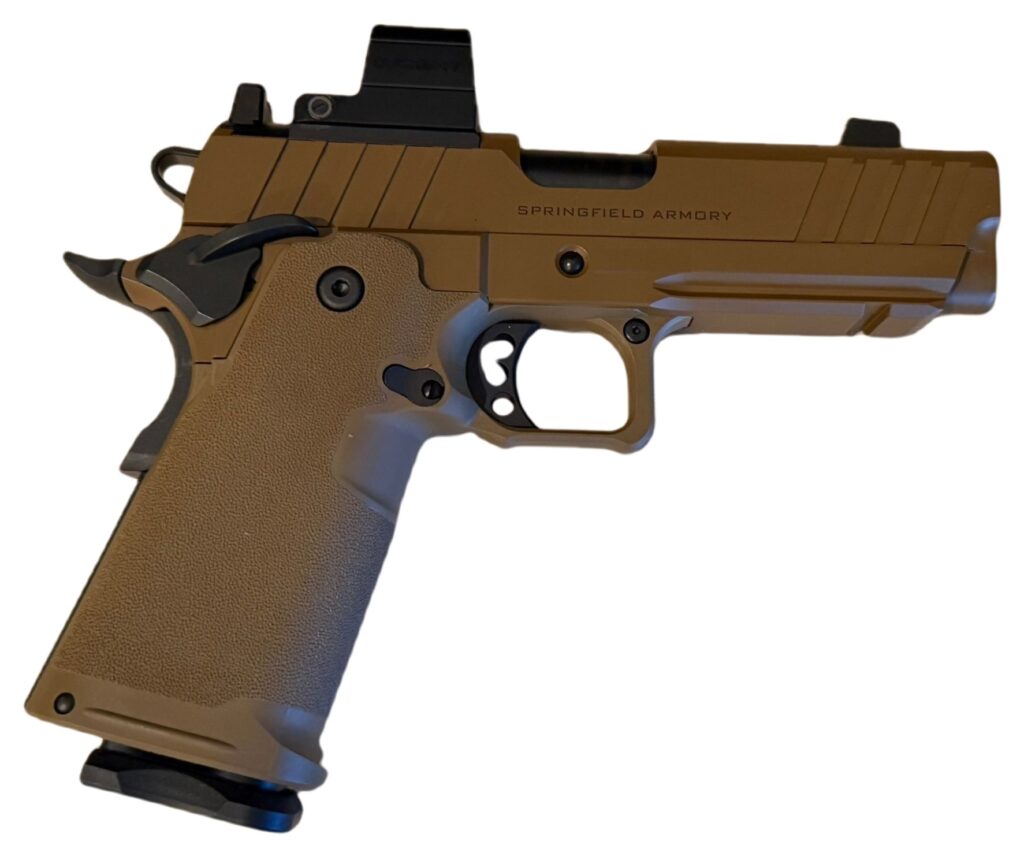
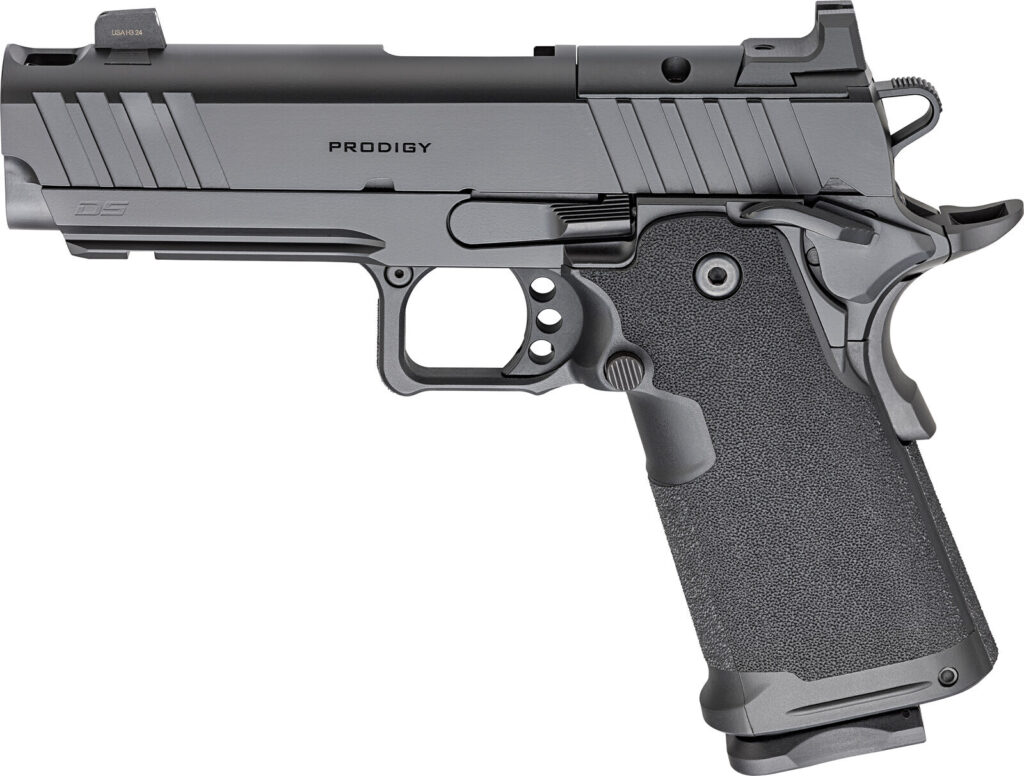
The Springfield Prodigy is a double-stack 9mm pistol built on the 1911 pattern, with a metal frame, a polymer grip module and a tapered double-column magazine. Springfield Armory announced it on September 1, 2022, as the first pistol in its 1911 DS line. Pistols built this way are usually called 2011s, and the best-known makers charge considerably more for theirs. As of November 2026, Springfield lists every current Prodigy model between $1,500 and $2,000. The account below draws on Springfield’s own press releases, product pages and warranty, the 1994 patent behind the 2011 frame, and published reviews from American Rifleman, Guns & Ammo, Outdoor Life, Gun Tests, Shooting Sports USA, Shooting Times and RECOIL.
Where the 2011 came from
John Browning’s Model 1911 held seven rounds of .45 ACP in a single-column magazine, inside a steel frame with grip panels screwed to its sides. Our history of the 1911 pistol and our biography of John Moses Browning cover the original. Widening the grip to take a double-column magazine was the obvious way to add capacity, and the first commercial answer was a wider metal frame. American Rifleman’s history of the double-stack 1911 dates the Para-Ordnance high-capacity frame, made in Toronto, to 1988 and Para’s first complete pistol, the P14-45, to 1990. With the right magazine base pad, a Para-framed 1911 held 21 rounds of .38 Super, and in American Rifleman’s words the frame “guaranteed a continuation of absolute domination” by the 1911 in USPSA’s Open division.
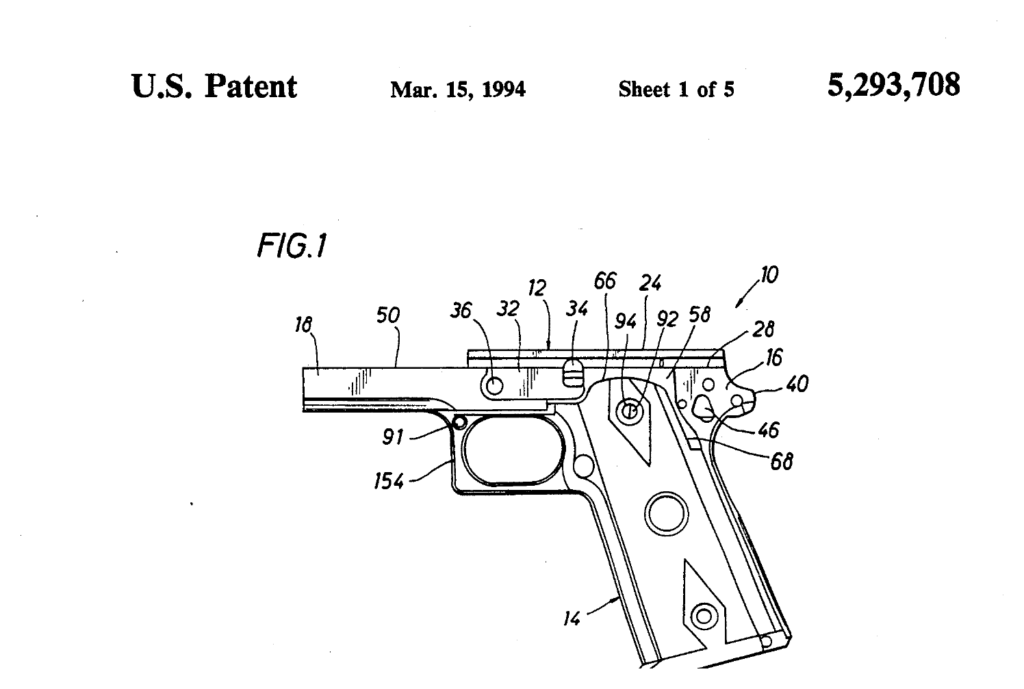
The 2011 took a different route. On March 15, 1994, Sandy L. Strayer and Virgil P. Tripp received U.S. Patent No. 5,293,708 for a “frame/handgrip assembly” for 1911-type pistols. The patent describes a metal frame that stops at the top of the grip and carries the rails, the slide and the standard 1911 parts. A separate handgrip, “preferably composed of a polymer material,” with the trigger guard molded in, is keyed and screwed to the frame. Together they form a magazine well wide enough for “a wide, staggered row, enhanced volume cartridge magazine.” The patent’s stated aim was a grip about as thick as a standard 1911 A1 while holding the larger magazine.
The idea did not start with Strayer and Tripp alone. Shooting Illustrated’s obituary of the gunsmith Chip McCormick credits McCormick with conceiving the modular gun, putting money into it and arranging parts purchases, while Strayer and Tripp “developed and patented it, creating what we know as the 2011.” The firm that built it became STI. Staccato’s own history says that “for over 25 years” the shooting world knew the company as STI, “the company that evolved John Browning’s classic 1911 design into the 2011® platform,” and that its guns were built first for competition. Staccato says it first used the Staccato name in 2019 for its duty and personal-defense pistols and rebranded the whole company as Staccato 2011 in 2020.
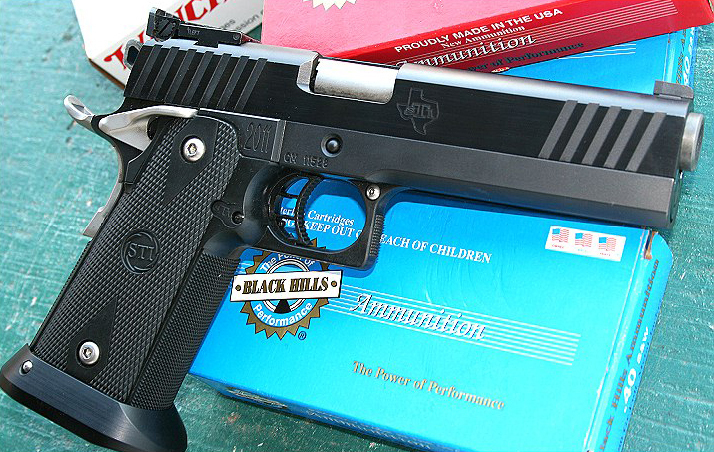
Staccato writes the name as 2011® on its site. Outdoor Life’s Tyler Freel put it plainly in his Prodigy review: “the 2011 is a Staccato,” and many guns called 2011s “technically aren’t.” Springfield’s own pages call the Prodigy a 1911 DS, for double stack, and use “2011®” when they name Staccato’s guns. In everyday use, though, “2011” has come to mean any 9mm 1911 with a steel frame, a bolted-on grip module and a tapered double-stack magazine. The Prodigy fits that description.
The Springfield Prodigy line, 2022 to 2026
Springfield’s press releases give the line’s history.
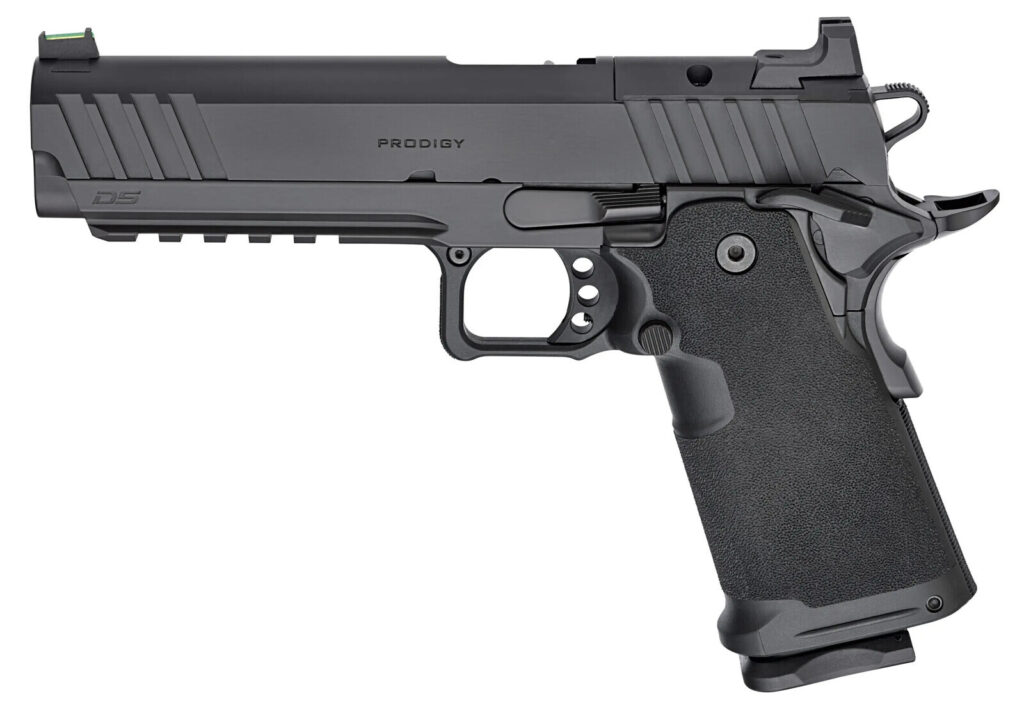
- September 1, 2022. The Prodigy AOS 9mm launched in 5-inch (PH9119AOS) and 4.25-inch (PH9117AOS) versions, each also offered with a HEX Dragonfly red dot. Each came with a 17-round flush magazine and a 20-round extended magazine, with a 26-round magazine sold separately.
- June 28, 2024. Ten-round versions of both, for states that limit magazine capacity.
- July 24, 2024. A Cerakote Coyote Brown finish.
- July 30, 2024. The Prodigy Comp, in 5-inch and 4.25-inch versions, with a single port cut through the top of the slide and barrel and a tritium front sight behind it.
- January 15, 2025. The Prodigy Compact, in 3.5-inch and 4.25-inch versions, with a 15-round flush magazine, a billet 7075-T6 aluminum frame, a shorter beavertail and a recontoured hammer. Springfield gives the 3.5-inch model’s weight as 25.5 ounces.
- February 18, 2025. The Comp in Coyote Brown.
- May 26, 2026. A 4.25-inch Prodigy with a slide cut for the Aimpoint A-CUT interface and an Aimpoint COA closed-emitter red dot fitted at the factory. It ships with 18-round magazines.
- August 18, 2026. The Prodigy 3.5″ AOS, a 3.5-inch slide on a full-length grip module and aluminum frame, with two 18-round magazines.
What the Prodigy shares with premium 2011s
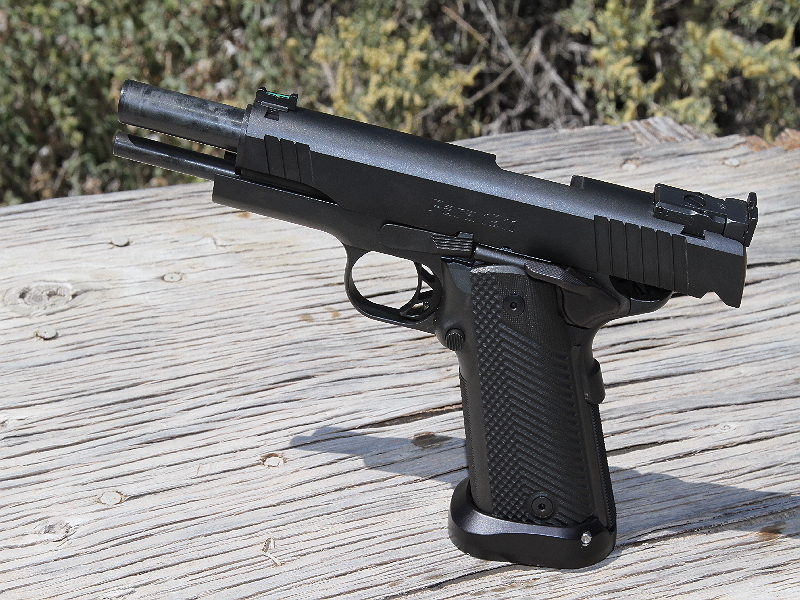
The Prodigy is built the way the 1994 patent describes. On the full-size 5-inch and 4.25-inch models, a forged steel frame carries the slide rails, the hammer, sear and disconnector, the thumb safety and the grip safety. The Compacts and the 3.5″ AOS use a billet aluminum frame instead. On all of them the frame stops at the top of the grip. Below it, a one-piece polymer grip module with the trigger guard molded in holds the magazine. Guns & Ammo’s Joe Kurtenbach describes the grip fastened “by way of two bushings and screws, one on each side, and a third screw in the front of the triggerguard.”
The magazine is the other half of the design. A 2011 magazine is double-column for most of its length and narrows near the top until the last cartridges sit in a single column, the way a standard 1911 feeds. Gun Tests described the Prodigy’s magazine as one that “basically transitions from a double stack to a single-stack magazine to feed rounds.” The bottom of the grip is beveled to guide the tapered magazine in.
The Prodigy also has the premium guns’ other features: a ramped bull barrel that fits the slide without a bushing, an internal extractor, a skeletonized hammer, an ambidextrous thumb safety, a beavertail grip safety, front and rear slide serrations, an accessory rail and a slide cut for an optic. American Rifleman measured its test gun’s trigger at 5 pounds 6 ounces and found “virtually no creep or overtravel with an exceptionally short reset.”
The AOS optic system
Springfield developed its optic mount with Agency Arms and calls it the Agency Optic System, or AOS. The slide has a single cut. A steel plate made for a particular optic’s footprint fills the cut, and each plate carries its own rear sight. The iron sights stay usable through the optic. The launch release describes the plates as “machined from billet 17-4 stainless steel.” The AOS models ship with a cover plate that carries a rear sight, for use without an optic, and a plate for the HEX Dragonfly footprint. The 2026 Aimpoint COA model uses Aimpoint’s own A-CUT mount instead. Outdoor Life noted that the plates “drop into a half-dovetail at the rear of the optic cut,” which takes some of the recoil load off the screws.
Springfield’s store lists plates for, among others, the HEX Dragonfly; the Trijicon RMR and SRO and Holosun 407C-X2, 507C-X2 and 508T; the HEX Wasp and Holosun 507K-X2 and 407K-X2; the Leupold DeltaPoint Pro; the Aimpoint Acro; and the Holosun 509. The included A13B plate fits the Dragonfly’s footprint, which Springfield’s list shares with the Vortex Viper, the Burris FastFire and the Crimson Trace CT RAD Pro. Other footprints need their own plate, bought separately.
Magazine compatibility with Staccato
Guns & Ammo’s 2025 review put it this way: “a double-stack 1911 is only as good as its magazine.” Springfield’s Prodigy page states: “1911 DS® magazines are cross compatible with Staccato 2011® platforms.” Guns & Ammo reported in 2022 that the company “has stated that magazines will be compatible with many existing 2011 and double-stack Model 1911 pistols from other makers.”
Testers confirmed it in both directions. Gun Tests wrote that “Prodigy magazines will function in Staccato P guns.” Outdoor Life found that the factory magazines “will function in a Staccato P” and that “Staccato magazines will also function in the Prodigy.” American Rifleman and Guns & Ammo both identify the factory magazines as made by Duramag, and Guns & Ammo describes them as “made in the U.S. by DuraMag exclusively for Springfield Armory.”
Grip lengths differ between makers, and that affects which aftermarket magazines seat fully. Atlas Gunworks, which sells its own 2011 magazines, says its 120 mm magazine “is not compatible” with the Prodigy “due to the longer grip,” while its 126, 140 and 170 mm magazines fit.
Where the Prodigy differs from more expensive competitors
Most of the Prodigy matches the premium guns. Reviewers found the differences in a short list of details.
- Internal parts. Outdoor Life reported that “many of the internal parts, a point of ire with some reviewers, are injection-molded and not forged.” Freel added that plug-and-play parts are common in modern pistols and “aren’t necessarily a bad thing.”
- Finish. The frame and slide are Cerakote, which Freel said “does feel more like a painted coating, which it is, than a blued or DLC finish.”
- Safety feel. Freel found the thumb safety lever could be pressed about .063 inch past its off position before springing back, “something you won’t see on high-end 1911’s and 2011-style pistols.”
- Trigger weight. American Rifleman measured 5 pounds 6 ounces, Gun Tests 5.4 pounds, and Guns & Ammo 5 pounds 4 ounces on a Comp after nearly 1,000 rounds. Gun Tests said it “would have liked it more toward 4 pounds.”
- Takedown. The two-piece guide rod comes apart with a hex wrench. Guns & Ammo noted that the Prodigy Comp “lacks a few of the Staccato P features, such as the clever tool-less takedown guiderod.”
- Grip size. Gun Tests found the Prodigy had the largest grip circumference of the four double-stack 9mm pistols in its test.
Not every expensive gun in this class uses the same magazine. Guns & Ammo noted in 2022 that Wilson Combat’s EDC X9 uses “a modified rendition of Walther’s PPQ magazine,” while Staccato, Nighthawk and the others “use dual-column magazines that taper sharply to a single-stack funnel at the top.” A Prodigy owner can share magazines with a Staccato owner, and an EDC X9 owner cannot.
On my own Prodigy, two changes closed most of that gap. A gunsmith did a trigger job on the factory trigger, and the slide was lapped. Both made a tremendous difference, and the pistol now feels much closer to the multi-thousand-dollar 2011s. Trigger work belongs with a qualified gunsmith.
Where the Prodigy is made
Springfield’s product pages and specification tables do not state a country of origin for the Prodigy. American Rifleman’s 2023 review calls it Springfield’s “U.S.-made Prodigy 1911 DS AOS.” Gun Tests’ specification table also lists it as made in the U.S., and Guns & Ammo says the magazines are made in the U.S. by Duramag. Springfield’s warranty gives its address as 650 Weber Drive, Geneseo, Illinois.
The cost question
The Prodigy’s price is the reason it gets compared with Staccato at all. The reviewers framed the difference in relative terms from the start.
- RECOIL’s Iain Harrison wrote at launch that Springfield had “made the cost of entry to the 2011 world much more affordable.”
- Guns & Ammo’s Kurtenbach wrote that the Prodigy pistols “are significantly less expensive than competitive double-stack 1911 and 2011 offerings” and “cost thousands less,” and that Springfield was offering them “for about half the price of its primary competitors.” In the same review, the pistols Kurtenbach named as the category’s notable players, Wilson Combat’s EDC X9 and Nighthawk Custom’s TRS, listed at roughly two to three times the Prodigy’s launch price. His “thousands” fits those two guns. The gap to the Staccato P in his figures was smaller.
- Gun Tests called the 4.25-inch Prodigy “a bargain compared to other comparable brands,” and noted that the 2011 platform is “mostly used in competition pistols that cost a king’s ransom.”
- Shooting Sports USA called the 5-inch model with a factory optic “a best buy for competitive shooters on the hunt for an affordable 2011-style pistol.”
- Guns & Ammo’s 2025 review of the Comp called it “one of the few comp’d 1911s costing less than $2,000.”
The same review said the Comp’s list price was “substantially lower than most of its competitors.” Dealer prices differ from list and change often. The retailer links below show the current figure.
The Prodigy is not the cheapest double-stack 1911. Guns & Ammo’s 2025 review named the Military Armament Corp. MAC 1911 Double Stack as less expensive and the Kimber KDS9c Rail as more expensive, and judged the Prodigy’s grip module, optic mount and sights better than those of the cheaper guns. On price, the Prodigy sits in the middle: well under the premium 2011s and above the budget double-stacks.
On the record above, the Prodigy shares the Staccato P’s layout, takes the same magazines, carries an optic mount with steel plates and comes in a wide choice of models. The reviewers’ list of what it lacks is short: forged internal parts, a DLC finish and a tool-free guide rod.
The early reliability reports
The Prodigy’s reputation took a hit in its first months. These are the published reports from September 2022 to February 2023.
- RECOIL, September 1, 2022. Harrison’s 4.25-inch gun had “two failures to feed in the short gun, both with hollow points, and both on the penultimate round from a magazine,” during the first range session. After that “it ran without a glitch.” He wrote that he would want to shoot a case of ammunition through both models “before pronouncing them fit for duty,” calling that “the nature of tight-fitting 1911s.”
- Guns & Ammo, September 1, 2022. Not every early gun had trouble. Kurtenbach’s launch-day review passed 2,000 rounds “without a single issue.”
- Outdoor Life, January 10, 2023. Freel wrote that “some early published reviews” had knocked the gun for reliability. He had “seen reports of feeding issues caused by both magazines and the slide being slowed down by a stiff disconnector on some pistols,” and had “heard of some trigger issues too.” Most were “being blamed on the injection-molded internal parts.” He also reported that “some early run users reported feeding issues with the factory magazines that were remedied by switching to Staccato brand mags.”
- Shooting Sports USA, January 20, 2023. After about 300 rounds, “the second round in the 17- and 20-round mags didn’t chamber twice.” A cleaning and lube ended the problem.
- Atlas Gunworks, January 2023. Atlas, which sells competing magazines, listed feeding complaints with Prodigy magazines, including rounds presented at an upward angle and tight springs. It is a seller describing a rival’s product, and it gave no counts.
- American Rifleman, February 7, 2023. With Speer 124-grain Gold Dot, “the round attempting to chamber would abruptly stop on the feed ramp.” The pistol went back to Springfield, where “according to the invoice, it was inspected, the feed ramp polished and the disconnector tuned.” That “eliminated the cycling issue.”
What Springfield did is less clear than what was reported. We found no published Springfield statement that acknowledged the early problems, no recall notice and no list of production changes. The record shows two things. Springfield reworked American Rifleman’s test gun; the invoice says it polished the feed ramp and tuned the disconnector. And on February 6, 2023, Springfield publicized a 10,000-round test of a 5-inch Prodigy run by Paul Carlson of Safety Solutions Academy and published on The Armory Life, a content site Springfield launched in 2019. Carlson reported one failure to chamber, at about 2,750 rounds, which he blamed on his own grip while shooting one-handed.
Later test guns ran better. Freel’s sample, built “several months after the first run,” had five stoppages in about 1,100 rounds, all with one flat-nose load. In 2025, Shooting Times reported no failure to feed, fire or eject from the 3.5-inch Compact during its test.
The early reports were real, they came from several independent testers, and they clustered around magazines, the disconnector and feeding. They do not show that every Prodigy had them, and the later tests do not prove that every later gun is free of them.
Claims and the record
Five things are said about the Prodigy often enough to check.
“The Prodigy is a 2011.” Staccato uses 2011 as its own registered name, and Springfield calls the Prodigy a 1911 DS. The design follows the 2011 layout of the 1994 patent: steel frame, polymer grip module and tapered double-stack magazine. Outdoor Life’s term, “2011-style,” fits the record.
“The Prodigy is unreliable.” The early reports are documented, and American Rifleman’s gun needed factory work. Later published tests were largely clean. We found no recall.
“It takes Staccato magazines.” Springfield says so, and Outdoor Life confirmed it in both directions.
“It costs half what a Staccato does.” Guns & Ammo said “about half the price of its primary competitors” in 2022, a line that covered Wilson and Nighthawk as well as Staccato. Against the Staccato P alone the gap was smaller. In 2025 the magazine called the Comp’s price “substantially lower than most of its competitors.”
“It is just a Springfield 1911 with a fat grip.” The trigger, the safeties and the swinging barrel link follow the 1911, and the full-size frame and slide are forged steel. The polymer grip module, the tapered double-stack magazine, the bushingless bull barrel and the AOS optic system are all departures from Springfield’s single-stack 1911s.
Warranty and support
Springfield’s limited warranty covers “the original retail purchaser” against “defects in workmanship or material” and lasts as long as that purchaser “owns the Product.” If a part fails from such a defect, Springfield “will provide, free of charge, a new, repaired or reconditioned (decided at our discretion) product.” After the owner reports the defect, Springfield sends a shipping coupon “so that we can pay for the shipping.” It excludes damage from unauthorized repairs or modifications, misuse, normal wear and tear, poor storage or maintenance, and “hand-loaded, reloaded, remanufactured, or defective ammunition.” Warranty service is reached at 800-680-6866 or [email protected].
Which Springfield Prodigy
All of these are 9mm. Each link goes to a current new listing at Guns.com.
- Prodigy AOS, 5-inch (PH9119AOS). The original full-size gun, with a forged steel frame and a five-slot rail.
- Prodigy AOS, 4.25-inch (PH9117AOS). The same frame and grip with a Commander-length slide. Kurtenbach called it possibly his “favorite gun Springfield Armory has ever built.”
- Prodigy Comp AOS, 5-inch (PH9119AOS-COMP). The integral port vents gas upward to hold the muzzle down. A 4.25-inch Comp is also made.
- Prodigy Compact AOS, 3.5-inch (PH9115AOS). The carry model, with an aluminum frame, a shorter grip and 15-round magazines.
- Prodigy 3.5″ AOS (PH9114AOS). The short slide of the Compact on a full-length grip, with 18-round magazines.
Springfield sells spare factory magazines in 10, 15, 17, 20 and 26-round sizes from its own store. Gritr makes an OWB Kydex holster for the Prodigy with an optic cut and an open bottom; the maker says it does not fit a pistol with a light or laser mounted. For other carry options, see our guide to concealed carry holsters.
The optics and light below fit the Prodigy’s AOS plates and rail. The Trijicon RMR and Holosun 507C-X2 both use Springfield’s A14B plate, sold separately. Guns & Ammo tested a 4.25-inch Prodigy with an RMR and a SureFire X300U.
-

Trijicon RMR Type 2 3.25 MOA Automatic LED Red Dot Sight, Black – RM01-C-700600
Purchase on Amazon -

HOLOSUN HS507C-X2 Red 2 MOA Dot & 32 MOA Circle Open Reflex Pistol Sight – Durable Shake-Awake Solar Failsafe Parallax-Free Aluminum Sight for Full-Sized Handguns – Multi-Reticle Red Dot
Purchase on Amazon -

SureFire X300 Ultra LED Handgun or Long Gun Weaponlight with T-Slot Mount
Purchase on Amazon
More on Powder & Lead
For the company behind the Prodigy, see our history of Springfield Armory, Inc. For another current Springfield design, see our Springfield Kuna review.
Sources
- Springfield Armory press releases: launch, September 1, 2022; 10,000-round test, February 6, 2023; 10-round models, June 28, 2024; Coyote Brown, July 24, 2024; Comp, July 30, 2024; Compact, January 15, 2025; Coyote Brown Comp, February 18, 2025; Aimpoint COA models, May 26, 2026; 3.5″ AOS, August 18, 2026.
- Springfield Armory, 1911 DS Prodigy handguns (product page and specifications), AOS mounting plates and Limited Warranty, accessed November 19, 2026.
- S. L. Strayer and V. P. Tripp, U.S. Patent No. 5,293,708, “Frame/handgrip assembly for autoloading handgun,” March 15, 1994.
- Staccato, Our Story, and Staccato P, accessed November 19, 2026.
- “A Look Back at the M1911 Double-Stack,” American Rifleman, October 25, 2017.
- Bill Loëb, “Obituary: Chip McCormick, Legendary Gunsmith and Innovator,” Shooting Illustrated, June 7, 2021.
- American Rifleman Staff, “Review: Springfield Prodigy 1911 DS AOS,” American Rifleman, February 7, 2023.
- Joe Kurtenbach, “Springfield Armory 1911 DS Prodigy 9mm Pistols: Full Review,” Guns & Ammo, September 1, 2022.
- Guns & Ammo Staff, “Springfield Armory 1911 DS Prodigy Comp AOS: Full Review,” Guns & Ammo, February 11, 2025.
- Tyler Freel, “Springfield Prodigy Review,” Outdoor Life, January 10, 2023.
- Robert Sadowski, “Springfield Armory 1911 DS Prodigy 4.25 AOS PH9117AOS 9mm Luger,” Gun Tests, July 18, 2023.
- John Parker, “Review: Springfield Armory 1911 DS Prodigy AOS,” Shooting Sports USA, January 20, 2023.
- Iain Harrison, “Springfield Prodigy: Best Affordable 2011?” RECOIL, September 1, 2022.
- Paul Carlson, “Springfield Prodigy Torture Test,” The Armory Life, February 2, 2023.
- Joel J. Hutchcroft, “Full Review: Springfield Armory’s New 1911 DS Prodigy Compact,” Shooting Times, April 22, 2025.
- Atlas Gunworks, “Springfield Prodigy Magazine Upgrade with Atlas Premium Magazines,” Atlas Gunworks blog, January 2023.
If you know of any forums or sites that should be referenced on this listing, please let us know here.