A Mechanical Curiosity Born in the Age of Gallery Guns
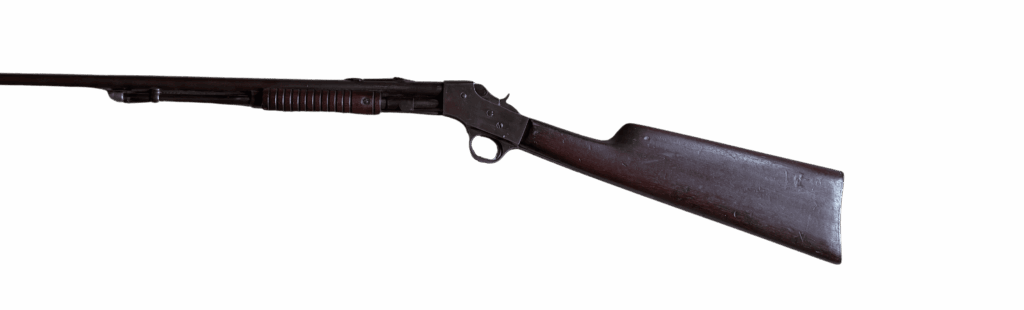
Introduction to the Stevens Visible Loader
By the first decade of the twentieth century, the American .22 rimfire rifle had already earned its place as the most familiar firearm in the country. It was the rifle of farms and backyards, of boys learning marksmanship, of trappers and small-game hunters, and of a booming entertainment industry that revolved around shooting galleries. In that environment, repeating .22 rifles were not novelties. They were necessities. Among them, the pump action held special appeal. It was fast, intuitive, and engaging, and it rewarded coordination in a way that single shots and bolt actions could not.
It was into this mature and competitive market that the Stevens Visible Loader appeared. The rifle did not attempt to outmuscle its rivals through brute simplicity or overwhelming durability. Instead, it offered something no other major manufacturer dared to sell at scale: a pump action .22 that openly displayed its feeding cycle. Each cartridge rose into view, paused briefly, and then entered the chamber in plain sight. The rifle quite literally showed the shooter what it was doing.
That choice defined the rifle’s character, its reputation, and its enduring place in American firearms history.
J. Stevens Arms and Tool Company and Its Approach to Design
J. Stevens Arms and Tool Company was founded in 1864 in Chicopee Falls, Massachusetts. From the outset, Stevens occupied a different niche than many of its competitors. The company was both a firearms manufacturer and a producer of precision machine tools. That dual role influenced its products. Stevens rifles often reflected an interest in mechanical solutions that went beyond the bare minimum needed to function.
By the late nineteenth century, Stevens was widely known for single-shot rifles such as the Favorite and Ideal, which were used for training, competition, and general sporting purposes. The company also produced repeaters, pistols, and shotguns, usually positioned as affordable alternatives to higher-priced competitors. Stevens designs tended to emphasize ingenuity and accessibility rather than luxury.
In 1920, Stevens became a subsidiary of Savage Arms. The Stevens name remained active, and existing product lines continued in production under Savage ownership. The Visible Loader spans both periods, appearing before and after the acquisition, with changes in markings reflecting corporate transitions rather than changes in fundamental design.
The Pump Action Landscape Before the Visible Loader
When Stevens introduced the Visible Loader in 1908, the pump action .22 rifle was already a proven commercial success.
Winchester’s Model 1890, designed by John Moses Browning, had established itself as the dominant pump rimfire. It was produced in very large numbers and became closely associated with shooting galleries, commercial amusement venues where patrons paid to fire strings of .22 Short cartridges at steel or moving targets. In that role, the rifle was prized for its fast pump action, durability under continuous use, and ability to function reliably through thousands of rounds fired daily. That same ruggedness made it equally attractive to private owners.
Colt also played a significant role in early pump rimfire history. In 1887, Colt introduced the Lightning slide-action rifle, including a small-frame version chambered in .22 rimfire. While Colt is best known for revolvers, the small-frame Lightning found a real market as a plinking and small-game rifle and saw use in gallery settings. The Lightning line remained in production until 1904 and demonstrated that there was room for multiple pump action designs beyond Winchester’s offerings.
Remington followed a year after the Visible Loader with the Model 12 in 1909, designed by John D. Pedersen. The Model 12 refined the pump action concept into a hammerless, takedown rifle that would remain in production until the mid-1930s. It became one of the most successful pump rimfires ever made and was also offered in gallery-oriented configurations.
By any measure, Stevens was entering a category filled with strong, well-established competitors. To gain attention, it needed a defining feature. Visible loading was that feature.
Shooting Galleries and Why Pump .22 Rifles Thrived
Shooting galleries were a central part of American popular culture from the late nineteenth century into the early twentieth. They appeared on boardwalks, at county fairs, in amusement parks, and in indoor arcades. Patrons paid a small fee for a set number of shots, typically firing .22 Short cartridges at steel knockdowns, moving ducks, rotating stars, or other reactive targets.
The gallery environment shaped firearm design. Rifles needed to cycle quickly, withstand constant use, and function reliably with low-powered ammunition. The .22 Short was favored because it produced less noise, generated lower recoil, and was easier to manage with close-range backstops. Pump action rifles dominated this space because they allowed rapid fire while still requiring deliberate action by the shooter, which kept the game engaging.
Manufacturers paid close attention to the gallery trade because it bought rifles in quantity and replaced them when worn out. Many of the most famous pump rimfires earned their reputations in this setting. Stevens was keenly aware of this market when it introduced the Visible Loader.
The Redfield Patents and the Concept of Visible Loading
The Visible Loader’s mechanism originated with inventor Edward E. Redfield. In 1907, Redfield received a patent for a repeating firearm with a distinctive feeding system. Stevens acquired the rights to the design and developed it into a commercial product.
A later Redfield patent, issued in 1910, describes improvements to the original system and makes clear the mechanical intent. The design relies on a sliding breech block, a vertically moving lifter, and a series of interlocks linking the lifter, hammer, and slide. These interlocks prevent the rifle from firing unless the breech block is fully closed and prevent the breech from opening unless the hammer is down.
What set the design apart was the lifter’s movement. Instead of raising the cartridge discreetly inside the receiver, the lifter elevated it into open view. During each cycle, the shooter could watch the cartridge rise from the magazine tube and align with the chamber.
This was not an incidental feature. It was the defining characteristic of the rifle.
The Stevens No. 70 Visible Loading Repeater
Stevens introduced the rifle in 1908 as the Stevens No. 70 Visible Loading Repeater. Early barrels were marked with that full designation. After the Savage acquisition, markings were often simplified to “Visible Loader.”
The rifle was offered in several configurations. Most examples were chambered to accept .22 Short, .22 Long, and .22 Long Rifle cartridges interchangeably. A Short-only variant, commonly referred to as the No. 70½, was produced for gallery use and other high-volume shooting applications.
Barrel lengths were typically 20 or 22 inches. Stocks were straight-gripped hardwood with plain finishes. Sights were basic open irons. The rifle was not ornate, and it was never intended to be. Its appeal lay entirely in its action.
Production is generally accepted to have run from 1908 until approximately 1934. Exact production numbers are unknown due to incomplete factory records and repeated serial number ranges, but total production is commonly estimated at roughly 100,000 rifles across all variants.
How the Action Works
The Visible Loader is mechanically more complex than most pump rimfires.
When the slide is drawn rearward, the breech block moves back, extracting and ejecting the fired case. At the same time, a pivoting lifter rises and captures the next cartridge from the tubular magazine. This cartridge is lifted into a visible window in the receiver where it can be plainly observed.
On the forward stroke, the lifter aligns the cartridge with the chamber and then drops away as the breech block pushes the round into battery. The hammer is cocked during this sequence. The interlocks described in the Redfield patents ensure that the rifle cannot fire out of battery and cannot be opened with the hammer cocked.
The system is precise and timing-dependent. It works best when parts are in proper condition and the action is fully cycled with each stroke.
Shooting Characteristics
In terms of accuracy, the Visible Loader performs as expected of an early twentieth-century .22 sporting rifle. With a good bore and proper ammunition, it is entirely capable of practical accuracy for plinking and small-game hunting.
The shooting experience is defined by the Visible Loader’s action. The pump stroke has a distinct feel, reflecting the multiple tasks being performed with each movement. It is less forgiving of short-stroking than simpler designs. The rifle rewards a deliberate, complete cycle.
What it offers in return is engagement. Watching each cartridge rise into view gives the shooter a direct connection to the mechanism. Few repeating rifles draw the shooter’s attention to the feeding process in this way.
The Nickname “Miserable Loader”
The Stevens Visible Loader has long carried the nickname “Miserable Loader,” sometimes also rendered as “Risible Loader.” The nickname originated with shooters rather than with the manufacturer.
The reason is straightforward. The Visible Loader’s feeding system is mechanically complex and less tolerant of wear, dirt, and improper assembly than competing pump action designs. When timing is off or parts are worn, the rifle can misfeed or jam in ways that frustrate users accustomed to the rugged simplicity of Winchester or Remington pumps.
The nickname reflects the rifle’s temperament, not its safety. When properly maintained and correctly assembled, the Visible Loader functions as intended. It simply demands more mechanical integrity than its rivals.
The Visible Loader’s Place Among Predecessors and Successors
The Visible Loader has no direct predecessor and no true successor.
It existed alongside the Colt Lightning, Winchester 1890, and Remington Model 12, all of which emphasized reliability and concealed feeding systems. Stevens chose to differentiate itself through mechanical transparency in the Visible Loader rather than brute endurance.
By the 1930s, market preferences shifted toward simpler designs. Bolt actions and semi-automatics gained favor, and pump actions that survived did so by minimizing complexity. No major manufacturer pursued the visible lifter concept again.
Why It Still Matters
The Stevens Visible Loader occupies a unique place in American firearms history. It represents a period when manufacturers were willing to gamble on mechanical originality, even in a mature market. It reflects the influence of shooting galleries, the popularity of pump action rifles, and a belief that showing how a rifle worked could be a selling point.
It is remembered not because it was the smoothest or most durable pump .22 ever made, but because it dared to be different and stayed in production for more than two decades.
Few rifles reveal themselves so openly. Fewer still invite the shooter to watch every round make its journey from magazine to chamber. That transparency is the Visible Loader’s legacy, for better and for worse.
J. Stevens was one of many American gunmakers who left a lasting mark. Explore more in our firearms companies archive.
If you know of any forums or sites that should be referenced on this listing, please let us know here.