The Winchester Model 1897 is the exposed-hammer, slide-action shotgun that John Moses Browning designed for Winchester and that Winchester built from 1897 to 1957. Hunters, police and the military used it for decades. In 1918 a short-barreled version fitted with a bayonet went to France with the American Expeditionary Forces, and in September 1918 the German government protested the American use of shotguns and threatened the lives of prisoners caught with them.
That protest is the best-known part of the gun’s story, and much of what is usually said about it does not match the record. The German note and the American reply are printed in the State Department’s own volumes. Army and Ordnance papers show how few of these guns reached the front line.
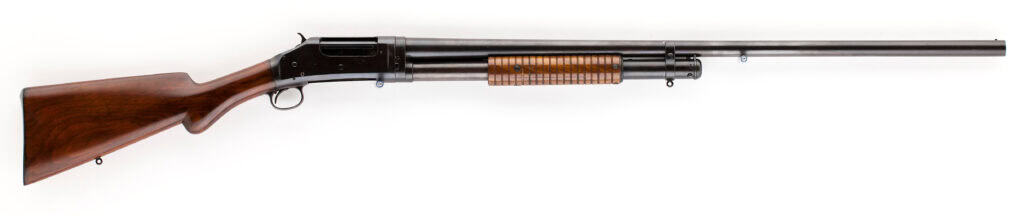
Winchester Model 1897 Origins: Browning’s Slide-Action Shotguns
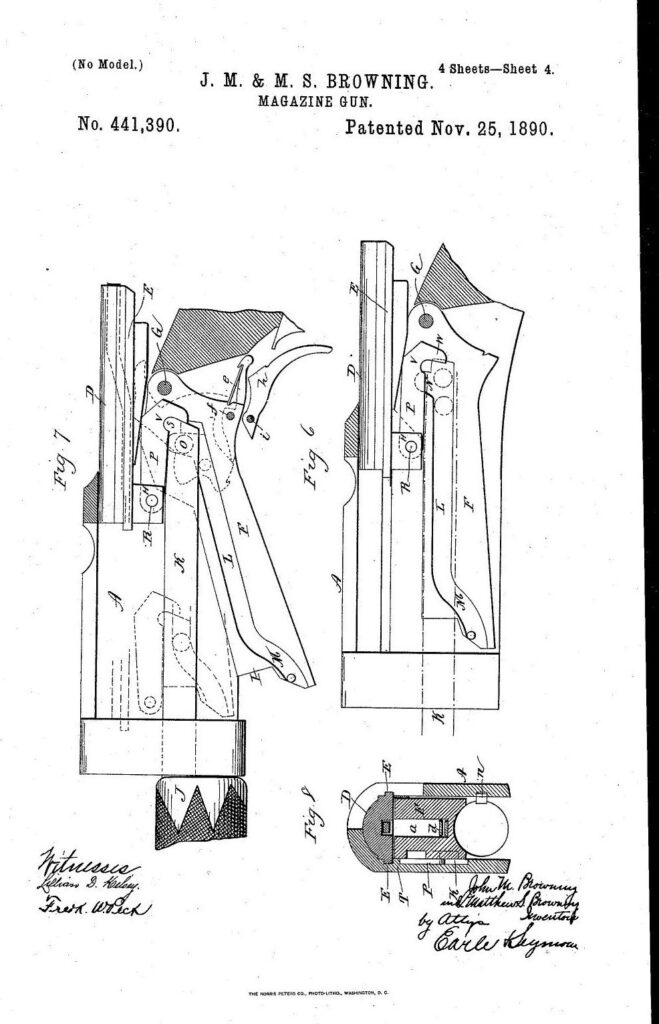
Browning’s first repeating shotgun for Winchester was a lever action, the Model 1887. His next was a slide action. On 25 November 1890, John M. and Matthew S. Browning of Ogden, Utah Territory, received US patent 441,390 for a “Magazine-Gun”, assigned to the Winchester Repeating Arms Company. The gun is worked “by means of a handle J arranged forward of the receiver and so as to slide longitudinally”. Winchester sold the design as the Model 1893.
Browning’s company history says the Model 1893 was built around the black powder shotshells of its day. As smokeless powder came in during the mid-1890s, the 1893’s open-top receiver proved not quite strong enough, and Browning revised it. The result was the Model 1897, with the same external hammer, tubular magazine and side ejection on a much stronger receiver (Browning, 2018).
American Rifleman’s account of the changes is more specific. Browning lengthened and strengthened the frame and put a bridge across its top. He changed the lockwork so the slide had to move slightly forward to unlock the bolt, which kept the action from opening as a shell fired. He added a cartridge guide to stop shells falling out of the magazine and lengthened the stock. The first year’s guns had solid frames, and a takedown version followed in 1898 (Dave Campbell, American Rifleman, 2020).
The Model 1897 came in 12 and 16 gauge. Campbell lists standard, Trap, Pigeon, Tournament, Brush, Riot and Trench grades, with barrels from 20 to 30 inches and longer ones to special order. The Riot and Trench guns had 20-inch barrels. Production ended in 1957. American Rifleman gives “more than a million” for the total. Browning’s own company gives more than 1.2 million in its BPS history, the figure our John Moses Browning biography uses.
How the Model 1897 Works
The Model 1897 is a slide action, often called a pump. The shooter works the action by moving the wooden forearm back and forward.
- Unlocking. After a shot, the slide first moves slightly forward to free the bolt, then back. Recoil usually does the first part on its own (Campbell).
- Cocking. In Browning’s patent, the breech-piece moving rearward “operates against the face of the hammer, forcing the hammer rearward into its cocked position”, where the sear holds it. The hammer can also be cocked or lowered by hand. On the Model 1897 the hammer stands exposed at the rear of the receiver.
- Feeding. A carrier hinged at its rear drops from the bottom of the receiver, takes a shell from the tube under the barrel and lifts it into line with the chamber (Campbell). The magazine holds five shells.
- Ejection. The empty hull leaves through a port on the right side of the receiver.
- Slam fire. The trigger has no disconnector. If the shooter holds the trigger back and works the slide, the gun fires as the bolt locks into battery. Bruce Canfield describes the Ordnance Department’s choice as a gun with six rounds in all, five in the magazine and one in the chamber, that “lacked a disconnector” and “could be fired by holding down the trigger while rapidly manipulating the slide” (Canfield, American Rifleman, May 2004, reprinted 2021).
Campbell notes that this feature has been dropped from modern shotguns.
From Riot Gun to Trench Gun
The Army bought shotguns before 1917, but only a few. Canfield writes that around 1900 the Army bought an estimated 200 Model 1897s for the fighting in the Philippines. In an earlier article he wrote “several hundred” (Canfield, American Rifleman, August 1999). Jonathon Krisko and Andrew Stolinski, working from Ordnance files, found that shotguns were then a regular issue item for only two purposes, guarding prisoners and hunting at remote posts (Krisko and Stolinski, American Rifleman, 2024).
The request that led to the trench gun came from France. According to the Chief of Ordnance, William Crozier, General Pershing cabled on 22 August 1917 recommending shotguns at “the rate of one gun for every fifty rifles for use in guarding prisoners.” By 24 November 1917 the AEF’s chief ordnance officer recorded that “Five thousand shotguns with bayonets have been ordered from the United States” (both quoted by Krisko and Stolinski).
The Ordnance Department chose a solid-frame Model 1897 with a 20-inch cylinder-bore barrel and asked for two additions (Canfield, 2004):
- A bayonet mount. A 12-gauge barrel is too wide to pass through a rifle bayonet’s ring. The bayonet clamps instead to an offset bracket at the muzzle. It takes the M1917 bayonet made for the M1917 Enfield rifle.
- A ventilated handguard. A perforated steel shield over the barrel lets the soldier grip the gun for bayonet work after the barrel has heated. Canfield writes that Springfield Armory worked with Winchester on the handguard and bayonet adapter.
Sling swivels completed the conversion. Some were hand-stamped “US” and the Ordnance flaming bomb on the right side of the receiver. Canfield later estimated that only about 20 percent of the wartime trench guns carry these markings. Canfield gives Ordnance records showing that Winchester delivered 19,196 Model 1897 trench guns during the war, and estimates that with commercial guns converted, as many as 25,000 were made. Remington supplied 3,500 trench guns built on its hammerless Model 10.
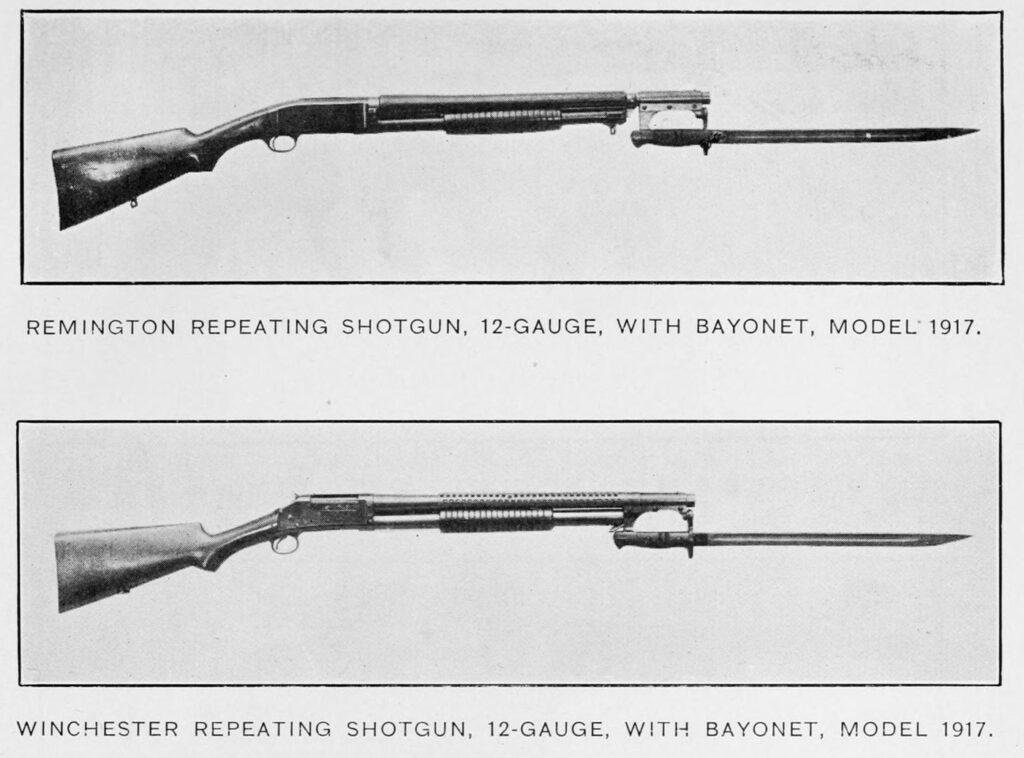
Benedict Crowell, the Assistant Secretary of War who ran munitions production, put the total higher and named the main purpose plainly. He wrote: “Manufactured primarily for the purpose of arming guards placed over German prisoners, these shotguns were undoubtedly in some instances carried into the actual fighting. The Ordnance Department procured some 30,000 to 40,000 shotguns of the short-barrel or sawed-off type” (Crowell, America’s Munitions 1917-1918, 1919). His figure covers all short-barreled shotguns, with and without bayonets.
In France, 1918
Most of the shotguns sent to France were meant for prisoner guards. In December 1917 Col. Fox Conner, the AEF’s operations chief, recommended keeping 1,000 of the 5,000 for trials “after organizations have been put into the line” and using the rest “in guarding prisoners” (Krisko and Stolinski). An Ordnance memo of 8 June 1918, quoted by Canfield, proposed issuing 50 guns to each of two divisions, with 100 rounds per gun, for a practical test.
The trials began in late June and July 1918. Krisko and Stolinski found that the 5th, 32nd, 35th and 82nd Divisions each received 50 guns and the 77th received 100 to 150. The reports varied:
- The 5th Division’s 11th Infantry scouts called the shotgun “Undoubtedly the weapon for short range patrol work.”
- The 82nd Division found it “valuable for patrol work.”
- The 35th and 77th found it useful in trench fighting but a burden in open warfare.
- The 32nd Division’s 127th Infantry wrote that the “men did not like them, preferring a rifle.” In the 128th, “all twelve men having these guns were killed or wounded.”
Paper-cased shells were the common complaint. Wet paper swelled and jammed the action. All-brass buckshot shells were ordered, but Krisko and Stolinski write that suitable ammunition was never fielded during the war.
On 15 September 1918 Brig. Gen. Fox Conner wrote that the Winchester shotguns “are to be adopted as a weapon for defensive trench warfare,” at about 100 per division. Two days later the AEF counted 9,675 shotguns with bayonet adapters: 717 with troops on the line, 6,708 in depots in France and 2,250 still in the United States. Conner added that “for the present, no further order for shot-guns need be placed” (Krisko and Stolinski).
Some of those guns saw hard use. Sgt. Lloyd M. Seibert of Company F, 364th Infantry, 91st Division, received the Medal of Honor for his actions at Epinonville on 26 September 1918. His citation says that with two other soldiers “he charged a machine-gun emplacement in advance of their company, he himself killing one of the enemy with a shotgun and capturing two others” (Congressional Medal of Honor Society).
The German Protest of September 1918
The German Government sent its protest through Switzerland, which represented German interests in the United States. The Swiss chargé d’affaires in Washington, Frederick Oederlin, passed it to Secretary of State Robert Lansing in a memorandum dated 19 September 1918. The cablegram passed to Lansing reads:
“The German Government protests against the use of shotguns by the American Army and calls attention to the fact that according to the law of war (Kriegsrecht) every prisoner found to have in his possession such guns or ammunition belonging thereto forfeits his life. This protest is based upon article 23(e) of the Hague convention respecting laws and customs of war on land. Reply by cable is required before October 1, 1918.” (Foreign Relations of the United States, 1918, Supplement 2, document 911)
Article 23(e) of the 1907 Hague Convention (IV) forbids belligerents “To employ arms, projectiles, or material calculated to cause unnecessary suffering” (Hague Convention IV, 1907, Avalon Project). It does not mention shotguns.
A semi-official Berlin telegram, reported from Amsterdam on 29 September, gave the German grounds. A repeating shotgun had been taken from prisoners captured in a patrol skirmish on 27 July. The prisoners, from the 307th Infantry of the 77th Division, said their patrol carried three such guns, each loaded with six cartridges “each cartridge containing nine shots of size 00.” A second shotgun was reported captured on 11 September from the “Third Infantry Regiment of the Fifth American Division,” as the telegram was printed; the 5th Division’s infantry regiments were the 6th, 11th, 60th and 61st (Daily Kennebec Journal, 30 September 1918, p. 1, continued on p. 4).
On 26 September Brig. Gen. Samuel T. Ansell, the Army’s acting Judge Advocate General, sent a memorandum concluding that the protest was “without legal merit” (Tom Laemlein, American Rifleman, 2018). Lansing’s reply is dated 28 September 1918:
“In reply to the German protest, the Government of the United States has to say that the provision of the Hague convention, cited in the protest, does not in its opinion forbid the use of this kind of weapon. Moreover, in view of the history of the shotgun as a weapon of warfare, and in view of the well-known effects of its present use, and in the light of a comparison of it with other weapons approved in warfare, the shotgun now in use by the American Army cannot be the subject of legitimate or reasonable protest.”
He went on: “inasmuch as the weapon is lawful and may be rightfully used, its use will not be abandoned by the American Army. Moreover, if the German Government should carry out its threat in a single instance it will be the right and duty of the Government of the United States to make such reprisals as will best protect the American forces, and notice is hereby given of the intention of the Government of the United States to make such reprisals.” (FRUS 1918, Supplement 2, document 912)
The reply was made public on 30 September and ran in American papers the next day (Norwich Bulletin, 1 October 1918, p. 1). Canfield found “no indication that the Germans ever executed any Doughboys for possessing a shotgun or shotgun shells.” The Armistice came on 11 November.
The first German protest, 1914
The 1918 note was not Germany’s first complaint about the Model 1897. On 5 December 1914, more than two years before the United States entered the war, Ambassador Johann von Bernstorff wrote to the State Department: “It has come to the knowledge of the German Government that the British Government has ordered from the Winchester Repeating Arms Company 20,000 ‘riot guns’, Model 1897, and, 50,000,000 ‘buckshot cartridges’ for the same. The buckshot cartridge contains nine shots. The use of this weapon and ammunition is as yet unknown to civilized warfare.” (FRUS 1914, Supplement, document 1283)
The Secretary of State answered on 6 January 1915 that Winchester “categorically denies that it has received an order for such guns and cartridges from, or made any sales of such material to the British Government, or to any other government engaged in the present war” (document 1285). Krisko and Stolinski read the early date as evidence that the 1918 protest owed as much to propaganda and legal argument as to battlefield results.
Winchester Model 1897 Trench Gun Myths and the Record
“Germany tried to ban the Winchester 1897.” The 1918 protest named shotguns in general. It named no make or model and asked for no treaty or ban. It demanded that the United States stop using them and threatened prisoners. The 1914 note is the one that named the Model 1897, about a British order Winchester said did not exist.
“The Americans answered with a list of German atrocities.” Lansing’s reply, as printed in Foreign Relations, makes no mention of gas, flamethrowers, serrated bayonets or shrapnel. It compares the shotgun only in general terms with “other weapons approved in warfare.” The comparisons with gas and flamethrowers come from later writers. Canfield, for one, calls it “perplexing” that the Germans, “who introduced and regularly used poison gas and flamethrowers,” objected to shotguns.
“Trench gun” as the official name. Crowell’s 1919 report captions the gun “Winchester repeating shotgun, 12-gauge, with bayonet, Model 1917,” and later writers call it the “Trench Gun, Model of 1917.” Krisko and Stolinski found no formal “United States Model of” designation in the wartime files. The usual term was “riot gun with bayonet adapter,” and “trench gun” appears only twice, in Infantry Board reports of 1921 and 1922.
“Trench broom” and “trench sweeper.” Browning’s company history says the gun was “Called a ‘Trench Broom’ by friend and foe alike,” and American Rifleman’s Rick Hacker wrote that it was “Nicknamed the ‘Trench Sweeper'” (American Rifleman, 2017). Neither cites a wartime source, and none of the records used here contains either name.
Shotguns everywhere in the trenches. In mid-September 1918 the AEF counted 717 shotguns with bayonet adapters in use on the line. Tom Laemlein, who has been through the Army Signal Corps photographs of the war, found no photograph of a Doughboy with a trench gun in combat. He suggests the AEF suppressed such photos, and says himself that the idea is unproven.
Shotguns at Seicheprey. American papers in April 1918 reported that Pershing’s men had used sawed-off shotguns to “mow down” German storm troops at Seicheprey. Krisko and Stolinski found no official record of shotgun use before the field trials began in late June, and call those stories likely fabrications or misunderstandings.
“Send us more shotguns.” A postwar line, quoted by Canfield, has GHQ cabling America “Give us more shotguns!” The September 1918 staff papers say the opposite. With 9,675 on hand, Conner wrote that no further order “need be placed.”
Crowell’s own slip. Crowell’s 1919 report says the State Department replied that shotguns were “not forbidden by the Geneva Convention as the Germans had asserted.” The German note cited the Hague convention. Crowell’s reference to Geneva is a slip.
After 1918: Police, World War II and Later
After the war the Army had more trench guns than it needed. Canfield writes that some went to the Marine Corps and the Navy and to agencies such as the Post Office, the Justice Department and the Border Patrol. In the early 1920s surplus trench guns went to police departments. Denver’s came by way of the Army a few years after the war, and Richmond, Virginia, received some from its National Guard armory when it closed in 1924 (Canfield, American Rifleman, 2024). Richmond traded 74 of its guns to SIGARMS in 2004, and collectors bought them within days.
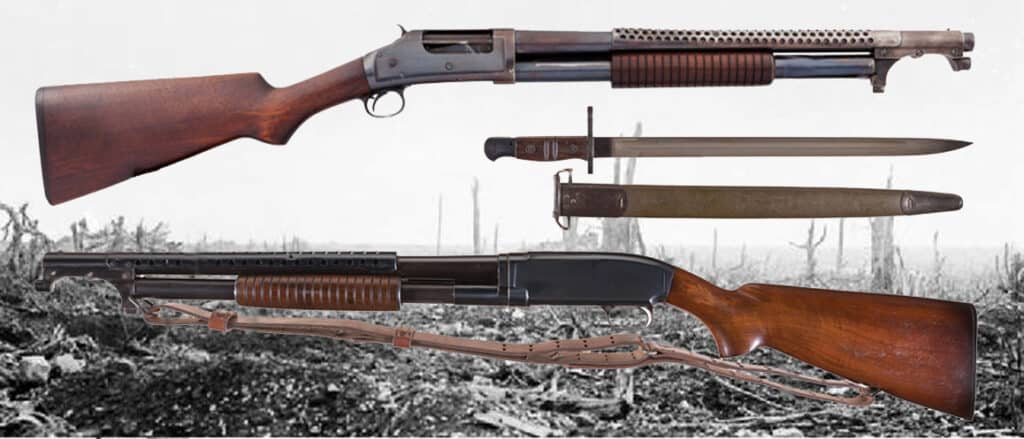
After Pearl Harbor the Army ordered new combat shotguns from Winchester, Ithaca, Savage, Stevens and Remington. Canfield writes that Winchester again made both Model 97 and Model 12 trench guns under contract, and that the World War II Model 97 was a takedown gun, where the World War I guns had solid frames. He found the shotguns saw “a surprising amount of use” in the Pacific, where a Marine division was authorized 306 combat shotguns, and that many saw use again in Vietnam (Canfield, 1999).
Winchester’s own successor was the hammerless Model 1912, later the Model 12, which the Army also bought in smaller numbers in 1917 and 1918 (Canfield, 1999). See our history of Winchester Repeating Arms. The Model 1897 stayed in the catalog beside it until 1957.
The Winchester Model 1897 Today
Original Model 1897s turn up at gun shows and auctions in every grade. World War I trench guns are scarce, and Canfield warns that any Parkerized World War I example has been refinished, since all the wartime guns left the factory blued. He also gives the serial blocks recorded for the wartime guns. The 74 Richmond guns, advertised in the fall of 2004 by the Ivanhoe Warehouse Outlet of Nutting Lake, Massachusetts, and known to collectors as the Ivanhoe guns, showed that genuine World War I contract trench guns, some completed in early 1919, run as high as the 705,000 range, above where some collectors had placed the end of wartime production.
New 1897-pattern shotguns are made for Cowboy Action Shooting and for shooters who would rather not fire an original. Any old Model 1897 should be checked by a competent gunsmith before it is fired, and the slam-fire feature means a shooter must keep a finger off the trigger while working the action.
Further Reading
The standard references on the gun and its military service:
-
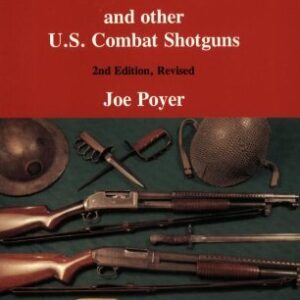
US Winchester Trench and Riot Guns and Other US Combat Shotguns
Purchase on Amazon -

Bruce N. Canfield's Complete Guide to United States Military Combat Shotguns
Purchase on Amazon -

U. S. Infantry Weapons of the First World War
Purchase on Amazon -

US Combat Shotguns (Weapon, 29)
Purchase on Amazon -

A comprehensive guide to the Winchester model 1897: Everything you ever wanted to know about the Winchester model 1897 shotgun
Purchase on Amazon -

Shotguns, All Types – TM 9-285 US Army Technical Manual (1942 World War II Civilian Reference Edition): Unabridged Field Manual On Vintage and Classic … the Wartime Era (Military Outdoors Skills)
Purchase on Amazon -

The History of Winchester Firearms 1866-1992
Purchase on Amazon -

The Winchester Book
Purchase on Amazon
- US Winchester Trench and Riot Guns and Other US Combat Shotguns by Joe Poyer. A collector’s guide to the Winchester trench and riot guns and other U.S. combat shotguns.
- Bruce N. Canfield’s Complete Guide to United States Military Combat Shotguns. A reference on U.S. military shotguns from the 1890s on.
- U.S. Infantry Weapons of the First World War by Bruce N. Canfield. The rifles, pistols, shotguns and machine guns of the AEF, including the trench gun.
- US Combat Shotguns by Leroy Thompson. A short illustrated history in Osprey’s Weapon series.
- A Comprehensive Guide to the Winchester Model 1897 by William A. Longiotti. A collector’s guide to the Model 1897.
- Shotguns, All Types: TM 9-285. A reprint of the War Department’s 1942 technical manual.
- The History of Winchester Firearms 1866-1992, edited by Thomas Henshaw. Winchester’s history, model by model.
- The Winchester Book by George Madis. A standard collectors’ reference on Winchester production.
Sources
- Foreign Relations of the United States, 1918, Supplement 2: the German protest (doc. 911) and Lansing’s reply (doc. 912).
- Foreign Relations of the United States, 1914, Supplement: Bernstorff’s note (doc. 1283) and the reply (doc. 1285).
- Hague Convention (IV) of 1907, Article 23, Avalon Project, Yale Law School.
- US patent 441,390, J. M. and M. S. Browning, 25 November 1890.
- Benedict Crowell, America’s Munitions 1917-1918 (Government Printing Office, 1919).
- Daily Kennebec Journal, 30 September 1918, p. 1 and p. 4; Norwich Bulletin, 1 October 1918, p. 1. Library of Congress, Chronicling America.
- Medal of Honor citation, Sgt. Lloyd M. Seibert.
- American Rifleman: Bruce N. Canfield, “The ‘Trench Gun’ in World War I” (May 2004), “Winchester Goes to War” (August 1999) and “A Genuine Time Capsule” (2024); Jonathon Krisko and Andrew Stolinski, “The Truth About ‘Trench Guns'” (2024); Tom Laemlein, “The Trouble With Trench Guns” (2018); Dave Campbell, “The Winchester Model 1897: A Look Back” (2020); “I Have This Old Gun: Winchester Model 1897 Trench Gun” (2017).
- Browning, “John M. Browning’s Greatest Hits, Episode 5” (2018) and the BPS at 40.
If you know of any forums or sites that should be referenced on this listing, please let us know here.