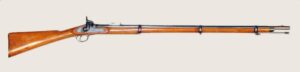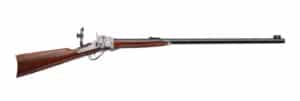
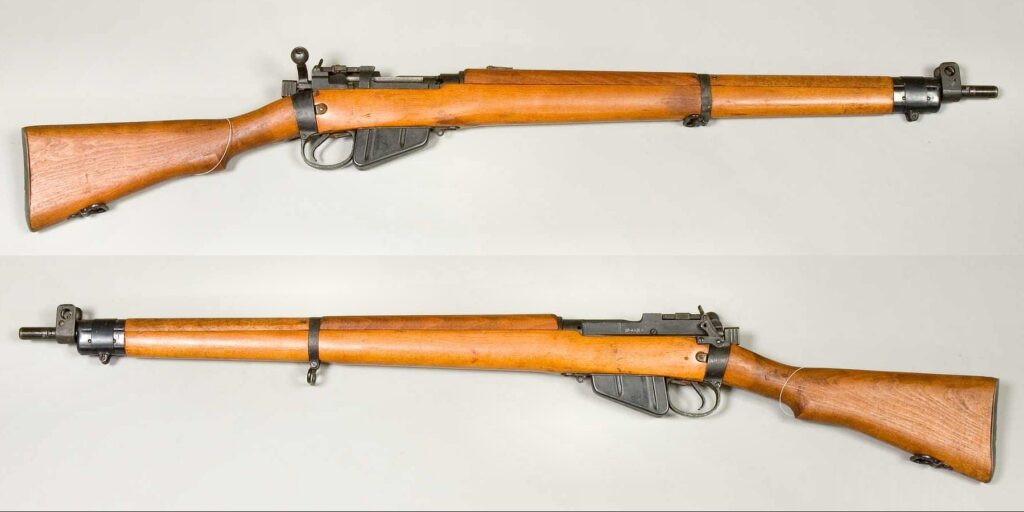
The Lee-Enfield was the bolt-action service rifle of the British Army, and of much of the Empire and Commonwealth, through both world wars. Its name joins two contributions. James Paris Lee designed the bolt and the box magazine. The Royal Small Arms Factory at Enfield designed the rifling that replaced William Metford’s in 1895. The best-known versions are the Short Magazine Lee-Enfield (SMLE) of the First World War and the Rifle No. 4 of the Second. The last British service rifle on Lee’s action, the L42A1 sniper rifle, was not declared obsolete until April 1992.
Several popular stories about the rifle do not match the record:
- The best-known source of the line that German troops at Mons thought they faced machine guns is the British official history of 1914. The same page records British machine guns firing at that bridge.
- The 1914 musketry course did not print a “mad minute” of 15 aimed rounds. Its timed rapid practice for trained infantry was 10 rounds in one minute at 300 yards, starting from an empty rifle.
- No period record has been found for the famous 38 hits in a minute credited to Sergeant Instructor Alfred Snoxall.
- In 1929 the Army’s own textbook said of the rear-locking action that, “mechanically, its design is unsound.” The same paragraph claimed that no other action could match its rate of fire.
The details are in the “Lee-Enfield legend and record” section below.
James Paris Lee and the Detachable Box Magazine
James Paris Lee was born in Hawick, Scotland, on 9 August 1831. His family emigrated to Ontario when he was four or five, and he grew up in Galt, now part of Cambridge, according to the Forgotten Weapons biography of Lee. He moved to the United States and spent many years working with Remington at Ilion, New York. Lee agreed with the Sharps Rifle Company to make his Magazine Rifle, Model 1879, but Sharps failed in October 1880, and Remington made his rifles in the United States after that. A later and different Lee design, the straight-pull Winchester-Lee Model 1895, served the U.S. Navy.
On 4 November 1879 Lee received US patent 221,328, “Improvement in Magazine Fire-Arms,” filed on 6 September 1878 by “James Lee, of Ilion.” The patent covers a bolt gun that “can be used in the ordinary manner as a single-loader, and can have a detachable magazine applied to it.” The magazine is a box that clips under the action in front of the trigger guard, with the cartridges laid “sidewise, one upon another” and pushed up by a spring in the bottom. The patent explains how to remove it: “To detach it, it is only necessary to draw back the catch E and pull out the box.”
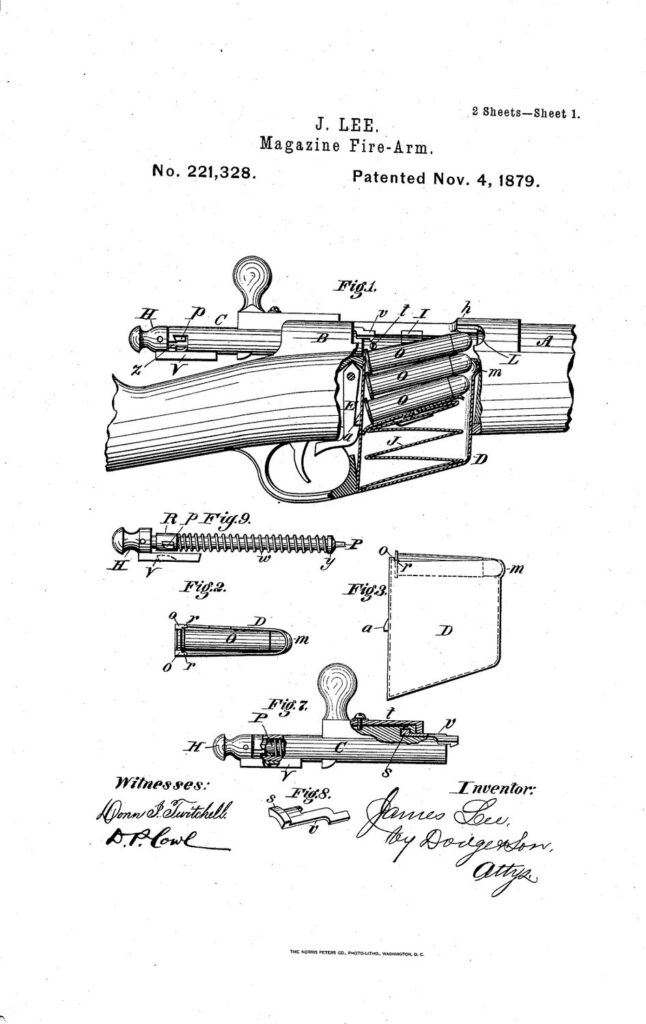
The Lee-Metford, 1888
In the 1880s the British Army wanted a magazine rifle to replace the single-shot Martini-Henry. The War Office’s Textbook of Small Arms (1929) records that the committee studying the question decided in 1887 that “the best of the systems before them was Lee’s magazine combined with his bolt action.” In January 1888 the committee recommended “a magazine rifle of ·303 calibre having the Lee breech action and Metford’s shallow segmental rifling.” American Rifleman gives December 1888 as the date of adoption.
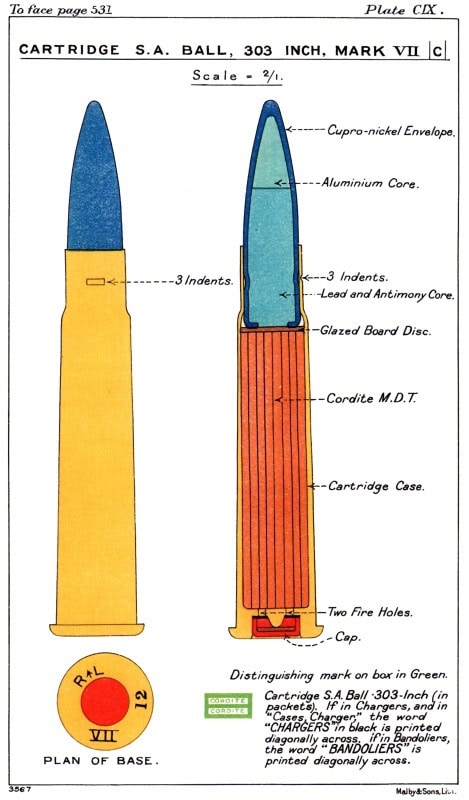
The first .303 service cartridge was loaded with black powder. The textbook gives the charge as 70 grains of black powder pressed into a pellet, driving a 215-grain bullet at 1,850 feet a second, because smokeless powder was “under experiment, but not yet available for adoption.” Those are the 1888 service specifications, quoted as history. They are not handloading data.
The magazine of the Lee-Metford Mark I held eight cartridges. The Mark II held ten, in two columns. The Historical Breechloading Smallarms Association gives Lee-Metford production as 280,770 rifles.
The new rifle had critics in Parliament. On 3 February 1891 Edward Marjoribanks, member for Berwickshire, moved for a Royal Commission on it. He told the Commons, “I am informed that something like 50 per cent. of these rifles have been returned to the armoury for repair,” referring to the 15,000 issued in 1890. Holding up a bolt, he called it “a fraud, a snare, and a delusion” (Hansard, HC Deb 3 February 1891).
Lee-Enfield History: From Metford to Enfield Rifling, 1895
Cordite, a smokeless propellant, came into service in 1892 and raised the velocity to 2,000 feet a second, according to the 1929 textbook. Metford’s shallow, rounded grooves had been designed to cope with black-powder fouling. Cordite left almost none, and it wore those grooves away. In 1895 the Army changed to square-edged grooves, with the lands as wide as the grooves and the depth increased from ·0045 to ·0065 inch. The textbook states, “The modified pattern was known as Lee-Enfield Mark I.” The bolt and magazine stayed as they were. A Lee-Metford carbine had come in 1894, and a Lee-Enfield carbine followed in 1896. More on propellants is in our piece on why there are different kinds of gunpowder.
How the Lee Action Works
The 1929 textbook describes the SMLE’s action in detail. In plain terms:
- Locking at the rear. The bolt has a solid rib on its right side and a lug on its left, both at the rear. When the bolt is turned down, they bear against shoulders at the back of the action body. Their faces are cut on a slope, which gives leverage to push the cartridge home and, when the bolt is lifted, to start the fired case out of the chamber.
- A bolt head that does not turn. The bolt head screws into the front of the bolt. A hook on its right side engages a rib on the action body, which keeps it from turning as it slides. It carries the extractor.
- Cocking. Lifting the bolt handle pushes the cocking-piece back and partly compresses the mainspring, which also pulls the firing-pin point back from the bolt face. The final compression happens as the bolt is turned down into the locked position. This is why the Lee is called a “cock-on-closing” action, although part of the work is done on opening.
- The magazine. It is a detachable sheet-steel box holding ten cartridges in two columns, pushed up by a zig-zag spring. The platform is higher on the left. The bolt takes a round from the left column first and then from each column in turn.
- Charger loading. Rounds came in chargers of five. The soldier set a charger in the guide above the action and swept the cartridges down into the magazine with his thumb.
- The cut-off. On the long rifles and the SMLE up to the Mark III, a plate pivoted on the right side of the action could hold the cartridges down in the magazine and act as a platform for loading one round at a time. The Mark III* has none.
The same textbook gives the case for and against. It called the rear lugs “not a desirable arrangement,” because firing puts the body into tension and the bolt into compression, causing sideways vibration that had to be corrected by offsetting the foresight. It concluded that, “mechanically, its design is unsound.” In the same paragraph it listed the advantages: there is no deep space in front of the action “in which dirt can accumulate,” and the bolt handle’s shape and position “allow of extremely rapid fire.” For comparison with front-locking designs, see our articles on the Mauser 98 and the M1903 Springfield.
The Boer War and the Short Rifle, 1902 to 1907
The 1929 textbook names two lessons from the South African War. The Army wanted a shorter rifle “suitable alike for infantry and for mounted troops.” It also found that its way of using the magazine was wrong. Soldiers had loaded single rounds from the pouch and kept the magazine shut off in reserve. Against enemies who fired from the magazine and refilled it five rounds at a time from a charger, that “gave little advantage over the breech-loader without the magazine.”
A committee appointed in January 1900 produced the “rifle, short, magazine, Lee-Enfield, Mark I,” approved on 23 December 1902. It was five inches shorter than the Lee-Enfield, stocked to the muzzle, with better sights, charger guides and a ten-round magazine filled from five-round chargers. The cut-off stayed, but fire was normally through the magazine. Kirk Brumbaugh’s study for the American Society of Arms Collectors says it was first issued in 1903 and re-sealed with minor changes on 1 January 1904.
The short rifle also had critics. Marjoribanks was still a critic thirteen years later. He had become Lord Tweedmouth in 1894, and in the House of Lords on 13 May 1904 he called the new rifle “a good one” but not “the best,” and objected that “a rifle will always out-range a carbine, and it is now proposed to arm all services with a carbine” (Hansard, HL Deb 13 May 1904). In July 1905 a member asked whether the rifle had been abandoned because its magazine jammed, its balance was bad and its metal was too soft. The Secretary of State for War replied that it had not been abandoned, that “a small defect in the magazine spring” had been corrected, and that the other two defects had not been found (Hansard, HC Deb 20 July 1905).
The SMLE Mark III followed in January 1907, with the charger guide on a bridge across the action, a blade foresight and a U-notch backsight. It took the Pattern 1907 sword bayonet. Its popular name was the “Smellie.”
Before 1914 Britain was preparing to replace it. A rifle with a front-locking, Mauser-pattern action in a new .276 cartridge was on trial in 1913 and 1914. When war came, the design was built in .303 as the Pattern 1914, which the 1929 textbook says was “admirable for sniping” but not generally issued to troops fighting abroad. Its American version is covered in our article on the M1917 Enfield.
The SMLE Mark III and Mark III* in the First World War
At Mons on 23 August 1914, the British Expeditionary Force held the line of the canal with the SMLE. Each infantry battalion also had two machine guns. The British official history, J. E. Edmonds’s Military Operations, France and Belgium, 1914, Volume I (1922), describes the attack on the bridge at St. Ghislain. It “was stopped while still three hundred yards distant from the Canal by the accurate fire of the West Kents and the machine guns of the Yorkshire Light Infantry,” with half a company of the Scottish Borderers. Edmonds quotes Walter Bloem, a company commander in the Brandenburg Grenadiers, on that day: “Our first battle is a heavy, unheard of heavy, defeat, and against the English, the English we laughed at.”
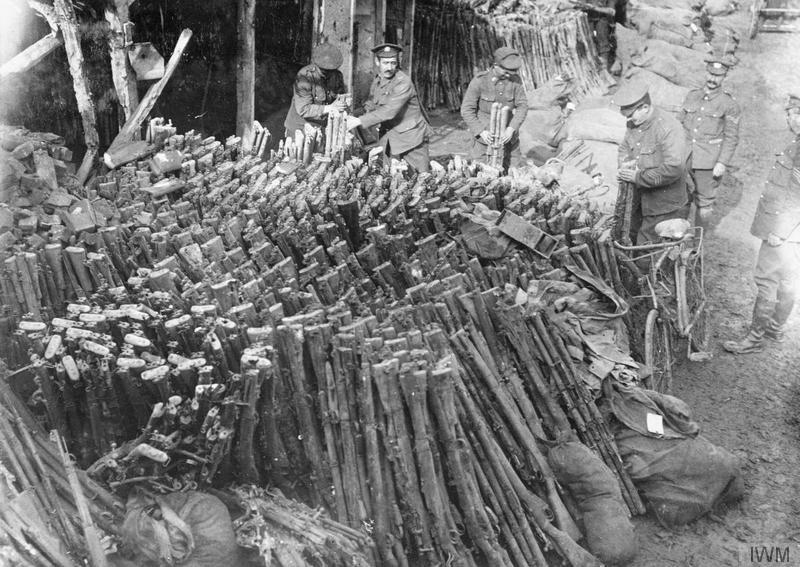
The war needed more rifles than the factories could finish with all the Mark III’s features. The Historical Breechloading Smallarms Association’s SMLE Mk III* record gives 2 January 1916 as the approval date of the simplified Mark III*. It dropped the long-range dial and aperture sights, the windage adjustment on the backsight and the magazine cut-off, among other details. The 1929 textbook’s table lists the Mark III* as approved in 1918, and Brumbaugh says the simplifications “were permitted effective January 1916.” The HBSA gives approximate production of the Mark III and III* as 2,235,000 at Enfield, 2,000,000 at BSA, 430,000 at the London Small Arms Company, 640,580 at Lithgow in Australia and 1,400,000 at Ishapore in India. Australian and Indian factories kept making the Mark III* through the Second World War. Enfield’s history is in our article on the Royal Small Arms Factory.
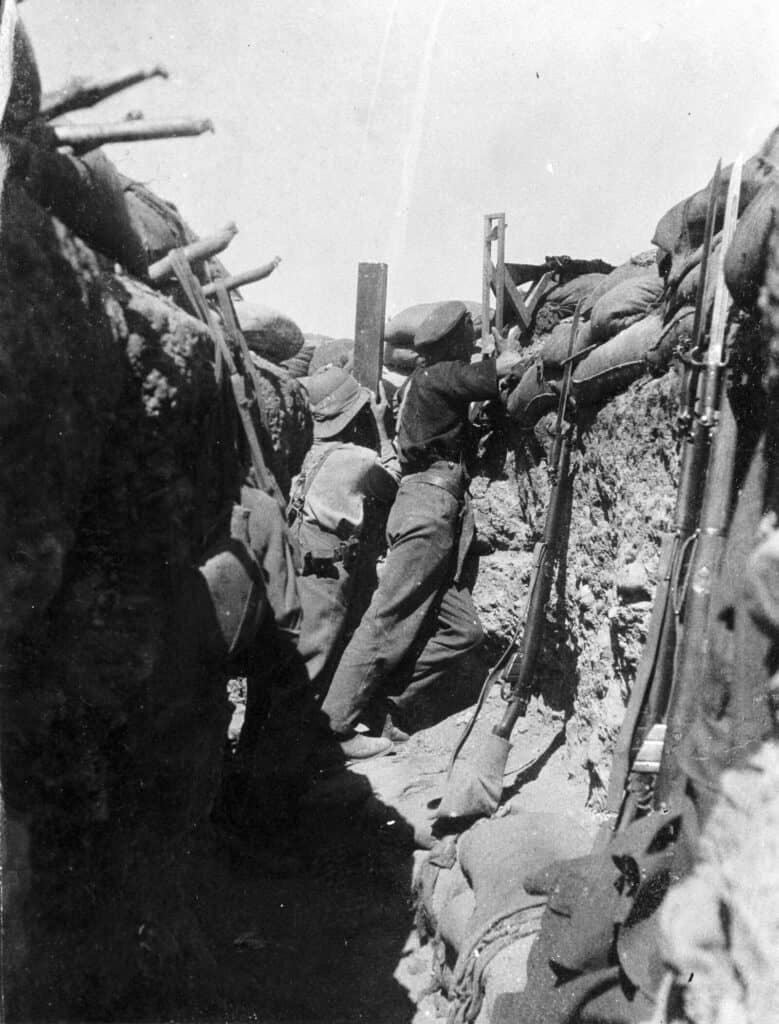
Sniping was improvised. Brumbaugh counts 21 different SMLE sniper conversions and says they were not a success because the telescopes were mounted offset to the left. By late 1916, he writes, the Army’s sniper school trained only with Winchester-made Pattern 14s fitted with a special peep sight.
Between the Wars: Rifle No. 1 and the No. 4
In 1926 the Army changed its names for small arms, and the SMLE Mark III and III* became the Rifle No. 1 Mark III and III*. Work on a successor had already started. The 1929 textbook describes a “recently approved” Mark VI with a stronger barrel and body, a projecting muzzle, an aperture sight and a short, cruciform bayonet “designed only for thrusting.”
Mark A. Keefe IV’s American Rifleman history of the No. 4 explains the slow progress. In the 1920s and early 1930s the Army’s first priority was a light machine gun, which arrived as the Bren in 1935. The No. 4 Mk I was officially adopted on 15 November 1939. American Rifleman’s 2010 article on the No. 4 lists the main changes: a heavier barrel that floats free and stands out from the fore-end, and aperture backsights. Keefe adds that a simple spike bayonet replaced the 17-inch Pattern 1907 sword bayonet.
The No. 4 in the Second World War
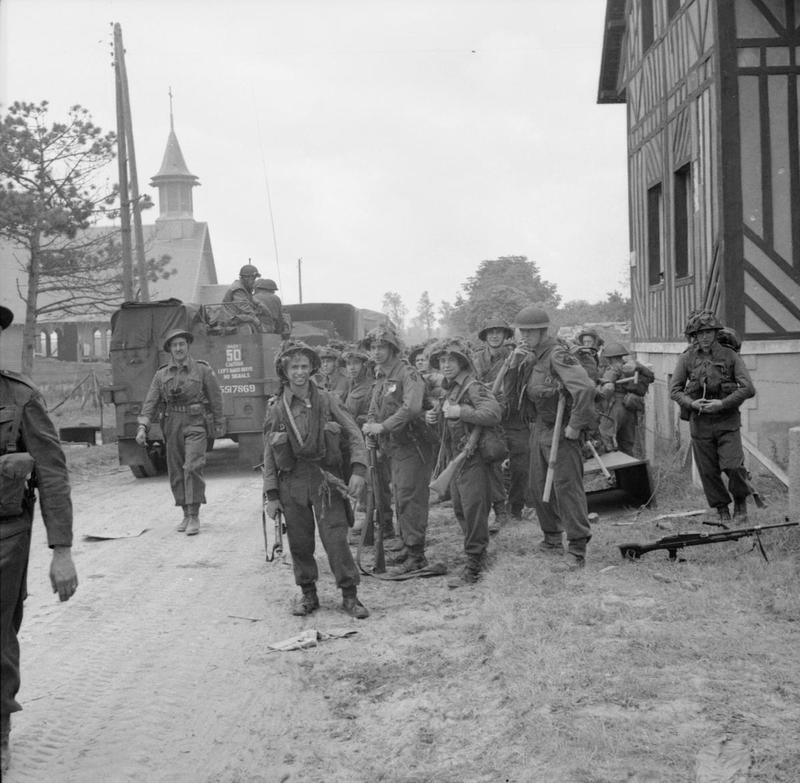
Two new government factories, Royal Ordnance Factory Fazakerley in Lancashire and ROF Maltby in Yorkshire, and BSA’s new Shirley plant in Birmingham all began producing the No. 4 in 1941, according to American Rifleman. The Royal Small Arms Factory at Enfield made none of the more than 2 million No. 4 Mk Is produced in England during the war. It concentrated on the Bren gun.
Britain also bought in North America. In early 1941, with the United States still neutral, the British Government contracted with Savage Arms to build 200,000 No. 4s at the former Stevens factory in Chicopee Falls, Massachusetts. After the United States entered the war, Savage continued under Lend-Lease, and those rifles were marked “U.S. Property.” Keefe gives Savage’s total as 1,236,706 rifles, with a “C” in the serial number. Small Arms Ltd. at Long Branch, near Toronto, marked its rifles “Long Branch” and used an “L” in the serial number. The simplified No. 4 Mk I*, built in North America from 1941, was not formally adopted until 1946.
Keefe writes that the British began the Second World War without a proper sniping rifle, apart from Pattern 14 (T) rifles left from the First. The answer was the No. 4 Mk I (T). According to Keefe, rifles from production were selected if they could place seven shots out of seven in a 5-inch circle at 200 yards. They were then fitted with pads for the mount of the No. 32 telescope, a sight first designed for the Bren gun.
The Last of the Line: the L42A1
When Britain adopted the L1A1 self-loading rifle in 7.62 mm NATO, the .303 No. 4 (T) stayed in service as the sniper rifle. American Rifleman’s history of the L42A1 says the SLR “was to prove an excellent battle implement,” but its accuracy “fell a long way short of that necessary for a sniper rifle.” The answer was to rebarrel No. 4 (T) rifles for 7.62 mm NATO. The result, the L42A1, went into production in 1970. The Australian War Memorial’s record of an L42A1 says these rifles served the British Army from the early 1970s until the late 1980s, when the L96 replaced them, including in Northern Ireland and the Falklands War of 1982. The L42A1 was declared obsolete in April 1992.
Lee-Enfield Legend and Record
“The Germans thought they faced machine guns.” The best-known source is the British official history. On page 71 of its first volume, Edmonds wrote of the canal fighting that “the Germans imagined that they were everywhere opposed by machine guns only, not realizing the intensity of British rapid fire.” The sentence closes a paragraph that also credits the Yorkshire Light Infantry’s machine guns at the same bridge. It is the British historian’s own statement. His footnote to it describes Walter Bloem’s account of his regiment’s losses, and the passage he quotes from Bloem does not mention machine guns.
“The mad minute was 15 aimed rounds.” The Musketry Regulations, Part I, 1909, reprinted with amendments in 1914 were the edition in force in 1914. In Table B, the annual course for trained cavalry, Royal Engineers and infantry, Practice 11 on page 259 is a rapid practice of 10 rounds at 300 yards: “Rifle unloaded and magazine empty until the target appears. Loading from the pouch or bandolier by 5 rounds afterwards. One minute allowed.” The regulations also warn that “it is not desirable to make a great sacrifice of accuracy to produce even the regulation rate,” and that “there is no obligation to fire all the rounds allotted in any rapid practice.” Later writers, including Brumbaugh, give 15 aimed rounds a minute. Other editions of the regulations may have used different figures. The 1914 reprint shows 10.
“Snoxall fired 38 hits in a minute.” The record is usually given as 38 hits on a 12-inch target at 300 yards by Sergeant Instructor Alfred Snoxall in 1914. No regulation, range return or period report of it has been found. Accounts disagree about whether the hits were on a 12-inch bull or on a much larger target.
“The fastest bolt action ever fielded.” That claim comes from the War Office’s own 1929 textbook. The 1929 textbook says roughly directed fire at 60 rounds a minute was “often attained and sometimes passed” in routine tests at the Small Arms Ammunition Inspection Department, and that “with no other action is it possible to attain anything like this rate of fire.” The figure is for roughly directed fire in range tests. The textbook gives no rate for aimed fire in the field.
“The rear lugs made it weak and inaccurate.” The 1929 textbook did call the arrangement mechanically unsound. It also said that with good ammunition and careful adjustment the British rifle’s accuracy “compares favourably with that of any Continental Service weapon.” It also credited the committee that chose Lee’s system, writing that “the Lee action and magazine, with modifications only of detail from their early form,” had “proved themselves thoroughly efficient and reliable in the Great War,” some thirty years after the first trials of 1888.
“Lee invented the detachable box magazine, and soldiers swapped magazines.” Lee’s 1879 patent does claim a detachable magazine. In British service, from the SMLE of 1902, rifles were loaded from the top with five-round chargers. The earlier long rifles were loaded a round at a time. The 1929 textbook mentions taking the magazine off only for examination and cleaning.
“The rifle that won two world wars.” In both wars the Lee-Enfield was the standard British and Commonwealth infantry rifle, but infantry fought alongside artillery and machine guns. At Mons in 1914 each British battalion already had two machine guns, and in the Second World War the Bren light machine gun fought beside the No. 4.
Owning and Shooting a Lee-Enfield Today
Military Lee-Enfields are sold used, one rifle at a time, and listings change daily. Guns.com’s current Lee-Enfield listings include No. 4 Mk I and SMLE Mk III rifles as well as sporterized rifles. Any rifle this old should be checked by a gunsmith, including its headspace, before it is fired.
New .303 British ammunition is still made. Guns.com carries PPU .303 British 174-grain FMJ for practice and Sellier & Bellot .303 British 150-grain soft point for hunting.
Further Reading
These are the standard collector references on the Lee-Metford and Lee-Enfield. Several are out of print, and Amazon sellers often have only a few copies.
-

The Lee-Enfield: A Century of Lee-Metford and Lee-Enfield Rifles and Carbines
Purchase on Amazon -

Lee-Enfield Story: A Complete Study of the Lee-Metford, Lee-Enfield, S.M.L.E. and No.4 Series
Purchase on Amazon -

British Enfield Rifles, Vol. 1, SMLE (No.1) Mk I and Mk III (Internet Workshop Series)
Purchase on Amazon -
Sale!

British Enfield Rifles, Lee-Enfield No. 4 and No. 5 Rifles, Vol. 2 (For Collectors Only)
Purchase on Amazon -

The Lee-Enfield Rifle (Weapon, 17)
Purchase on Amazon -

British Sniper: British and Commonwealth Sniping and Equipment
Purchase on Amazon -

The Advance from Mons 1914
Purchase on Amazon
- The Lee-Enfield: A Century of Lee-Metford and Lee-Enfield Rifles and Carbines by Ian D. Skennerton. The main reference on every mark.
- Lee-Enfield Story by Ian D. Skennerton. Skennerton’s illustrated study of the Lee-Metford, Lee-Enfield, SMLE and No. 4.
- British Enfield Rifles, Vol. 1: SMLE (No. 1) Mk I and Mk III by Charles R. Stratton. A collector’s guide to the SMLE’s markings and variations.
- British Enfield Rifles, Vol. 2: Lee-Enfield No. 4 and No. 5 Rifles by Charles R. Stratton. The same for the Second World War rifles.
- The Lee-Enfield Rifle by Martin Pegler. A short illustrated history in Osprey’s Weapon series.
- British Sniper by Ian D. Skennerton. British and Commonwealth sniping and its equipment, including the No. 4 (T).
- The Advance from Mons 1914 by Walter Bloem. The German company commander quoted in the official history, in G. C. Wynne’s translation.
Sources
- James Lee, US patent 221,328, Improvement in Magazine Fire-Arms, 4 November 1879.
- War Office, Textbook of Small Arms, 1929 (London: HMSO), chapter I, sections 1 to 3.
- War Office, Musketry Regulations, Part I, 1909, reprinted with amendments 1914, paragraph 397 and Appendix I, Table B.
- J. E. Edmonds, Military Operations, France and Belgium, 1914, Volume I (London: Macmillan, 1922), pages 71 to 72.
- Hansard: HC Deb 3 February 1891, Magazine Rifle; HL Deb 13 May 1904, The New Service Rifle; HC Deb 20 July 1905, Defects of the New Short Rifle.
- Kirk E. Brumbaugh, “The Early Short, Magazine Lee-Enfield Rifle as Issued, 1902-1932”, American Society of Arms Collectors Bulletin 114.
- Historical Breechloading Smallarms Association: Lee-Metford 1888 and SMLE Mk III*.
- American Rifleman: Mark A. Keefe IV, “Archives: Britain’s ‘New’ Rifle” (first published 1995, reposted 2019); “Lee-Enfield No. 4 Rifle” (2010); “The L42A1: A Sniper Rifle To Remember”.
- Australian War Memorial, Lee-Enfield L42A1 Sniper Rifle, REL/16987.001.
- Forgotten Weapons, James Paris Lee.
If you know of any forums or sites that should be referenced on this listing, please let us know here.
If you know of any forums or sites that should be referenced on this listing, please let us know here.