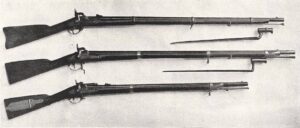
I was in a gunshop recently and spotted a rifle-musket in a display case right at the front of the store. The owner encouraged me take it out and look it over. It is a Lamson, Goodnow & Yale Special Model 1861, lock dated 1864, .58 caliber, 40-inch barrel. About nine and a half pounds. One of 50,000 produced by a firm in Windsor, Vermont, that most people have never heard of -- but should have.

The Factory on Mill Brook: Robbins & Lawrence and the Birth of Precision Manufacturing
The LG&Y story starts with the building. The three-and-a-half-story brick armory on Mill Brook in Windsor, Vermont, was built in 1846 by Samuel Robbins, Nicanor Kendall, and Richard Lawrence after they won a government contract for 10,000 Model 1841 "Mississippi" rifles.
What Robbins & Lawrence did there went past filling a rifle contract. They developed specialized machine tools, precision gauges, jigs, and fixtures that let them produce firearms with truly interchangeable parts -- any component from one rifle fit any other rifle of the same model without hand fitting. That system -- later called the "American System of Manufacturing" -- spread to sewing machines, clocks, and eventually automobiles.
In 1851, Robbins & Lawrence exhibited six Model 1841 rifles at the Crystal Palace Exhibition in London. Visitors could disassemble them, mix the parts, and reassemble them into working rifles. The British government took notice and in 1854 contracted with Robbins & Lawrence for 150 machine tools to equip the Royal Small Arms Factory at Enfield Lock -- the same factory that produced the Pattern 1853 Enfield rifle-musket. That Enfield connection comes back later.
Robbins & Lawrence also took a subcontract for about 25,000 Pattern 1853 Enfields for the British during the Crimean War. They overextended, delivered only about 10,400, and declared bankruptcy in October 1856.
The assets went to auction. Gun manufacturers came to Windsor and bought machinery, tooling, and fabricated parts for pennies on the dollar. Among the buyers: Samuel Colt, and two men named Ebenezer G. Lamson and Abel F. Goodnow.
Lamson, Goodnow & Yale: The Men and the Company
Ebenezer Lamson had manufacturing experience. In his early twenties he co-founded a cutlery business with family in Shelburne Falls, Massachusetts -- the Lamson & Goodnow Company, which produced knives and cutlery and survived well into the modern era. He was also a committed abolitionist.
In 1858, Lamson joined with Abel Goodnow and B. Buchanan Yale to buy the bankrupt Robbins & Lawrence armory in Windsor. The new firm inherited the building, the machinery, the tooling, and the institutional knowledge -- including all the Enfield-pattern equipment and expertise.
When Confederate guns opened fire on Fort Sumter on April 12, 1861, Ebenezer Lamson moved fast. He traveled to Washington and secured government contracts for rifle-muskets. The firm received two contracts for 25,000 rifle-muskets each, dated July 11 and October 7, 1861 -- 50,000 arms total.
LG&Y started with about 100 workers and subcontracted for barrels and stocks early on. At peak production they had roughly 400 workers. They also built the machine tools that other Northern arms factories needed -- supplying production equipment to Colt, Remington, Sharps, the Providence Tool Company, and others. LG&Y armed the Union twice: once with their own rifles and once with the machines that built everyone else's.
Deliveries began in September 1862 and continued through December 1864. At peak output, the factory was producing nearly 2,000 rifles per month -- roughly 300 to 1,000 per week depending on the period. All 50,000 were delivered on schedule.
What Makes a "Special" Model 1861
The standard U.S. Model 1861 was the workhorse infantry arm of the Civil War. Made primarily at Springfield Armory, .58 caliber, percussion cap, 40-inch barrel. The Union produced about 700,000 across all manufacturers. It was reliable, accurate enough for the tactics of the day, and straightforward to manufacture.
The "Special Model 1861" is a different animal. From across the room it looks like a Springfield. Up close, it is a hybrid -- outwardly Springfield, internally more Enfield.
It starts with Samuel Colt. When Robbins & Lawrence went bankrupt, Colt bought a load of their Enfield-pattern machinery at auction. In June 1861, Colt's superintendent Elisha K. Root went to Erskine S. Allin, the Master Armorer at Springfield, with a proposal: instead of retooling to make exact Springfield copies, Colt would build a rifle-musket that met Springfield's external specs but used Enfield-derived internals and manufacturing methods. The existing tooling made this far more efficient.
Allin agreed, and the "Special Model 1861" was born. The key differences from the standard Springfield Model 1861 include:
The hammer. The Special Model uses a recurved, beveled "S"-shaped hammer instead of the standard Springfield hammer. This design was later adopted for the U.S. Model 1863 rifle-musket.
The barrel bands. Standard Springfield Model 1861 rifles use solid barrel bands held in place by flat band springs. The Special Model uses split (clamping) barrel bands secured by screws -- an Enfield-derived feature. This is one of the quickest ways to identify a Special Model at a glance.
The bolster and clean-out screw. The standard Springfield uses a bolster with a 90-degree gas channel that requires a clean-out screw for maintenance. Root's design eliminated the clean-out screw entirely by implementing a more direct breech vent. The bolster itself sits higher on the breech than a standard Springfield.
The lock internals. Behind the lock plate, the Special Model runs Enfield-pattern lockwork. The lock plate itself is thinner than the Springfield version.
The rear sight. Root redesigned the rear sight with higher base walls to protect the 100-yard and 300-yard sight blades when folded flat. He recessed the tension screw head to prevent damage, squared off the tops of the sight leaves, and deepened the notches for easier adjustment and a clearer sight picture. These improvements impressed Allin enough that the Root-designed rear sight was adopted across all Model 1861 production at Springfield starting in July 1861.
Several of these features were good enough that Springfield Armory adopted them into the Model 1863 when they redesigned the standard infantry arm.
The Three Special Model Contractors
Only three contractors produced the Special Model 1861: Colt's Patent Fire Arms Manufacturing Company of Hartford, Connecticut; Lamson, Goodnow & Yale of Windsor, Vermont; and the Amoskeag Manufacturing Company of Manchester, New Hampshire. Between them, they delivered over 177,000 Special Model rifle-muskets to the U.S. Ordnance Department:
Colt produced approximately 100,005 between 1862 and 1864. LG&Y produced approximately 50,000 during the same period. Amoskeag produced approximately 27,001 between 1863 and 1865.
The connection between these three makers runs through the Robbins & Lawrence bankruptcy. All three had access to Enfield-pattern tooling and machinery from the auction, giving them the ability to produce the hybrid Special Model design efficiently. Parts were interchangeable across all three manufacturers and with the Colt-pattern musket -- a direct result of the precision manufacturing standards that Robbins & Lawrence had pioneered in that same Windsor factory a decade earlier.
Technical Specifications
The LG&Y Special Model 1861, like all rifles in the Model 1861 family, is a .58 caliber, single-shot, percussion-cap muzzleloader. Here are the numbers:
Caliber: .58
Action: Percussion lock (caplock)
Barrel length: 40 inches, rifled with three grooves
Overall length: Approximately 56 inches
Weight: Approximately 9 to 9.5 pounds
Sights: Blade front sight; two-leaf folding rear sight (Root pattern) graduated for 100, 300, and 500 yards
Ammunition: .58 caliber Minie ball, typically 500 grains over 60 grains of black powder
Muzzle velocity: Approximately 950 feet per second
Effective range: 200-400 yards; capable hits on man-sized targets to 500 yards
Rate of fire: 2-3 aimed rounds per minute in trained hands
Bayonet: Socket bayonet with triangular blade
A 500-grain lead slug at 950 fps does serious damage. The soft lead deformed on impact and shattered bones rather than drilling clean holes, which is why Civil War surgeons performed so many amputations. The weapons had outpaced both the tactics and the medicine.
Markings on a Lamson, Goodnow & Yale Rifle-Musket
LG&Y rifles carry distinctive markings that differentiate them from Colt and Amoskeag Special Models. On this 1864-dated example, the key markings are:
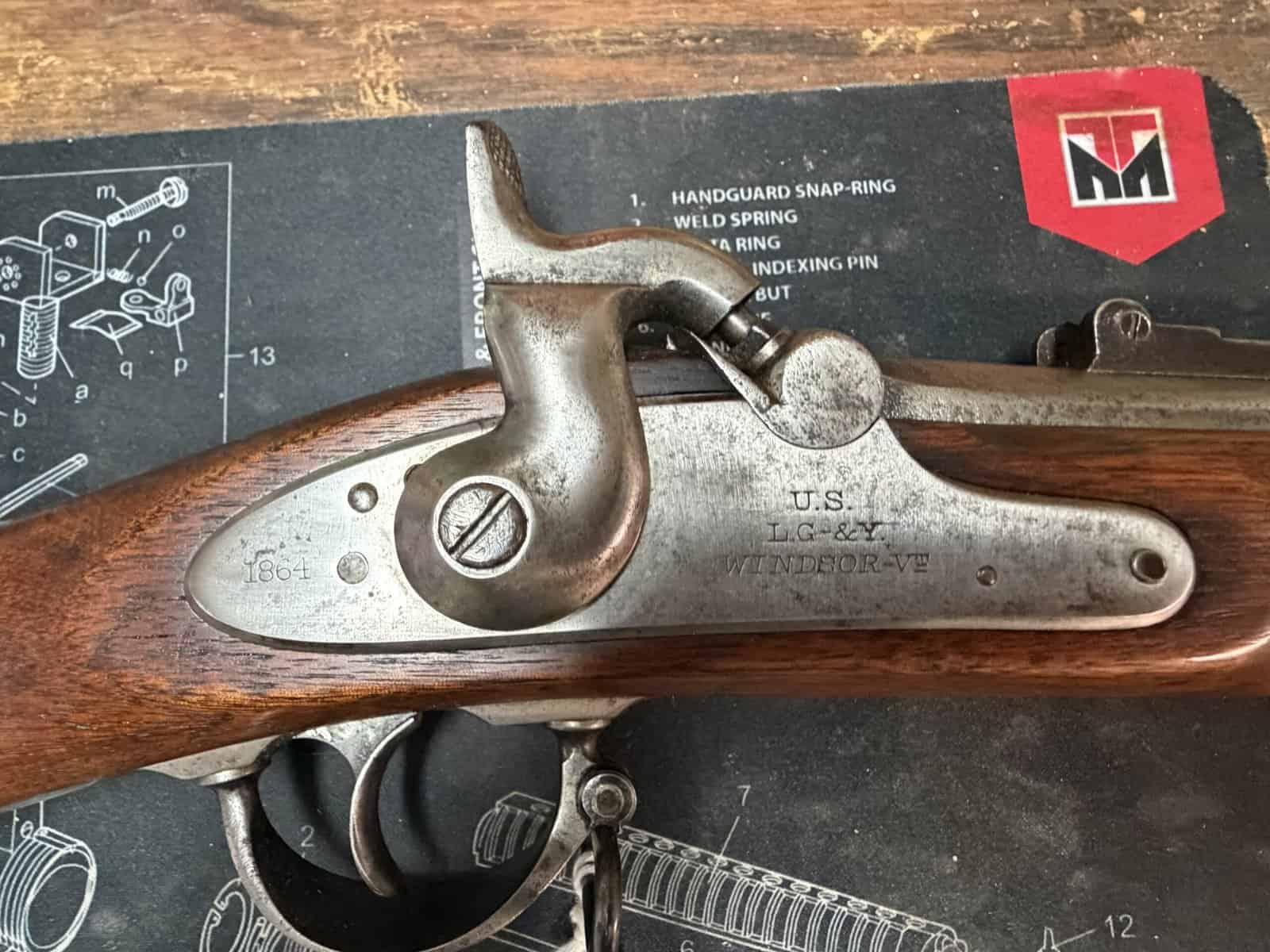
Lock plate: An eagle motif forward of the hammer, with "L.G. & Y." over "WINDSOR-Vt" stamped behind the hammer and below the bolster. The date appears on the lock plate as well.
Barrel: The top flat of the barrel breech is stamped with the date of manufacture. The left flat carries U.S. proof marks: "V" (viewed), "P" (proofed), and an eagle head -- the standard government inspection marks indicating the barrel passed proof testing.
Buttplate tang: Stamped "US."
Stock: Inspector's cartouche (stamped initials in a rectangular box) on the left flat of the stock, indicating the rifle passed final government inspection.
The quality control behind these markings was rigorous. The Ordnance Department required dozens of precision gauges to inspect each rifle-musket's components. Government inspectors were stationed at contract factories, and completed arms were graded by fit and finish.
In the Hands of Soldiers
A rifle-musket dated 1864 was made during the hardest year of the war. By then it was a grinding war of attrition. Grant was pushing Lee through the Overland Campaign -- the Wilderness, Spotsylvania, Cold Harbor, the siege of Petersburg. Sherman was cutting through Georgia. The armies consumed men and material at a rate the Northern industrial base -- including the Windsor factory -- had to keep pace with.
An LG&Y rifle produced in 1864 could have been issued to Union troops at any point during that year or into 1865. The Model 1861 and its Special Model variants were standard-issue infantry arms. They were carried at Petersburg, in the Shenandoah Valley, through the Carolinas Campaign, and at Appomattox. A relic LG&Y rifle was recovered from the Cold Harbor battlefield, placing at least one example at one of the war's most infamous engagements.
There is no way to trace the individual service history of this rifle. Military records of the era tracked men, not weapons. A rifle-musket issued to an infantry regiment might pass through multiple hands as soldiers were killed, wounded, discharged, or transferred. But holding an 1864 LG&Y, you know this: it was built to fight in the final campaigns of the Civil War, and it almost certainly did.
After the War: From Rifles to Machine Tools
When the war ended in April 1865, so did the arms contracts. In 1869, textile manufacturer Russell Jones partnered with Ebenezer Lamson, and the firm became Jones, Lamson & Company. The focus shifted to machine tools -- the same kind of precision equipment that had been the factory's real contribution all along.
In 1876, the machinery manufacturing branch was separately incorporated as Jones & Lamson Machine Company. Under superintendent James Hartness, who arrived in 1889 and designed the flat turret lathe that revived the company's fortunes, Jones & Lamson became one of the premier machine tool manufacturers in the United States. The company eventually relocated to nearby Springfield, Vermont, but the legacy remained rooted in that brick building on Mill Brook.
Today, the original Robbins & Lawrence / LG&Y armory building houses the American Precision Museum. If you are ever in Windsor, Vermont, it is worth a stop.
Collecting the LG&Y Special Model 1861
Civil War rifle-muskets are one of the most active segments of the antique arms market, and the Special Model 1861 occupies an interesting niche. It is less common than a standard Springfield Model 1861 (which was produced in far greater numbers), but more available than some of the rarer contract arms. LG&Y produced 50,000 rifles -- enough that examples appear regularly at auction and through dealers, but few enough that they command a premium over standard Springfields.
As of recent years, expect to see LG&Y Special Model 1861 rifles in the $1,000 to $3,000 range depending heavily on condition. A rough but complete example with dark patina and a worn bore might sell in the $1,000-$1,500 range. A well-preserved example with clear markings, strong mechanics, and a decent bore can push toward $2,000-$3,000 or beyond. Exceptional examples -- original bright finish, sharp markings, bright bore -- can bring more at major auction houses like Rock Island or Morphy's.
When evaluating an LG&Y rifle-musket, collectors look for:
Markings clarity. The "L.G. & Y." and "WINDSOR-Vt" markings on the lock plate, the date on the breech, and the V/P/eagle head proof marks should be legible. Clearer markings mean higher value.
Correct parts. All three barrel bands should be present, and they should be the correct split (screw-fastened) type, not solid Springfield-pattern bands. The ramrod should be original steel with a tulip-shaped head. The rear sight should be the correct two-leaf Root pattern. Replacement parts reduce value, particularly if they are from a standard Springfield rather than a Special Model.
Bore condition. A bright bore with visible rifling is rare in rifles that are 160+ years old. Most will show dark bores with faint rifling. A bright bore adds real value.
Stock condition. Original walnut stocks with inspector's cartouche intact, minimal cracks, and no repairs are preferred. Nearly all surviving examples show handling marks, dings, and wear from military service -- expected, not a defect.
Lock function. The lock should be mechanically sound with a strong mainspring. A crisp half-cock and full-cock indicate a mechanism that was well-made and has survived intact.
One important note: all original Civil War-era firearms manufactured before 1899 are classified as antiques under federal law and are exempt from the requirements of the Gun Control Act of 1968. They can be bought, sold, and shipped without an FFL (Federal Firearms License). State laws vary, so check your local regulations, but federally, these are antiques, not firearms.
Holding History
This LG&Y is not a museum piece. It is a tool built for war, and the men who built it in Windsor were part of an industrial effort that mattered as much as anything that happened on the battlefield. The manufacturing tradition they inherited from Robbins & Lawrence -- precision, interchangeability, machine-driven production -- was the North's real advantage.
Every inspection mark on the barrel represents a government inspector who gauged, measured, and approved this specific weapon. The lock date puts it in 1864. The split barrel bands and S-shaped hammer connect it to Root's Enfield-influenced design, which traces back through the Robbins & Lawrence Enfield contract to the Crystal Palace Exhibition in 1851. Nine and a half pounds of iron, steel, and walnut with a direct line to the birth of American precision manufacturing. I like knowing exactly where this one came from.
The rifle featured in this article is available for sale at Guns Galore. Contact Dave at [email protected] or (254) 501-7147.
If this rifle caught your interest, here are the references worth having:
United States Model 1861 Rifle-Musket by James Whisker & Kevin Spiker -- the most directly relevant reference. Covers all the private contractors who built the Model 1861, including LG&Y.
Flayderman's Guide to Antique American Firearms and Their Values (9th Ed.) by Norm Flayderman -- the collector's bible. Over 4,000 individually priced antique firearms.
Civil War Firearms: Their Historical Background and Tactical Use by Joseph Bilby -- goes beyond identification into how these weapons were actually used in combat.
Standard Catalog of Civil War Firearms by John Graf -- combines historical context, identification, and pricing with a 1-to-5 rarity index.
For those who shoot reproduction muskets or collect Civil War-era arms:
Lee Precision .58 Cal Minie Ball Mold (578-478-M) -- cast your own historically accurate minie balls.
CCI Musket Caps -- the ignition source for any percussion musket.
Traditions Brass Musket Capper -- holds and dispenses musket caps for easy loading.
Genuine Dug .58 Cal Civil War Minie Ball -- an actual battlefield-recovered minie ball. Good conversation piece next to the real thing.
If you know of any forums or sites that should be referenced on this listing, please let us know here.