Introduction to the Stevens Favorite 1894 Rifle
The Stevens Favorite was the single shot rimfire rifle rural American families bought when they wanted something light, cheap, and accurate enough for small game. J. Stevens Arms & Tool Company of Chicopee Falls, Massachusetts, sold it from the 1890s into the 1930s, and American Rifleman puts the total built at more than a million.
The 1894 is the pattern most often found today, and the one collectors usually mean when they say Favorite. Stevens stopped building the original guns by about 1940, but Savage put the name back in the catalogue more than once afterward.
Origins and History of the Stevens Favorite
The Beginnings of J. Stevens Arms & Tool Company
Joshua Stevens founded the firm in 1864 in Chicopee Falls, Massachusetts, with backers W. B. Fay and James Taylor, under the name J. Stevens & Co. Its first product was a tip-up single shot pocket pistol. Tool work came later and grew large enough that the company reorganized in 1886 as J. Stevens Arms & Tool Co., the name that appears on Favorite barrels. Savage Arms bought the company on April 1, 1920.
By the late 1800s Stevens was selling single shot rifles for small game hunting, target shooting, and teaching young shooters. Collectors divide the early small frame guns into an 1889 model, the 1894, and the 1915. The 1894 was an improved version of the small frame rifle Stevens was already making, and it is the one that sold in quantity, so histories that date the Favorite from 1894 are describing the successful version rather than the first one. Other Stevens rimfires, including the pump action Stevens Visible Loader, came along later.
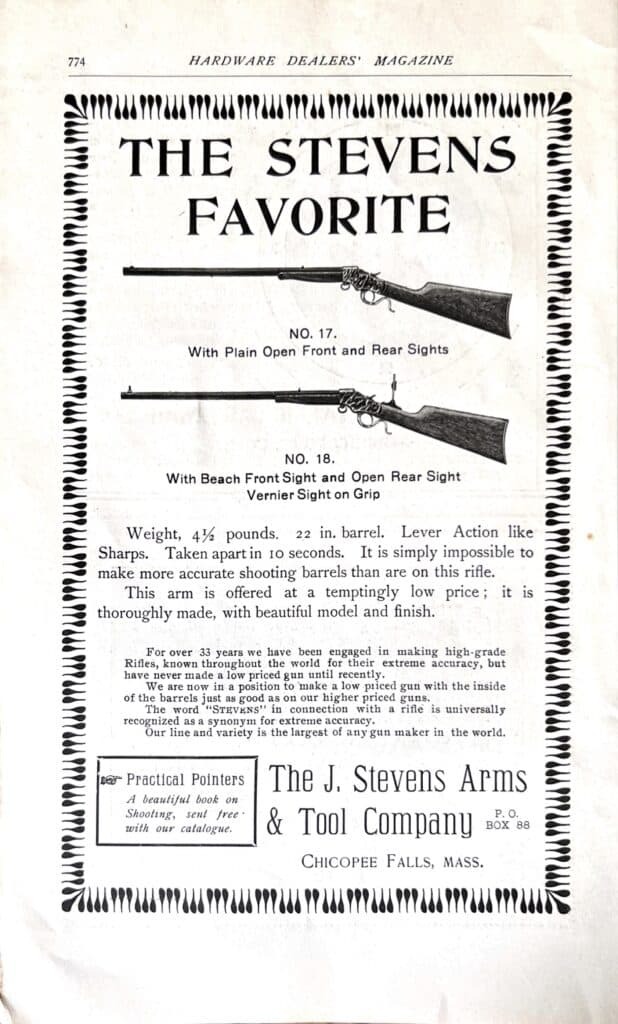
The Favorite arrived when the frontier was recent memory and a farm rifle had to do several jobs at once. Price was a large part of the appeal. Stevens listed the plain No. 17 at $6, the peep sighted No. 18 at $8.50, and the Lyman tang sighted No. 19 at $9. It became a household rifle in rural America, used on rabbits, squirrels, and whatever else needed shooting around a farm.
Design and Technical Specifications
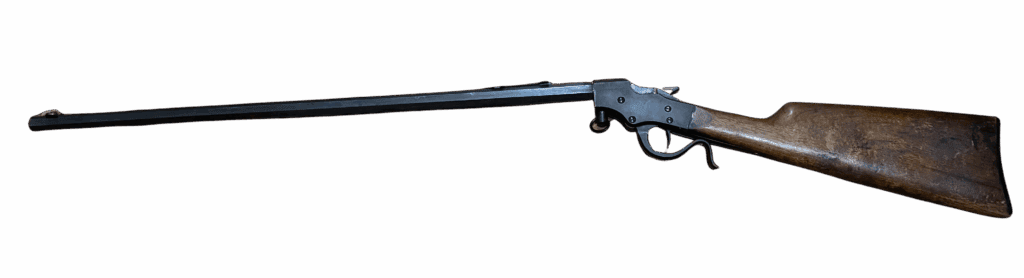
The Favorite is a single shot rimfire rifle with a pivoting breechblock. It is usually called a falling block, and American Rifleman describes the design as based on the Martini falling block action, but the block does not drop straight down the way the block in a Winchester Model 1885 does. It swings on a pivot screw in the middle of the receiver. That made the action lighter and cheaper to build. Stevens built exactly one true falling block, the Model 44½.
A lever inside the trigger guard works the block. Drop the lever and the block swings clear, opening the chamber for loading. Closing the lever locks the block behind the cartridge. Opening the action after a shot works an extractor that lifts the fired case partway out of the chamber, and the shooter pulls it the rest of the way by hand. The 1894 carries its extractor in the bottom of the barrel. The 1915 uses an ejector type unit instead.
Key Specifications:
- Overall Length: ~36 inches
- Barrel Length: ~20 inches (round, half octagon, and full octagon barrels were offered in several lengths)
- Weight: ~4 to 5 pounds
- Action: Single shot, lever operated pivoting block (also called a swinging block)
- Frame: Case-hardened steel
- Barrel: Blued steel
- Stock: American walnut
- Buttplate: Crescent-shaped metal
The weight matters more than any other number on that list. At four to five pounds the rifle fits a small shooter and costs nothing to carry all day.
Calibers and Ballistics
Stevens chambered the Favorite for the common rimfire cartridges of the period. Most were .22 rimfire, with smaller numbers in .25 Stevens and .32 rimfire. A .22 Long Rifle chamber also takes .22 Short and .22 Long, which is how one rifle covered three cartridges. The figures below are typical for these loadings rather than measurements from any one rifle.
| Caliber | Bullet Weight (grains) | Muzzle Velocity (fps) | Energy (ft-lbs) |
|---|---|---|---|
| .22 Short | 29 gr | ~1,080 fps | ~70 ft-lbs |
| .22 Long | 29-40 gr | ~1,200 fps | ~95-130 ft-lbs |
| .22 Long Rifle (LR) | 40 gr | ~1,250 fps | ~140 ft-lbs |
| .25 Stevens | 67-86 gr | ~1,150 fps | ~200-250 ft-lbs |
| .32 Rimfire | 80-100 gr | ~1,100 fps | ~215-270 ft-lbs |
The .22 LR outlasted the rest and is still the standard small game and target rimfire. The .25 Stevens and the .32 rimfire have been obsolete for decades, so a Favorite in either one is a collector’s rifle rather than a shooter.
Performance and Competitive Edge
Accuracy and Handling
The Favorite does its work inside 50 to 75 yards, which covers most small game shooting. A light trigger, a close barrel fit, and a stock that comes up straight account for most of that. The crescent buttplate takes some learning, and open iron sights reward a steady position.
Comparison to Other Rifles of the Era
The Favorite had several direct competitors, including:
- Winchester Model 1885 (more expensive, true falling block action)
- Remington No. 4 Rolling Block (comparable price, heavier action)
- Marlin Ballard Single-Shot (higher grade, bought mostly for target work)
Stevens undercut all three on price, and at $6 the No. 17 sat inside reach of buyers who were never going to own a Winchester 1885 or a Ballard.
Discontinuation and Revival
Stevens dropped the Favorite in the middle 1930s. The No. 17 ran from 1894 to 1935, while the 1915 pattern and the related Model 418 stayed in the line until about 1940. Savage brought the name back more than once:
- Model 71 Favorite (1971): A limited run of 1,000 rifles at $75 each. Savage sold later versions as the Models 71, 72, and 74 depending on the barrel. All of them are look-alikes; no parts interchange with the original rifles.
- Model 30 series, including the Model 30G: Modern production rifles in the Favorite’s shape, reported as arriving in 1999. The 30G was sold as a youth rifle and stayed in the Savage catalogue the longest.
Why the Stevens Favorite 1894 Remains a Classic
Original Favorites still change hands steadily, with condition and bore doing most of the work on price. The design is simple enough to keep running, and parts houses still stock extractors, mainsprings, and firing pins for the 1889, 1894, and 1915, which is why plenty of these rifles are still shot instead of hung on a wall. For anyone interested in historical firearms, small game hunting, or shooting iron sights, the Favorite is cheap history that still works.
Key Takeaways:
- Cheap and accurate: $6 bought the plain No. 17, and it shot well enough for small game inside 75 yards.
- Light and simple: Four to five pounds, one pivoting block, one lever in the trigger guard.
- Built in quantity: More than a million, which is why rifles and parts are both still available.
- Copied later: Savage reissued the pattern as the Model 71 in 1971 and again in the Model 30 series.

If you know of any forums or sites that should be referenced on this listing, please let us know here.