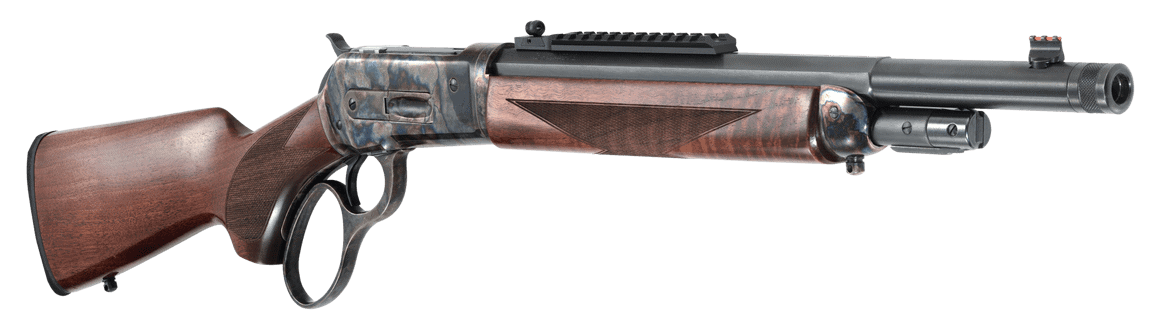
I’ve owned a lot of .45-70 lever guns. The Taylor’s & Company TC86 Takedown is one of the best looking and smoothest shooting of the bunch. It’s an incredible mash-up of old and new. Stunning to behold, practical beyond belief. Color case-hardened receiver, hand-oiled walnut, a 16.5-inch threaded barrel and the whole thing breaks down for transport with more details to follow. It’s a reproduction of John Moses Browning’s Winchester Model 1886 — arguably the strongest lever action ever designed — chambered in .45-70 Government and built to run suppressed if you want it to.
That’s a lot of features crammed into a 37.5-inch package, and every one of them makes a difference.
Why 1886 Rocks?
Before getting into what Taylor’s has done with the TC86, it’s worth understanding why the 1886 action is special. John Browning designed it specifically because Winchester needed a lever action that could handle big-bore cartridges — .45-70, .45-90, .50-110 — rounds that would have torn the popular Model 1873 apart. Browning’s solution, patented on October 14, 1884 (Patent 306,577), used dual vertically sliding locking lugs that locked the bolt into the receiver like a vault door. Winchester produced roughly 159,994 of these rifles between 1886 and 1935.
The design was so fundamentally sound that Browning refined it into the Models 1892, 1894, and 1895. But the 1886 remained the big-bore king. It was overbuilt by any reasonable standard, which is exactly what you want when you’re feeding it modern .45-70 loads that generate pressures the original black powder cartridges never approached.
And here’s the thing people forget: Winchester offered the original 1886 in a takedown configuration too. So the TC86 isn’t bolting a modern gimmick onto a classic design — it’s faithful to what Winchester actually offered 140 years ago.
For the full history of the Winchester Model 1886 — Browning’s design choices, the cartridges it was built to feed, what makes the action so robust, and why it was eventually eclipsed by lighter-recoiling rifles — see the Winchester Model 1886 article.
What Taylor’s Built
The TC86 Takedown is manufactured by Chiappa Firearms in Italy and imported by Taylor’s & Company, who have been bringing quality Italian reproductions to the American market for decades. The rifle takes the 1886’s proven action and wraps it in a package designed for the modern shooter who still appreciates walnut and case hardening.
The barrel is 16.5 inches of part-octagonal, matte-blued steel. That octagonal profile isn’t just for looks — it adds rigidity and gives the barrel a heft that a pure round profile doesn’t have. The muzzle is threaded 5/8×24 with a protective cap included, making it one of the very few traditional lever actions that ships suppressor-ready from the factory. Thread a can onto a color case-hardened .45-70 lever gun and tell me that’s not the most absurd and wonderful thing you’ve seen at the range.
The receiver wears proper color case hardening — swirls of blue, purple, gray, and straw that look different every time the light hits them. The fit and finish is stunning. I’m not exaggerating — the case hardening and wood on my TC86 are genuinely gorgeous, the kind of thing that makes you want to just sit there and look at the rifle instead of shooting it. The contrast between the 19th-century aesthetics and the modern features is what makes this gun so unique. It shouldn’t work, but it does.
The stock and forend are checkered walnut with a pistol grip, hand-oiled rather than slathered in glossy varnish. Hand-oiled walnut has a warmth and depth that polyurethane kills. It also means you can refresh the finish yourself with linseed oil or tung oil as the wood develops character over the years. The rubber buttplate is a concession to practicality over aesthetics — and with .45-70 coming out of a 7.8-pound gun with a 16.5-inch barrel, you’ll appreciate the recoil absorption.
Specifications
| Specification | Detail |
|---|---|
| Caliber | .45-70 Government |
| Action | Lever action (1886 pattern) |
| Barrel Length | 16.5″ part-octagonal, matte blued |
| Barrel Threading | 5/8×24 (cap included) |
| Twist Rate | 1:18″ |
| Overall Length | 37.5″ |
| Weight | ~7.8 lbs |
| Capacity | 4+1 (tubular magazine) |
| Receiver | Color case-hardened steel |
| Stock | Checkered walnut, pistol grip, hand-oiled |
| Forend | Checkered walnut, matching |
| Buttplate | Rubber |
| Sights | Skinner peep rear (scout rail mounted) + fiber optic front |
| Optics Rail | Forward Weaver/Picatinny scout rail |
| Lever | Large loop (glove-friendly) |
| Loading | Side-loading gate |
| Takedown | Yes |
| Sling Mounts | Included |
| Manufacturer | Chiappa Firearms (Italy) |
| Importer | Taylor’s & Company |
| SKU | LC1/220100 |
| Chiappa Model | 920.423 |
| MSRP | ~$2,184 (street prices as low as ~$1,360) |
The Takedown System
The whole point of a takedown rifle is that it splits into two halves for easier transport and storage. The TC86’s takedown mechanism lets you break the rifle at the receiver, separating the barrel and forend from the action and stock. Reassembly locks everything back to zero — or close enough that it doesn’t matter at the distances a .45-70 lever gun typically works.
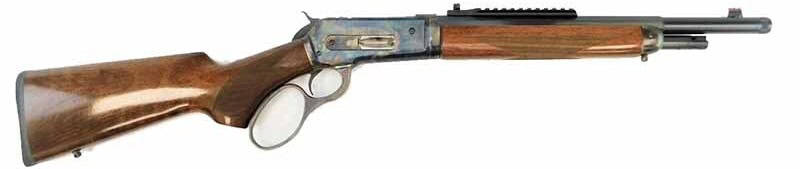
Why does takedown matter? Practicality. A 37.5-inch rifle fits in a backpack or a compact case when it’s in two pieces. For backcountry use, truck storage, bush hunting, or anyone who doesn’t want to lug a full-length rifle case around, takedown is a genuine functional advantage. It’s also worth noting that your options for takedown .45-70 lever guns are extremely limited. The Marlin 1895 and Henry .45-70 are both fixed-frame designs. If you want a .45-70 lever action that breaks down, the TC86 is essentially it.
The Sighting System
Taylor’s made a smart call on the sights. The TC86 ships with a Skinner peep sight mounted on a forward Weaver/Picatinny scout rail, paired with a fiber optic front sight. Gun Digest called them “some of the best irons you can find on a lever-action,” and that’s not an overstatement.
Skinner sights are the gold standard for lever-action peep sights. The aperture is fast to acquire as your eye naturally centers the front sight in the rear ring without conscious effort. The fiber optic front gathers light and gives you a bright aiming point even in low-light timber conditions where .45-70 lever guns tend to earn their keep.
The scout rail also opens the door for optics. A red dot in a forward scout position gives you both-eyes-open shooting with unlimited eye relief. A compact scout scope in 2-7x or similar would extend the practical range without cluttering the receiver. The rail is there if you want it, and the Skinner peep is excellent if you don’t.
The Large Loop Lever
The TC86 comes with a large loop lever, and it’s more than a John Wayne tribute. A large loop lets you cycle the action with heavy gloves — winter hunting gloves, mechanix gloves, whatever you’re wearing. It also makes the cycling motion faster and more fluid for shooters with larger hands. On a rifle designed for close-range, fast-shooting scenarios against dangerous game or in thick brush, that’s not a cosmetic choice. It’s a functional one.
The .45-70 in a Short Barrel
Cutting a .45-70 barrel to 16.5 inches costs you some velocity compared to a 24-inch or 26-inch tube. That’s physics, and there’s no way around it. But .45-70 was never a velocity cartridge. It’s a big, heavy bullet at moderate speed, and it hits like a freight train at reasonable distances regardless. The 1:18″ twist rate will stabilize the heavy-for-caliber bullets: 300-grain, 350-grain, 405-grain loads that make .45-70 what it is.
What you gain from the short barrel is handling. At 37.5 inches overall and roughly 7.8 pounds, the TC86 moves through brush and timber like a rifle half its caliber. It shoulders fast, points naturally, and clears branches and doorways that a 26-inch barrel catches on. For the kind of shooting where .45-70 excels, at close to moderate range, heavy cover, big animals, a short barrel is arguably the better tool.
And with that threaded muzzle, you can tame the increased blast and flash of the short barrel with a suppressor. A suppressed .45-70 lever gun sounds like a contradiction, but subsonic .45-70 loads through a can are remarkably quiet. Heavy 405-grain loads at trapdoor-safe pressures are already flirting with subsonic velocities from a short barrel, and purpose-built subsonic .45-70 loads are available. Thread on a .45-caliber suppressor and you’ve got a brush gun that won’t blow out your eardrums or spook every animal in the next drainage.
The Rest of the TC86 Family
Taylor’s offers several variants in the 1886 lineup, all in .45-70:
- 1886 Takedown Classic: 26-inch full octagonal barrel, 8+1 capacity, $2,251 MSRP. The traditional-length option for shooters who want more velocity and capacity.
- 1886 Ridge Runner Takedown Matte Black: 18.5-inch barrel, D-shaped lever, muzzle brake, $2,158 MSRP. The tactical-leaning option with a more modern aesthetic.
- 1886 Ridge Runner Takedown Chrome: 18.5-inch barrel, chrome finish, $2,245 MSRP. Same Ridge Runner platform with a chrome treatment.
The TC86 sits in the sweet spot — the shortest barrel in the lineup, the traditional case-hardened look, and the large loop lever. It’s the one that balances classic aesthetics with modern utility most effectively.
What to Know Before You Buy
The price is the elephant in the room. At an MSRP around $2,184 and street prices starting around $1,360, the TC86 costs more than a Marlin 1895 or a Henry .45-70. You’re paying for the takedown capability, the 1886 action, the case hardening, the hand-oiled walnut, the Skinner sights, and the threaded barrel. Whether that premium is worth it depends on how much you value those features — particularly the takedown, since that’s the one thing the competition simply doesn’t offer in .45-70.
Like any lever action, expect the action to need some break-in time. Run a few hundred rounds through it and things smooth out — mine cycles like butter now.
The Firearm Blog, covering the rifle at SHOT Show 2022, said Taylor’s “appear to have struck gold” and called it “a stunning rifle.” Gun Digest noted it was “overbuilt, designed to handle any modern .45-70 gov’t load” and praised the combination of “classic aesthetics combined with modern features.” Those are strong words from publications that see hundreds of new rifles every year.
Who It’s For
The TC86 Takedown makes the most sense for a few specific shooters. If you hunt in thick cover where a short, fast-handling rifle matters more than a 300-yard zero, it’s built for that. If you want a backcountry companion that packs down small and hits hard, the takedown design earns its keep. If you want a suppressor-ready lever gun without aftermarket barrel work, the factory threading handles that. And if you’re a lever-action collector or enthusiast who appreciates the historical lineage of the 1886 action, this is one of the only modern production rifles keeping Browning’s big-bore design alive.
It’s not a long-range precision rifle. It’s not a high-capacity tactical carbine. It’s a beautifully made, historically rooted, hard-hitting brush gun that breaks in half and accepts a suppressor. There’s nothing else quite like it on the market, and that alone makes it worth a hard look.
If you know of any forums or sites that should be referenced on this listing, please let us know here.
Further Reading
-

The Winchester Book
Purchase on Amazon -
Sale!

History of Browning Firearms: A Complete Chronicle of the Greatest Gunsmith of All Time
Original price was: $19.99.$18.63Current price is: $18.63. Purchase on Amazon -
Sale!

The Guns of John Moses Browning: The Remarkable Story of the Inventor Whose Firearms Changed the World
Original price was: $28.00.$24.34Current price is: $24.34. Purchase on Amazon