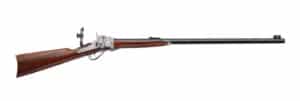

The Winchester Model 1876 is the rifle Theodore Roosevelt carried as a Dakota Badlands ranchman, and the rifle he killed his first grizzly with in Wyoming’s Bighorn Mountains in 1884. A pistol-grip, half-magazine .45-75 sporting rifle that TR ordered in 1883, used hard through his ranching years, wrote about in his published books, and that survives today on display at Sagamore Hill National Historic Site on Long Island.
I own a Cimarron 1876 in the same chambering, .45-75 WCF, partly because of that story, and I have a Cimarron Presidio in .50-95 Express on order, which is a cartridge that turned out fewer than 3,500 originals in the rifle’s twenty-year run. The 1876 is a niche rifle today: one effective producer, four obscure chamberings, a small modern market, and a place in American firearms history that the more famous 1873 doesn’t share.
Lineage: From the 1873 to the 1876, and the 1886 That Replaced It
By the mid-1870s the Winchester Model 1873 was the most commercially successful repeating rifle in America. Its .44-40 WCF cartridge, a 200-grain bullet at around 1,245 fps, was on its way to becoming the closest thing the frontier had to a continental standard. The toggle-link action borrowed from the Henry and 1866 cycled fast, fed reliably, and locked tightly enough for the cartridge it was built around. On deer, antelope, and men, the 1873 was the rifle to have.
On elk, moose, grizzly, and bison it was not. Even less so on African Safari. The .44-40 lacked the bullet mass and velocity to drive vitals on animals weighing 800 to 2,000 pounds: big-game hunters needed something on the order of two to four times the projectile energy. Chambering the 1873 in a bigger cartridge wasn’t possible either: the toggle-link locking system, two pivoting links flexing outward to lock the bolt against the receiver, can safely contain the .44-40’s modest peak pressures, but cannot handle the heavier loads big-game cartridges require. The 1873 wasn’t merely small; it was mechanically capped by its locking geometry.
The big-game market belonged to the Sharps Model 1874 and similar single-shot breechloaders chambered for big black-powder cartridges: .45-70 Government, .45-100, .50-90 Sharps. A buffalo hunter could lay down a Sharps with a sandbag rest and kill animals at distances a lever-action couldn’t approach. Winchester wanted a share of that market, and wanted to deliver it in the form factor the company’s customers already loved: a tubular-magazine, repeating, lever-action rifle.
The solution was a scaled-up toggle-link. Winchester took the existing action from the Henry, 1866, and 1873 and enlarged everything around it: longer, heavier, taller receiver; longer bolt; longer toggle links; longer carrier; longer cartridge guides. Mechanically the 1876 is the 1873 grown up: same action geometry, sized to take medium-power big-game cartridges. The shared visual lineage is obvious to anyone who handles both rifles: same side-loading gate, same dust-cover styling, same lever geometry. Side by side, the 1876 just looks like a 1873 that has hit the gym.
The 1876 didn’t survive because the toggle-link, even scaled up, was still a compromise. It could handle .45-60, .45-75, and .50-95, but not the .45-70 Government loads buffalo hunters preferred or the higher-pressure cartridges late-19th-century big-game shooting demanded. When John Browning’s vertical-locking-lug Model 1886 arrived ten years later (chambering .45-70, .45-90, .50-110, and more) the 1876 was instantly obsolete in the market it had been designed to serve. Roughly 64,000 1876s were produced before Winchester ended the line in 1897, against the 1873’s 720,000-plus. The 1876 was the right answer for an eight-year window, and a footnote afterward.
The Centennial Debut
Winchester unveiled the new rifle at the Centennial International Exhibition in Philadelphia, which opened May 10, 1876 and ran through November 10, 1876: the United States’ 100th-birthday world’s fair. The exhibition is the source of the rifle’s “Centennial” nickname. Winchester displayed four configurations at Philadelphia: a deluxe sporting rifle, a standard sporting rifle, a carbine, and a rifle musket. These were the same configurations that would dominate the production catalog over the rifle’s twenty-year life.
The Philadelphia unveiling was a prototype and showpiece debut, not a shipping debut. The first production Model 1876 was not delivered to Winchester’s shipping department until June 8, 1877. A year after the public unveiling. Several common sources elide that gap.
The Rifle Itself: Configurations and Production
Winchester manufactured the 1876 from 1877 through December 17, 1897. Total production was 63,871 units, a figure from Winchester factory records held at the Cody Firearms Museum and confirmed in George Madis’s The Winchester Book. Serial numbers run from 1 through 63871. A subset of secondary sources cite roughly 24,881 units, which refers to a partial count rather than the total; 63,871 is the verified figure.
Winchester cataloged the 1876 in four basic configurations:
- Sporting Rifle. 28-inch barrel, octagonal (standard) or round, full-length magazine. The cataloged default and the most commonly encountered variant today.
- Express Rifle. Shorter barrel (typically 24 to 26 inches; sources vary), octagonal or round, often a half-magazine. The trimmer “express” form for short-range heavy-game work.
- Carbine. 22-inch round barrel, saddle ring, full-length magazine. The variant the North-West Mounted Police adopted.
- Musket. Long barrel (typically 30 to 32 inches; sources vary), round, full-length stock, bayonet lug. Contract and military pattern; never sold in volume.
The Sporting Rifle and Carbine numbers are universally consistent across primary sources. The Express and Musket barrel lengths show some variation between secondary sources; Madis is the canonical reference.
The rifle is a scaled-up 1873. Side loading gate on the right of the receiver, on Nelson King’s 1866 patent. Tubular magazine beneath the barrel: full-length on Sporting Rifle, Carbine, and Musket; half-magazine on the Express. External hammer with half-cock safety; no tang safety, no thumb safety. The toggle-link locks the bolt against the receiver behind the chamber, with the lever breaking the toggle on the downstroke. Magazine capacity varies by chambering: eleven to twelve rounds in a 28-inch Sporting Rifle in .45-75, eight rounds in the 22-inch Carbine in the same caliber, somewhat less in the heavier .50-95.
Winchester ran the same “One of One Thousand” and “One of One Hundred” special-order program for the 1876 that it had run for the 1873, with far smaller numbers. Madis and the Winchester Collectors Association document 54 “One of One Thousand” and 7 “One of One Hundred” Model 1876s across the production run. Surviving examples with documented provenance auction in the high six and low seven figures.
Chamberings: and the .45-70 Government Question
Winchester chambered the 1876 in four cartridges across the twenty-year production run:
- .45-75 WCF (1876). The original chambering and the cartridge the rifle was designed around. A 350-grain bullet over 75 grains of FFg black powder in a bottlenecked, rimmed case commonly given as 1.89 inches long, delivering approximately 1,400 fps from a 28-inch barrel. Theodore Roosevelt’s chambering. The North-West Mounted Police chambering. The Cimarron reproduction’s primary chambering.
- .45-60 WCF (1879). A straight-walled lighter loading: 300-grain bullet over 60 grains of black powder, about 1,300 fps. Trimmer recoil for shooters who didn’t need the full .45-75 charge.
- .50-95 Express (1879). The “Express” big-bore: a 300-grain .50-caliber bullet over 95 grains of powder, around 1,560 fps. Hard-hitting and uncommon; roughly 3,300 originals across the production run, which makes it the rarest of the four chamberings.
- .40-60 WCF. A lighter mid-bore: 210-grain bullet over 60 grains of powder, around 1,560 fps. Flat-shooting compared to the .45-75 and .45-60. Secondary sources show some variation on the introduction year: 1879 or 1884; Madis is the canonical primary citation.
The 1876 was never chambered in .45-70 Government. Not in original Winchester production, and not in any modern reproduction.
Two reasons. First, action length. The .45-70 Government case is 2.10 inches long. The .45-75 WCF case is commonly given as 1.89 inches. The scaled-up toggle-link receiver of the 1876 was sized to feed the shorter .45-75. The .45-70 simply does not fit through the action. Second, pressure. Even at the .45-70’s modest black-powder pressures of the era, the toggle-link’s mechanical lockup was already at its design ceiling for the .45-75 it was built to handle. The 1876 represented Winchester’s stretch of the toggle-link to its limit, not an action that could safely accept a longer, higher-pressure cartridge.
This is exactly the problem Winchester hired John Browning to solve. Browning’s vertically-locking-lug design (the Model 1886) was the response: a brand-new action, longer and dramatically stronger, that could chamber .45-70 Government, .45-90, .50-110, and ultimately the smokeless .33 WCF. The 1886 made the 1876 obsolete for the heavy-hunting use case within a few years of its introduction.
.45-75 WCF vs. .45-70 Government: Same Bullet, Different Cartridge
Both fire .458-inch-diameter bullets. Beyond that they are not interchangeable and not similar. The .45-75 is a rimmed, bottlenecked case commonly given as 1.89 inches long, 350-grain bullet, 75 grains of black powder, around 1,400 fps. The .45-70 is a rimmed, straight-walled case 2.10 inches long, 405-grain bullet, 70 grains of black powder, around 1,300 fps.
The .45-75 trades bullet weight for velocity, in a bottlenecked case that feeds more reliably through a lever-action’s carrier and chamber than a long straight-walled case does. That was Winchester’s engineering rationale: a cartridge designed for the rifle, rather than a cartridge retrofitted to fit it.
Theodore Roosevelt’s Winchester Model 1876: The Primary Historical Anchor
Roosevelt ordered his Model 1876 in 1883, months before the day his wife Alice and his mother both died: February 14, 1884. The rifle was a deluxe sporting rifle in .45-75 WCF with several factory custom options: a pistol-grip stock (narrower than the standard rifle stock; Roosevelt had small hands relative to his stout build, and the grip suited him), a half-magazine, and deluxe-grade walnut. Per Cody Firearms Museum and Sagamore Hill National Historic Site records, the rifle was forwarded to him in the Badlands in July 1884, in time for his seven-week hunting expedition into the Bighorn Mountains that summer.
Roosevelt used the 1876 extensively from 1884 through his Badlands ranching years (roughly 1884 to 1886), and intermittently thereafter when he returned West. In Hunting Trips of a Ranchman he wrote that he used it “almost exclusively, having killed every kind of game with it, from a grizzly bear to a big-horn.” Bison are the one animal the popular story gets wrong. Roosevelt killed his first bison in September 1883, on a short hunt out from the Little Missouri, ten months before the 1876 reached him; on that first trip west he carried a Sharps Model 1874 in .45-120. A year later, with the 1876 in hand, he crossed the old buffalo range again and wrote that “not a living one did we see.” The great Northern herd was essentially gone.
Roosevelt wrote about the rifle in his Western books, all still available as primary sources. Hunting Trips of a Ranchman (1885) is his first Western book, and the 1876 is the rifle he names there as his favorite, the “45-75 half-magazine Winchester” that was “by all odds the best weapon I ever had.” It was with him on the 1884 Bighorn hunt for elk and grizzly. Ranch Life and the Hunting Trail (1888) continues the narrative with further 1876 references. By the time of The Wilderness Hunter (1893) he had moved on: “I now use a 45-90, with my old buffalo gun, a 40-90 Sharps’, as spare rifle.” The .45-90 was a Model 1886, and the Model 1895 in .405 Winchester that he carried to Africa in 1909 came later still.
The rifle itself is on display at Sagamore Hill National Historic Site in Oyster Bay, New York. Sagamore Hill was Roosevelt’s home from 1885 until his death in 1919, today an NPS site. Some secondary sources cite the Cody Firearms Museum; Cody holds significant Roosevelt firearms material, but the specific pistol-grip half-magazine .45-75 is at Sagamore Hill per the National Park Service. Roosevelt owned multiple Winchester rifles across his lifetime, distributed today across Sagamore Hill, Cody, the NRA Museum, and private hands. The Sagamore Hill pistol-grip half-magazine is the rifle most consistently identified as TR’s 1876.
I bought a Cimarron 1876 in .45-75 partly because of that story. The same cartridge Roosevelt killed his first grizzly with, in a modern rifle that handles the way the original did: same toggle-link feel, same heft, same sights, same gate. There is a particular pleasure in loading the rounds Roosevelt loaded into the action Roosevelt cycled. The Cimarron Presidio in .50-95 Express that I have on order is the same logic taken farther: a chambering Winchester only produced about three thousand originals of, in a configuration the Texas Rangers carried in the 1880s. Neither rifle is a practical hunting choice in 2026. Both are the right rifle for the kind of hunting where the experience matters as much as the result.
The North-West Mounted Police Carbine
The other major historical user of the Model 1876 is the North-West Mounted Police (NWMP): the force that became the Royal North-West Mounted Police in 1904 and the Royal Canadian Mounted Police in 1920. The NWMP carbine in .45-75 is, in Canadian cultural memory, the Mountie rifle, the shoulder arm that armed the scarlet-tunic image of the Canadian West.
The NWMP was founded in 1873 and initially issued single-shot Snider carbines, which by the late 1870s were dangerously obsolete. The catalyst for replacement was Custer’s defeat at Little Bighorn in June 1876. The Lakota under Sitting Bull crossed the U.S.–Canada border into NWMP jurisdiction in the months afterward, well-armed with repeating rifles acquired in the years leading up to the battle and with Springfield carbines taken from the Custer dead. A Mountie with a single-shot Snider facing a Sioux warrior with a captured 1866 was dangerously outclassed.
The NWMP acquired 50 Model 1876 carbines in .45-75 WCF for trials in 1878. Production adoption followed in 1883 with a larger order, and total NWMP purchases of the carbine between 1878 and 1885 totaled approximately 1,600 carbines, all in .45-75. The rifle served as the NWMP standard long arm from 1878 through approximately 1905, came briefly out of service in the mid-1900s, then resumed and served through 1914, when the Lee-Enfield replaced it. Its service, with that interruption, spanned approximately 36 years, making the 1876 by far the longest-serving rifle in NWMP, RNWMP, and RCMP history until the Lee-Enfield itself.
The carbine armed the North-West Rebellion of 1885, the Klondike Gold Rush from 1896 to 1899, the early settlement of the Canadian Prairies, and the policing of the Canadian West before the First World War. A common misattribution worth correcting: some popular accounts confuse the NWMP carbine with the Winchester 1873, which was far more numerous. The NWMP carbine was the Model 1876 in .45-75 WCF. The cartridge difference matters. The .45-75 is a serious big-bore stopping cartridge; the .44-40 is a pistol-class cartridge. Different rifles for different problems.
Other Famous Owners (and a Production-Timing Correction)
Tom Custer. Captain Thomas Ward Custer was George Armstrong Custer’s younger brother and one of the first soldiers to win the Medal of Honor twice, in two separate Civil War actions. Tom Custer is sometimes described as having owned and carried a Model 1876 at Little Bighorn. The production timing rules it out. Little Bighorn was June 25, 1876, and the first production Model 1876 didn’t ship from Winchester until June 8, 1877. A full year later. Tom Custer died at Little Bighorn alongside his brother, and whatever long arm he carried that day, it was not a Winchester 1876. The cavalry issue at the battle was the .45-70 Springfield Trapdoor Carbine.
Sitting Bull. Several secondary accounts describe Sitting Bull as owning or carrying a Model 1876 in his later years. The attribution is plausible (Winchester rifles, including big-bore lever-actions, circulated through Plains nations via trade, capture, and direct purchase), but the documentation in primary sources is thin. The Smithsonian’s National Museum of Natural History collection holds a Winchester Model 1866 attributed to Sitting Bull, surrendered at Fort Buford in 1881; that one is well-documented. A specific 1876 attribution is best treated as plausible secondary attribution rather than verified provenance.
Arthur Merrifield. Roosevelt’s hunting guide and ranching partner in the Badlands owned a Model 1876 and used it alongside Roosevelt’s. Merrifield’s 1876 appears in Hunting Trips of a Ranchman; the rifle has reasonable secondary documentation through Roosevelt family papers and Rock Island Auction Company catalog research.
The Modern Reproductions Market
The 1876 reproduction market is narrower than the 1873 market: most of the manufacturers who produce 1873 reproductions skip the 1876, and the original chamberings are obscure to the modern handloader. As of 2026 there is effectively one producer.
Uberti (Italy): The Active Producer
A. Uberti, headquartered in Gardone Val Trompia, Italy, is the only meaningful current producer of Model 1876 reproductions. Uberti has manufactured the 1876 since the mid-2000s and supplies the rifle to several U.S. importer-finishers. The actions, the receivers, the barrels, the toggle-link components, and the stocks all originate in Gardone Val Trompia; the finish work and import packaging happens in the United States.
Cimarron (the dominant U.S. importer)
Cimarron Firearms in Fredericksburg, Texas is the largest U.S. distributor of Uberti 1876s. The standard line is the 1876 Centennial Rifle (Cimarron SKUs CA2500, CA2501, CA2503 depending on chambering): a 28-inch octagonal-barrel Sporting Rifle pattern in .45-60, .45-75, or .50-95, with a color-case-hardened receiver, lever, and hammer, blued barrel, and American walnut stock. Eleven-round magazine. About ten pounds in hand. This is the rifle for buyers who want the standard cataloged 1876 configuration in the period-correct cartridges.
The variant worth a separate callout is the 1876 Texas Ranger Presidio (Cimarron SKU CA2524), which is an Express-pattern short rifle: 20-inch octagonal barrel, carbine-style buttstock, saddle ring, chambered in .50-95 Express. The receiver carries sideplate engraving reading “Texas Rangers Co. E / Para muerte de diablos / Presidio Del Norte / Texas, 1883,” a reference to the Texas Rangers’ Big Bend posting in the period. Henry-pattern ladder rear sight. MSRP $2,375 at Cimarron’s current published pricing. The Presidio is a niche-of-a-niche product, and the one I’m waiting on.


Cimarron also offers a 22-inch round-barrel NWMP Carbine with saddle ring and Mountie-pattern markings in .45-75, on intermittent availability. The carbine is the right reproduction for buyers focused on NWMP history specifically.
Pricing across the Cimarron 1876 line sits in mid-four-figure modern lever-action territory: premium to a 1873 reproduction, comparable to a Miroku-built 1886. Browse current Cimarron 1876 listings at Guns.com.
Taylor’s & Company
Taylor’s & Company is the secondary U.S. importer of Uberti 1876s. The Taylor’s catalog has carried 1876 variants intermittently: fewer SKUs than Cimarron, but the same underlying Uberti rifle. Buyers who already work with Taylor’s for SAA-pattern revolvers and 1873 lever-actions can sometimes find the 1876 through that channel.
Chaparral Arms: Historically Yes, Currently Inactive
Chaparral Repeating Arms (with some early production imported by Charter Arms) imported Model 1876 reproductions from late 2006 through approximately 2008, covering .40-60, .45-60, .45-75, and .50-95 in 22-inch, 26-inch, and 28-inch barrels. Quality reputation was poor: owner reports cite extensive warranty work, fitment issues, and feed reliability problems. Charter Arms reportedly dropped the Chaparral line over warranty volume. As of 2026 Chaparral does not appear to be actively importing or distributing 1876s in the U.S. market. Numrich Gun Parts continues to stock Chaparral parts, which is typical of dormant import lines. Treat Chaparral 1876s on the used market as buyer-beware.
Who Does NOT Make a 1876
Several manufacturers come up in buyer questions and do not produce 1876 reproductions:
- Winchester (Miroku-Japan). The modern Winchester Repeating Arms lever-action line, manufactured under license by Miroku in Kochi, Japan, does not include the Model 1876. Miroku-made Winchester models are the 1873, 1886, 1892, 1894, and 1895. No 1876. The 1876 falls historically between the 1873 (which Miroku makes) and the 1886 (which Miroku also makes), but Miroku does not produce the 1876. For buyers who want a modern factory-warrantied Winchester-branded lever-action in a heavy-hunting cartridge, the 1886 is the option.
- Davide Pedersoli. Pedersoli’s lever-action production focuses on the 1886 and to a lesser extent the 1894. Pedersoli does not currently make the Model 1876. The catalog emphasis on the 1886 reflects the same commercial logic Miroku follows: the 1886 is a stronger, more flexible action serving the same heavy-game market.
- Henry Repeating Arms, Rossi, Chiappa, Pietta. None produce a Model 1876. Henry makes its own steel- and brass-frame lever-actions but no Winchester historical reproductions. Rossi focuses on the 1892 reproduction (the Rio Bravo and Puma lines). Chiappa produces 1892 reproductions. Pietta focuses on Colt SAA reproductions and cap-and-ball revolvers; no Winchester-pattern lever-actions.
The effective producer count for a new-production 1876 in 2026 is one (Uberti), distributed through Cimarron primarily and Taylor’s secondarily. If you want a new 1876, that is your market.
Use Cases: What the 1876 Is Actually Good For
Big-bore lever-action hunting. The 1876’s natural and historical role. The .45-75 will kill any North American game animal cleanly within typical lever-action ranges, say inside 150 yards. The .50-95 Express will kill it harder still. The .45-60 is the lighter-recoiling choice for elk and the occasional moose. The .40-60 is the flat-shooter for deer at moderate range. None of those cartridges is a modern hunting choice in any practical sense. A buyer who picks a Cimarron 1876 for elk is choosing it for the same reason a buyer picks a Sharps 1874 single-shot for the same hunt: the experience matters as much as the result.
Cowboy Action Shooting. The 1876 is not legal in SASS main-match rifle categories, which require rifles chambered for revolver cartridges of .32 to .45 caliber; the .45-75 and .50-95 are rifle cartridges. Its place in SASS is the long-range rifle-caliber events. Practical realities count against it there too: heavier than a 1873, harder-recoiling, more expensive to feed (factory .45-75 ammunition costs meaningfully more than factory .45 Colt or .44-40), and slower-cycling than a slicked-up 1873. Where it appears, the 1876 shows up for character, not for scores.
Historical reenactment. The 1876 is the period-correct heavy lever-action for several specific reenactment contexts. Dakota Territory and Badlands frontier (the 1880s). NWMP and Mountie reenactment (1878 through 1914). The North-West Rebellion of 1885. Both sides used 1876s. The Yukon Gold Rush of 1896 through 1899. NWMP issue.
Collecting. Original Model 1876s in fine condition trade well. A standard-grade 28-inch Sporting Rifle in original .45-75 in 80-percent-or-better condition trades in the mid-four to low-five figures depending on documentation. NWMP-marked carbines trade above standard-grade rifles. Express Rifles and .50-95 chamberings command premiums over the more common .45-75 and .45-60 sporting rifles. “One of One Thousand” 1876s auction in the high six and low seven figures with documented provenance. Modern Uberti and Cimarron reproductions are user-grade, not collector-grade, and depreciate the way any modern firearm does.
Adjacent Rifles: Do Not Confuse
Several rifles in the Winchester lineage and the broader 1870s-1880s big-bore market get confused with the 1876.
The Winchester Model 1873 is the 1876’s smaller-frame predecessor. Same toggle-link mechanism, smaller. Pistol-cartridge chamberings (.44-40, .38-40, .32-20, and the .22 rimfire variants), where the 1876 chambers rifle cartridges. The 1876 is mechanically the 1873 scaled up; the chambering classes are functionally different categories of firearm.
The Winchester Model 1886 is Browning’s vertically-locking-lug big-bore successor. Chambered for .45-70 Government, .45-90 WCF, .50-110 Express, and ultimately the smokeless .33 WCF. The 1886 made the 1876 obsolete as a heavy-hunting rifle within a few years of its introduction. For buyers who want a modern factory-warrantied heavy-hunting Winchester lever-action, the 1886 is the answer, not the 1876.
The Sharps Model 1874 is the single-shot falling-block competitor. The dominant buffalo rifle of the 1870s. Same big-bore market the 1876 targeted; entirely different mechanism. A Sharps and an 1876 in the same camp are answering the same question two different ways.
The Marlin Model 1881 is Marlin’s competing big-bore lever-action, introduced (as the name suggests) in 1881. The 1881 did chamber .45-70 Government, beating Winchester to the heavy-cartridge punch by five years on a different (lifter) action. The 1881 is one of the rifles that made Winchester urgently need the 1886.
The Winchester Model 1895 is Browning’s box-magazine lever-action: the rifle Roosevelt took to Africa in 1909. Box magazine, not tubular. Spitzer-bullet-capable. Designed for smokeless cartridges including .405 Winchester, .30 Army (.30-40 Krag), and .30 Government 1906 (.30-06). Entirely different from the 1876. The Roosevelt connection makes the two rifles get confused; they are not the same animal.
Related historical arms worth knowing on the muzzleloading side of the line: the Hawken Rifle, the half-stock plains rifle that preceded the cartridge era; the Pennsylvania Rifle, the long-barreled flintlock that built American rifle culture; and the Enfield Pattern 1853, the British military percussion rifle-musket that armed both sides of the U.S. Civil War.
References and Resources
The canonical reference work for any serious 1876 research is George Madis’s The Winchester Book (1961, with revised editions through the 1980s). Madis is out of print and trades on the secondhand market. It remains the definitive authentication reference for everything Winchester produced from the Henry through the 1980s, including the 1876 serial-number and configuration tables. Herbert G. Houze’s Winchester Repeating Arms Company: Its History & Development from 1865 to 1981 (Krause, 1994) is the corporate-history reference; R. L. Wilson’s Winchester: An American Legend (Random House, 1991) is the more accessible general-reader book.
For Theodore Roosevelt’s own writing on the rifle, the three primary-source books are all in the public domain and freely available in print and electronic editions: Hunting Trips of a Ranchman (1885), Ranch Life and the Hunting Trail (1888), and The Wilderness Hunter (1893). R. L. Wilson’s Theodore Roosevelt: Outdoorsman (1971) covers the broader Roosevelt firearms collection.
Museums worth knowing. Sagamore Hill National Historic Site in Oyster Bay, New York holds Roosevelt’s pistol-grip half-magazine .45-75: the canonical 1876 with documented Roosevelt provenance. The Cody Firearms Museum at the Buffalo Bill Center of the West in Cody, Wyoming holds Winchester factory production records, the broader Roosevelt firearms collection, and a deep Winchester rifle collection generally. The National Firearms Museum (NRA) in Fairfax, Virginia holds selected 1876 examples. The Winchester Collectors Association at winchestercollector.org hosts a free serial-number lookup tool and an active authentication forum.
The Morphy Auctions (morphyauctions.com) catalog archive is one of the standout marketplaces for rare and historically significant American firearms, including original Model 1876s in all chamberings and configurations. Their sales are worth following whether you are buying, researching, or just looking at very good firearms photography.
The Texas Gun Collectors Association (tgca.org) holds two shows a year that always feature significant historical Winchesters alongside other important American firearms. Worth attending whether you are buying, researching, or just looking.
If you know of any forums or sites that should be referenced on this listing, please let us know here.