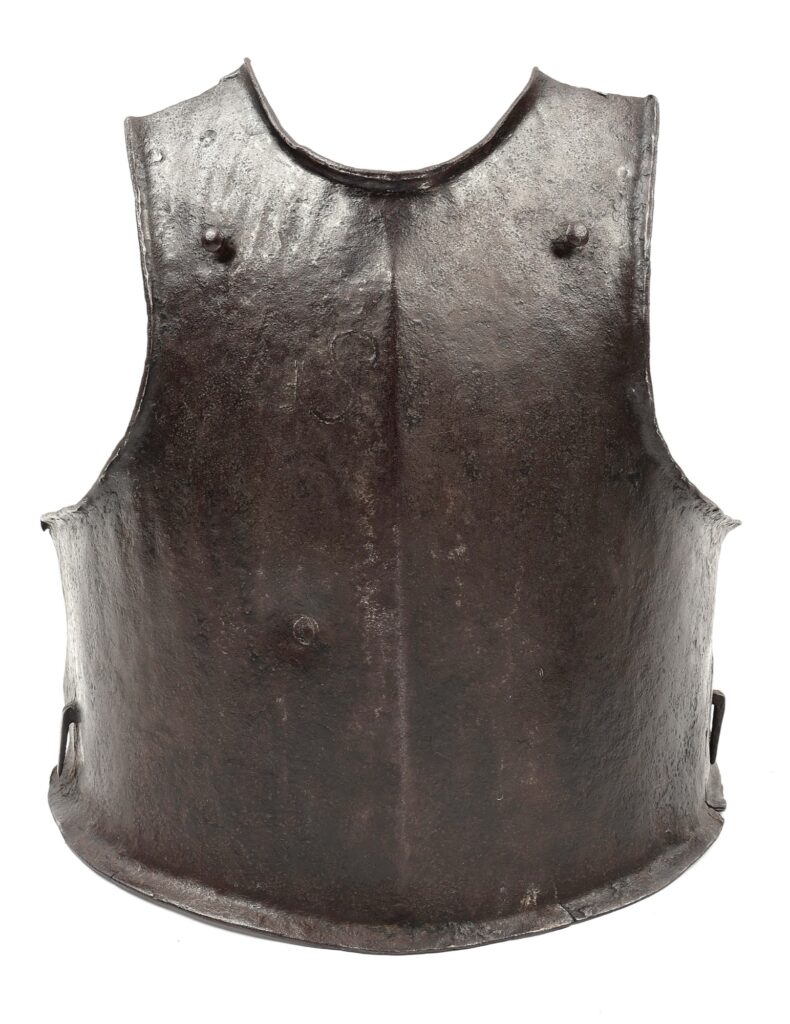
The history of body armor against bullets begins with the gun itself. Armorers of the 1500s shot at their own plates to prove them against firearms. The chapters that followed include the steel vests sold to Civil War soldiers, the silk cloth of the 1890s, the trench armor of 1916, the flak suits of 1943, the nylon and Doron vests of Korea, and Kevlar and ceramic plates. The record below comes from the people who made and tested the armor: Bashford Dean’s 1920 book for the Metropolitan Museum and Yale, period newspapers and patents, the Army Medical Department’s Wound Ballistics, Natick laboratory reports and the National Institute of Justice. The ratings themselves are covered in our guide to body armor levels.
Proof Armor: The First Bullet Test
Bashford Dean, curator of armor at the Metropolitan Museum and head of the Army Ordnance armor unit in the First World War, wrote in Helmets and Body Armor in Modern Warfare (1920) that “as early as 1340” armor came in two grades, “proof” and “half proof.” Proof would stop the bolt of a heavy crossbow. Half proof stopped only arrows and light bolts.
Firearms raised the standard. Dean says that “by about the middle of the sixteenth century” proof armor was expected to resist the war musket, and half proof the lighter firearms, “including pistols.” A suit could mix the two, with proof plate in front and half proof on the back and arms. The demands kept climbing, through grades Dean lists as “high-proof,” “caliber proof” and “musket proof.”
Cities certified the results. Many helmets and breastplates carry the proof mark of Nuremberg, Venice or Augsburg. The test itself was simple. Dean, citing the Verney family memoirs for 1667, gives a lead bullet of about one ounce over enough black powder to cover the bullet in the palm of a hand. He notes the bullet test was still in use for both front and back plates “as late as 1734.”
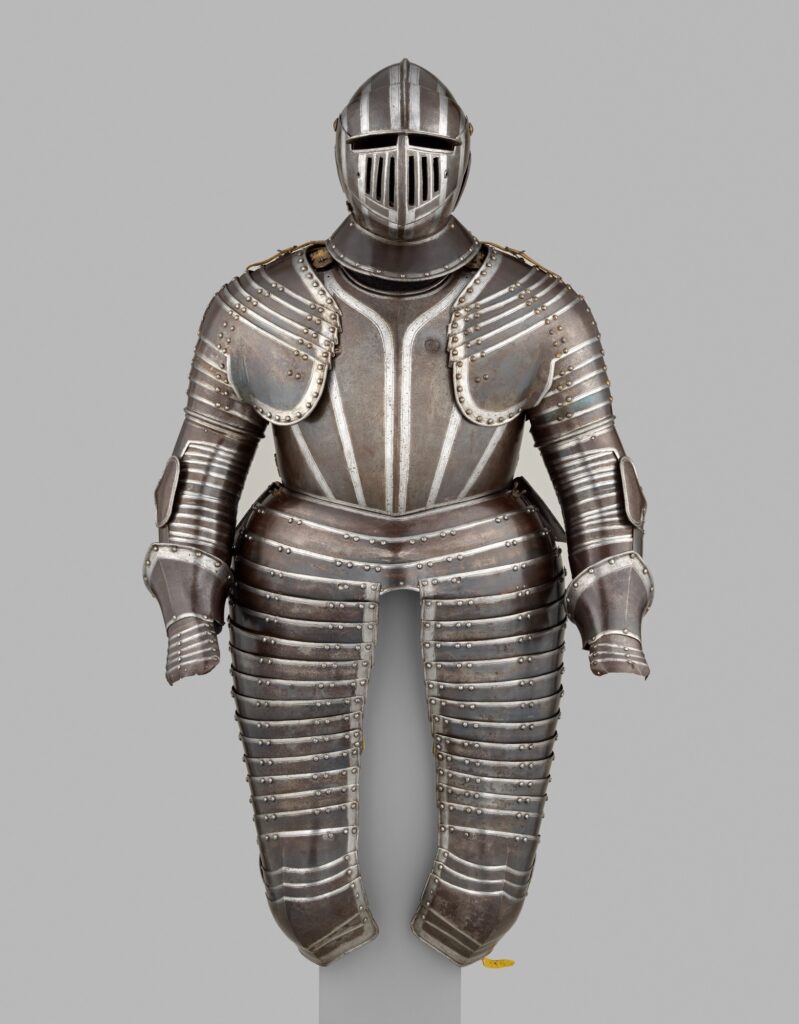
The dents in surviving armor are mostly these test marks. Dean wrote that armor of about 1560 to 1750 often bears bullet dents and that “they are usually testing marks.” They were made before the armor was finished, and the dent often sits under the bluing or gilding, or becomes the center of an engraved ornament. The Metropolitan Museum’s label for the Italian cuirassier armor pictured above says the armor “was fired at with a pistol or musket to test its effectiveness against bullets, and the bullet dents were left as a guarantee of the strength and quality of its steel.” The Met’s French “Shot-Proof Cuirass” of the early 1700s has a shallow dent in the lower left of its breastplate for the same reason.
Proof armor was heavy. The Met holds an Italian reinforcing breastplate of about 1625 to 1630, made to be strapped over a cuirassier’s breastplate “in order to make it bulletproof.” It weighs 14 pounds 11 ounces by itself. Dean quotes La Noue, in an English translation of 1587, complaining that against “harquebuzes and dagges” (muskets and pistols) the horsemen of his day “have laden themselves with stithies,” or anvils. Our page on the matchlock arquebus covers the guns those armorers faced.
Silk appeared early as well. Dean quotes Roger North, who recorded that “an abundance of silken back and breast plates were made and sold that were pretended to be pistol proof.” North added that the wearer was safe only because nobody could strike at him “for laughing.”
Civil War Steel Vests
Armor came back to American soldiers as a private purchase. By December 1861 the Worcester Daily Spy reported that “the new steel vests made at New Haven stand a rifled pistol shot at twenty-five paces, by actual test.” In March 1862 the Confederate Daily Richmond Whig reprinted a Philadelphia Inquirer notice under a headline that included “Bullet Proof Vests for Yankee Soldiers.” It named the makers as G. & D. Cook & Co. of New Haven.
The Inquirer described the “Soldier’s Bullet-Proof Vest” as an ordinary military vest holding “two plates of fine, light steel.” It weighed three and a half to five pounds. The Inquirer said it would stop pistol balls at ten paces and rifle balls at forty rods. The vest was sold at Elliott’s on Broadway in New York. The notice said a board of officers appointed by the War Department was testing it, and that “officers and men are supplying themselves, to a considerable extent, at their own expense.”
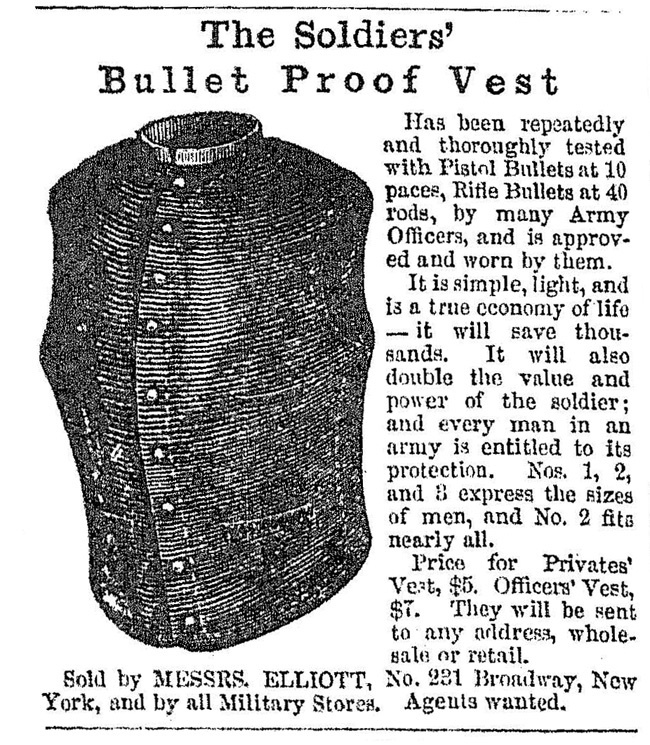
An Army board did test a vest. The Dollar Weekly Mirror of Manchester, New Hampshire, reported on February 1, 1862, that “a board of officers are testing the merits of a bullet proof vest in Washington.” The vest stopped pistol balls at fourteen paces and was to be tried next with Springfield rifles. No published report of the result or of an Army purchase is known. Other tests went badly. The Springfield Republican reported a test at Hartford with the armor fastened around a tree: one rifle “made a large dent and then a hole in the armor; and Colt’s rifle tore a hole both in the armor and the vest.”
The papers also printed saves. The Springfield Republican wrote that Colonel Briggs of the 10th Massachusetts, in “the late battle before Richmond,” was struck “in the breast, by a ball which was stopped by a steel vest.” The New York Herald reported that a steel vest saved the life of the lieutenant colonel of the 24th New York in Pope’s battles of August 1862. Other papers told of a captain at Williamsburg whose vest stopped seven bullets before an eighth struck him in the head.
Dean collected a veteran’s account in 1920. General Nathaniel Wales wrote that the vests were “worn more often than we had any idea of, but many officers felt they should not be protected better than their men, consequently those who wore the armor did not advertise it.” Wales said his own vest stopped a bullet “just below the heart” at Antietam. Dean describes a set preserved in a Richmond museum, taken from a dead soldier in the trenches during the siege, and said such armor was made at New Haven. The metal was mild steel .057 inch thick, and the “suit” weighed about seven and a half pounds. A surviving Civil War piece he tested resisted a 200-grain .45 Colt bullet at about 700 feet per second.
Silk and the Bulletproof Vest of the 1890s
Silk came back in the 1880s. Dr. George Goodfellow of Tombstone, Arizona, published “Notes on the Impenetrability of Silk to Bullets” in the Southern California Practitioner in March 1887. He described a man whose silk handkerchief was carried into a chest wound by a ball and came out with the bullet inside it. The silk showed “only two slight tears or cuts.” In another case two buckshot lay in the folds of a silk neckerchief without cutting “a fibre of the silk.” Goodfellow concluded that “a few layers of light silk” could stop bullets that passed through flesh. He reported what he saw and proposed no garment.
The man who made silk armor famous was Casimir Zeglen, a Chicago priest. An April 1897 report in the Chicago Chronicle, reprinted by the Indianapolis Journal, said the idea came to him the night Mayor Carter Harrison was murdered in 1893. Zeglen repeated the story himself in 1902. His first U.S. patents, Nos. 577,999 and 578,000 for “Bullet-Proof Fabric,” were granted on March 2, 1897. The fabric was a composite: a canvas face, a layer of Angora hair, then woven layers of silk cord, all stitched together. In a third patent, No. 604,870 of 1898, Zeglen wrote that his cloth resisted “modern rifles, such as the Krag-Jorgensen and the like.”
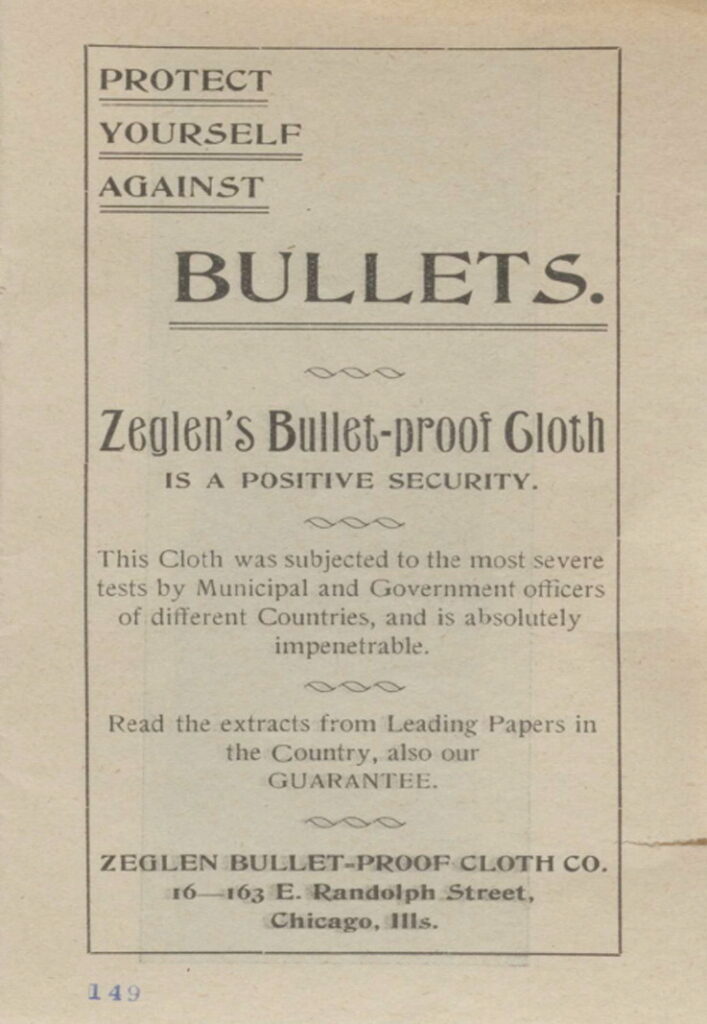
Zeglen proved it on a dog and then on himself. The New-York Tribune reported on July 4, 1897, that two .44 bullets fired from ten feet failed to hurt a dog wrapped in the cloth. On July 10 his former pupil, Lieutenant Sarnecki of the Austrian army, fired five pistol shots at Zeglen’s chest from ten paces on the roof of a Chicago hospital. The New York Journal gave the calibers as .32 to .44 and noted that doctors stood by “with long knives and probing instruments, expecting a catastrophe.” He was unhurt.
The claims grew with the business. In 1902 the Irish Standard printed his claim that he had filled orders “for nearly all the crowned heads of Europe and 100 men in the bodyguard of the czar.” The same article described the cloth by then as pure silk in three-ply cords, about one eighth of an inch thick. No independent record of those royal sales is known. The Army’s view was cooler. Dean records tests of Zeglen’s cloth at Springfield in 1899 and 1904. Tests in Washington found it would not stop jacketed .45 automatic bullets at 600 feet per second, and “its resistance was hardly 400 foot seconds.”
In the Russo-Japanese War silk was combined with steel. Dean writes that Russian officers were issued breastplates of chrome-nickel steel one eighth of an inch thick, covered and lined with Zeglen fabric, and that a lot of 50,000 was ordered for General Linevich’s army. Dean also tells of the Australian outlaw Ned Kelly, whose 1880 armor, beaten from plowshares, weighed ninety-seven pounds.
World War I: Trench Armor
The armies of 1914 issued no body armor at all. “When war began, in August, 1914, a soldier, even under special conditions, was given no defenses for head or body,” Dean wrote. The case for armor came from the wound figures. Dean gave figures showing that 60 to 80 percent of French wounds, and 65 to 80 percent of American wounds, came from missiles of middle and low velocity, such as shell fragments and shrapnel.
The French built light armor first. By the end of 1916 General Adrian had an abdominal shield of two pounds, and Dean says 100,000 were made. The British market filled with private armor. The Dayfield Body Shield was one of the best known. Its heaviest model weighed 14 to 18 pounds, and Dean records “about 20,000 sets” of the type in use in France in October 1917. “Its clumsiness and weight caused it in the end to be discarded.” The British government issued its own corselet in 1917, of 9 1/2 pounds of Hadfield manganese steel, which Dean says “will resist the ball of the automatic pistol, also shrapnel and grenade.”
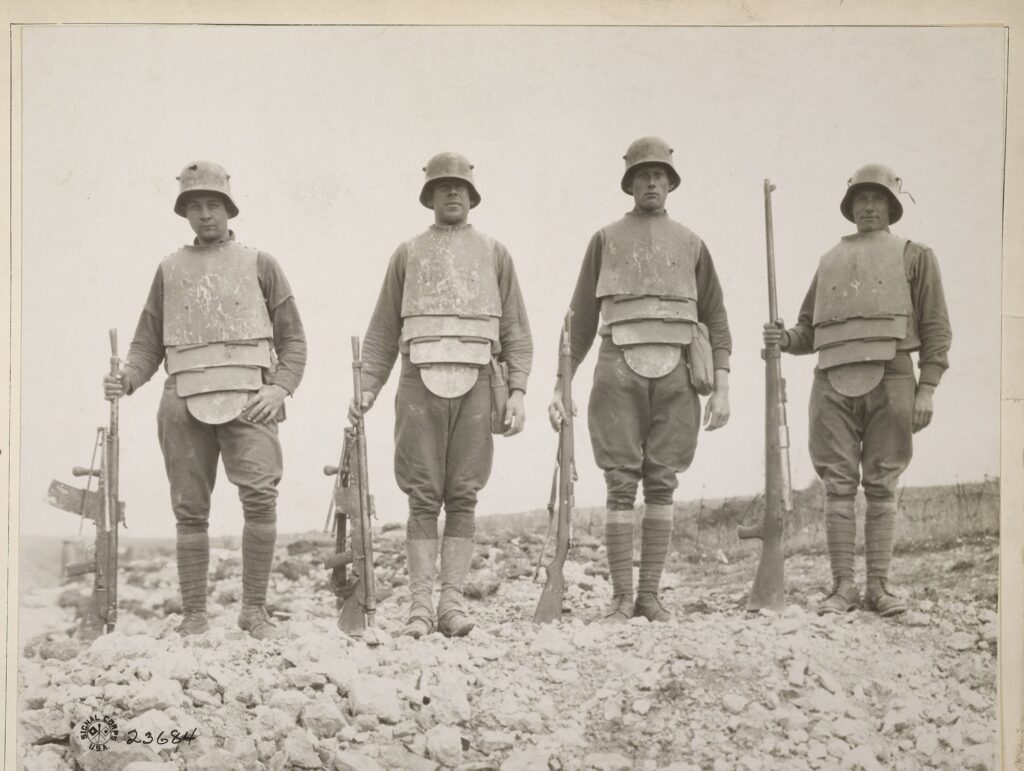
The Germans issued heavy armor on a large scale. Dean gives two sizes: 19 to 22 pounds and about 24 pounds, in silicon-nickel steel. The National Army Museum in London says the German Army “issued around 500,000 pieces of such armour during 1916.” It was never meant for the assault. A captured order signed by Ludendorff on June 5, 1917, says “the armour is not generally intended for operations, but it will prove valuable for sentries, listening posts, garrisons of shell holes, gun teams of machine guns scattered over the ground, etc.” A German field report added that “when the enemy attacks, the armour has to be taken off.” One battalion’s scale of issue in June 1917 was two per company.
Dr. Brewster and the American Trials
The best-known American armor of the war came from a private inventor. Dr. Guy Otis Brewster of Dover, New Jersey, built a breastplate of chrome-nickel steel from Bethlehem Steel, carried on a sprung frame, with a visored helmet. His patents, No. 1,350,062 and No. 1,348,204, were filed in 1915 and 1917 and granted in August 1920. In April 1917 at Picatinny Arsenal, Brewster stood in front of a Lewis machine gun and took a number of service bullets at about 2,700 feet per second. Dean reports that he called the blows “only about one tenth the shock which he experienced when struck by a sledge-hammer.”
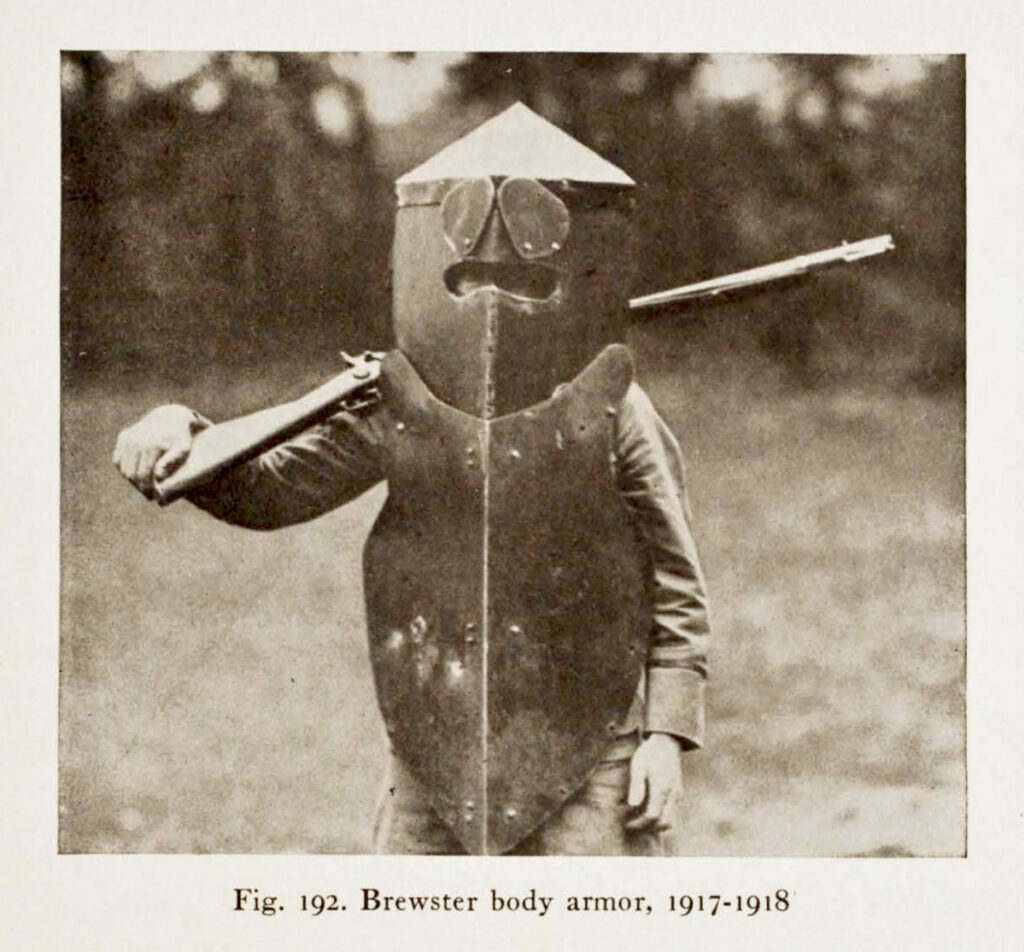
Dean admired Brewster’s nerve and also recorded the limits of the test. The armor weighed about forty pounds, and “in this test the breastplate was not struck normally but at an angle of 35 to 45 degrees.” The main objection was weight: critics said the American soldier “could not be induced to carry” it. General Pershing asked in the summer of 1917 that work on body armor continue. Dean says Ordnance examined “upward of thirty types of body shields,” and none received a favorable report from American headquarters.
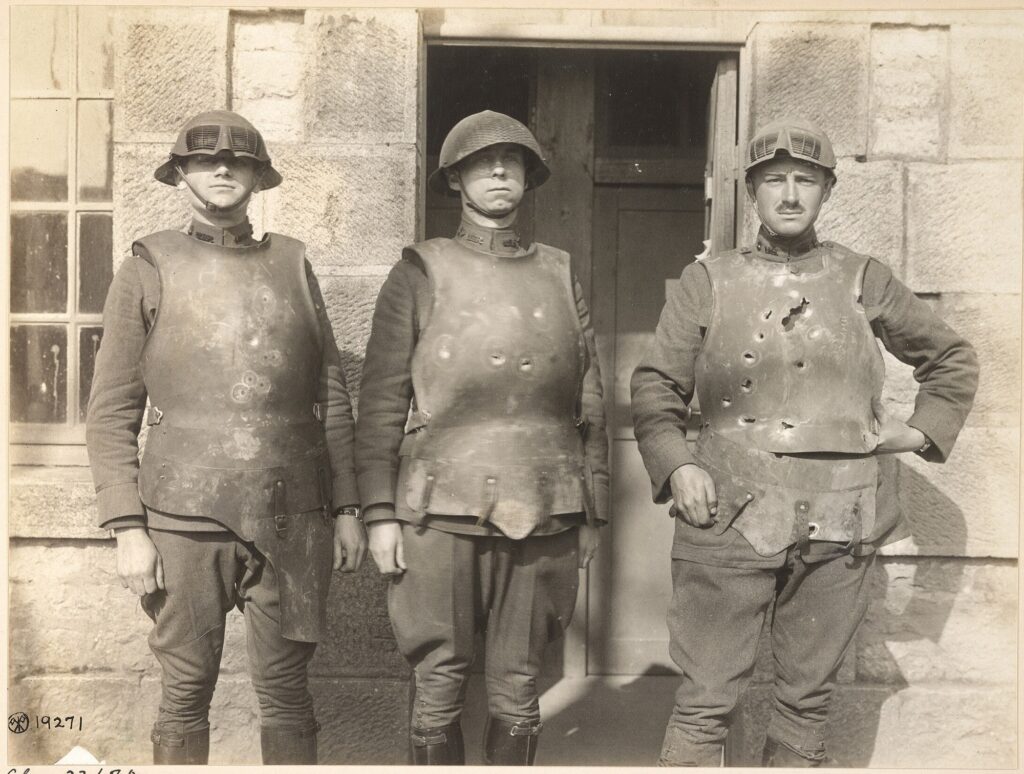
The Ordnance Department tried its own designs, drawn up in the armor workshop of the Metropolitan Museum. A heavy breastplate modeled on fifteenth-century armor, 27 pounds in all, was designed in February 1918 and on a ship for France 26 days after work on it began. The troops at the Langres armor school reported that it tired their shoulders and backs, was noisy, and got in the way of their machine guns. A light set of 8 1/2 pounds of manganese steel stopped revolver bullets at 850 feet per second. Dean concluded that he saw no reasonable chance that body armor would be used “unless a different system is adopted for the transport of the equipment of the soldier.”
World War II: The Flak Suit
Between the wars, the Army’s Wound Ballistics history says, work on body armor “was maintained at a very low level.” The Army decided officially in November 1942 that armor for ground troops seemed “a military luxury which could not be indulged in during an all-out global conflict.” The bomber crews were a different case. An analysis of Eighth Air Force wounds in October 1942 found about 70 percent were caused by “relatively low velocity missiles,” mostly flak and cannon-shell fragments.
Colonel Malcolm C. Grow, the Eighth Air Force surgeon, designed a vest with the Wilkinson Sword Company of London. The Wound Ballistics chapter on armor describes 2-inch squares of Hadfield manganese steel, overlapped in pockets and sewn to a canvas backing. British tests had shown that 1 mm of manganese steel would stop a .303 bullet at about 1,250 feet per second. General Carl Spaatz approved ten suits for testing on October 15, 1942, and armor for the crews of twelve B-17s arrived about March 1, 1943. British makers produced 600 in England. The full vest weighed 16 pounds.
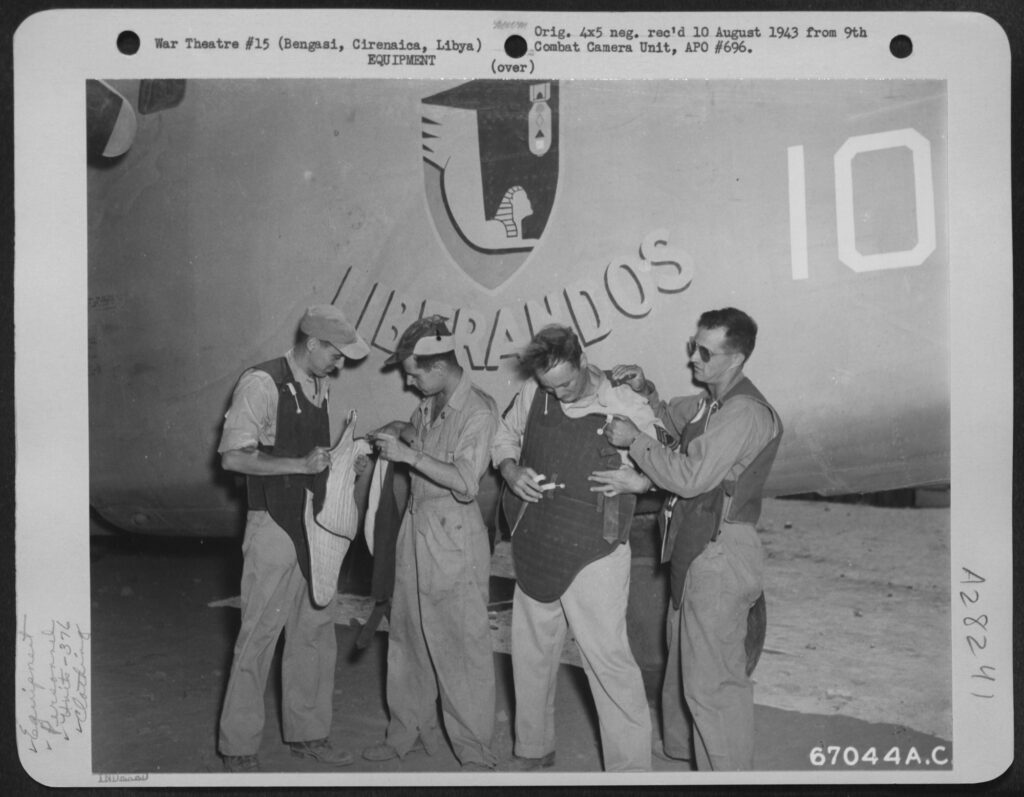
The crews called it the flak suit, and they knew what it could not do. The official history by Link and Coleman (1955) says they “were never under any illusions concerning the nonresistance of the suit to .30 and .50 caliber guns.” Some were never convinced. As late as April 1945 a memo asked headquarters to forbid “the improper use of the flak suit as a floor mat.” The standard Flyer’s Vest M1 weighed 17 pounds 6 ounces, and 338,780 were made between August 1943 and August 1945.
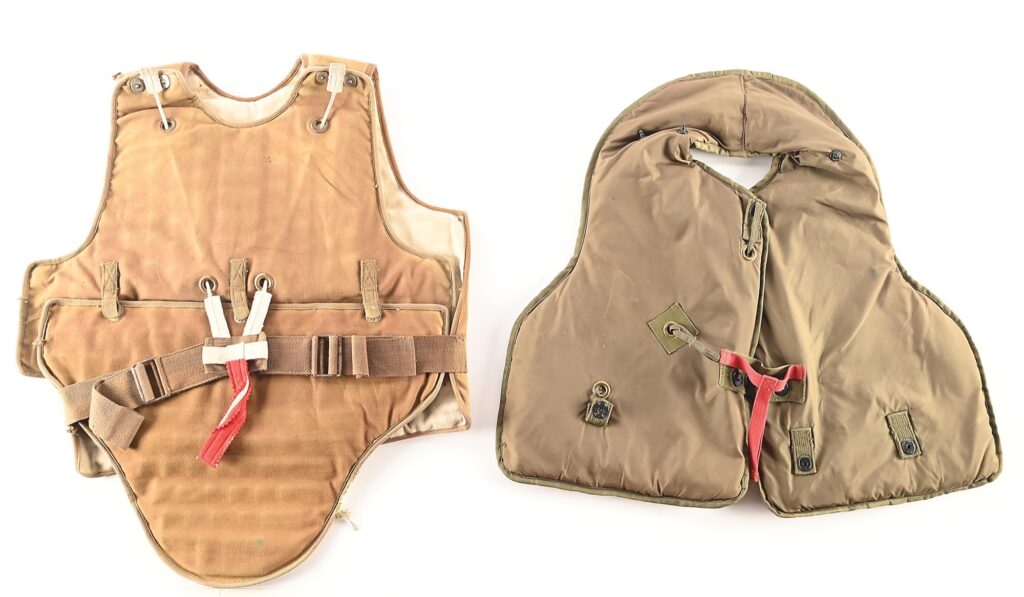
The results came from Grow’s own office, in an Air Surgeon’s Bulletin report he wrote with R. C. Lyons in January 1945. Comparing heavy-bomber crews before and after armor, the Army history gives “a reduction of 58 percent in persons wounded” per thousand crewmen. Aircraft battle damage fell 18 percent over the same periods, and the history allows that “some of the reduction” had other causes. The postwar survey gave sharper figures: among men hit in the chest, the death rate fell from 34.9 percent without armor to 15.3 percent with it.
Doron and the Ground Vest
Ground armor came late. In May 1943 the Dow Chemical Company laminated a glass-fiber fabric that showed promise. Men working for Colonel Georges F. Doriot of the Quartermaster General’s office named it “doron” in his honor. The Army preferred steel and aluminum, but the Navy pursued doron. Two Navy officers proved it with a .45 pistol: Lieutenant Commander Andrew Paul Webster fired at Lieutenant Commander Edward L. Corey in a doron-armored jacket, “and this demonstration was repeated 21 times with no serious injury.” About 1,000 jackets were readied for a Marine division at Okinawa, but that division was not used there. A few jackets were probably worn late in the fighting, and no large-scale survey was made. The Army’s aluminum and nylon Vest M12 was standardized in August 1945, too late for the war.
Korea: Nylon and Doron Vests
The Wound Ballistics authors wrote that “it was not until the Korean War that the numerous sceptics were convinced” about body armor. The Army’s survey teams found about 92 percent of the missiles that wounded men were fragments, and most had too little velocity to pass through the body. Laboratory tests had shown that stopping most bullets “with any reasonable weight of body armor material” was impossible. The goal became a light vest against fragments.
In June 1951 the Naval Field Medical Research Laboratory at Camp Lejeune made 50 test vests of 6.1 pounds: basket-weave nylon over the chest and shoulders and 16 curved doron plates below. The Wound Ballistics chapter on Korea says they were worn by “approximately 6,000 soldiers and marines.” The Marine Corps standardized its doron-and-nylon vest, the M1951, by November 16, 1951. The Army’s answer was an all-nylon vest of 12 plies, the T52. In 1952 more than 15,000 soldiers wore 1,400 test vests for about 400,000 man-hours.
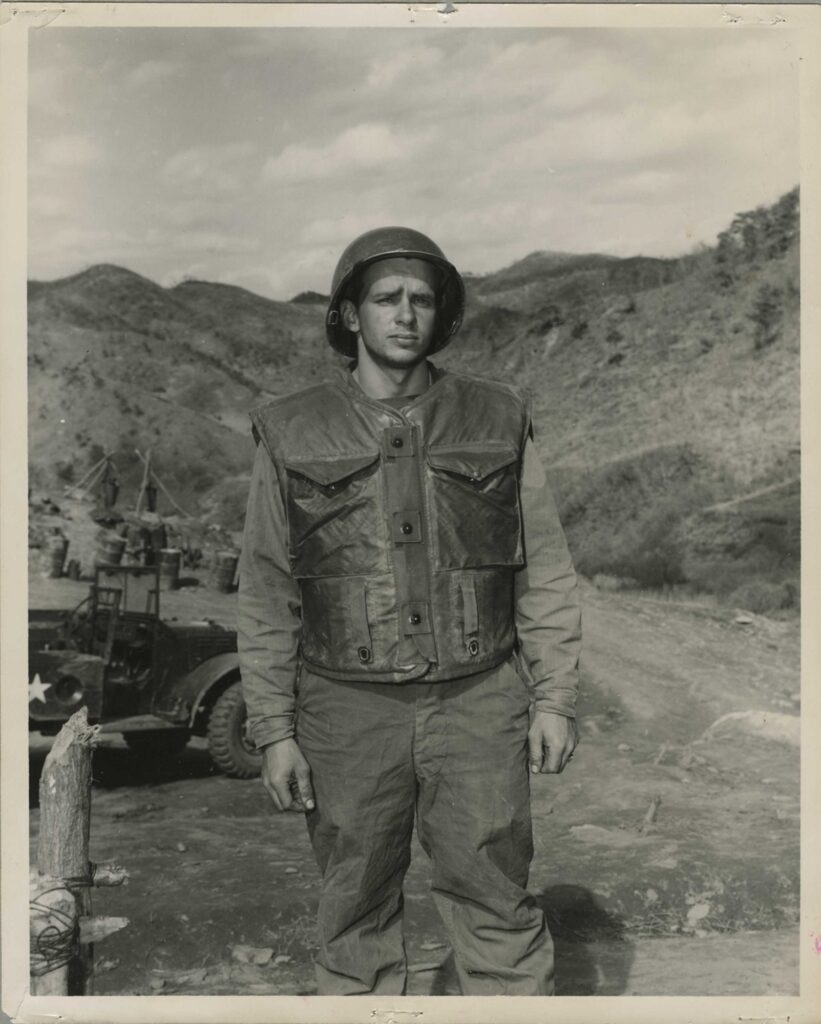
The test report of September 1952 put the limits in numbers: the vest defeated “75.7% of all fragments” and “24.4% of all small arm missiles.” It reported that the vest “reduced the incidence of chest and upper abdominal wounds by 60 to 70%.” The Army’s T52-3 became standard in the fall of 1952, and the first shipment left the Philadelphia Quartermaster Depot about December 3, 1952. Later Army reports call it the M1952. Soldiers wanted them. The test teams saw wounded men “relieved on the battlefield of their armor by other soldiers who did not have vests.”
The Quartermaster Corps tried to correct the language in its fact sheet of December 23, 1952: “Despite the widespread popular use of the term, no military service has developed a practical ‘bullet-proof’ vest.” The vests were “designed primarily to stop fragments of mortar shells, hand grenades and other types of low-velocity missiles.” The Navy’s 1951 test vest was rated to stop a .45 pistol or Thompson bullet at the muzzle. Rifle bullets needed a new material.
Vietnam: Flak Jackets and the First Ceramic Plates
Ground troops in Vietnam wore the nylon M1952 and its successor, the M69, and the Marines wore the doron M1955. The Army special operations history journal Veritas gives the M69 as 8.4 pounds of ballistic nylon, with a protective collar that got in the way of the M1 helmet. It adds that soldiers “seldom wore body armor while patrolling, as it was bulky and trapped heat and moisture.” The vests went on for static positions and convoys.
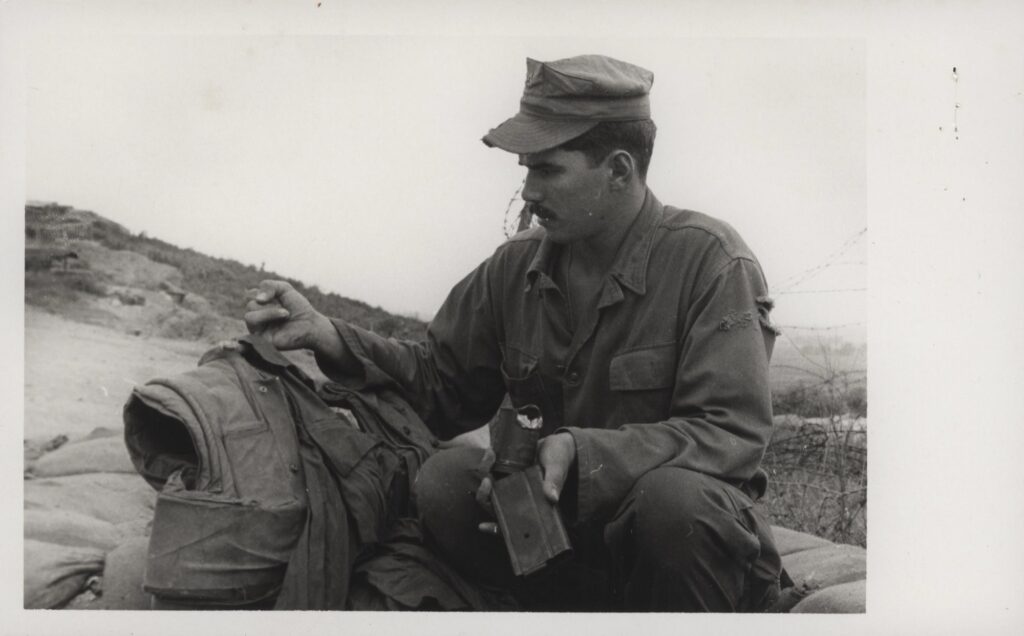
The helicopter crews got the first light body armor that stopped rifle bullets. A 1969 Natick Laboratories report, Body Armor for Aircrewmen, says such armor “first became possible in 1962” with a composite of ceramic backed by glass-cloth plastic, effective against caliber .30 AP ammunition. The first Army aircrews in Vietnam had only World War II flyer’s vests and the M1952. Pilots laid flak vests in the nose bubble, and gunners sat on spares.
In 1962 the Army Transportation Research and Engineering Command (TRECOM) designed pilot’s shields of 1-inch doron, 17.5 pounds each, held on the lap, and shipped more than 150 kits to Vietnam by January 1963. In August 1964 the Army set a requirement for aircrew armor and gave the work to Natick. The first plates had an aluminum oxide face backed by doron. By the summer of 1965 they were made as single curved torso plates. Boron carbide and silicon carbide sets, one to three pounds lighter, were first bought in 1965 and cost two to four times as much. A study of 72 aircrew casualties from July 1966 to June 1967 found that 76.4 percent wore torso armor and only 3.6 percent of wounds were to the chest or back. Crews called them “chicken plates.”
Plates for ground troops came last. Veritas says “variable-type” armor with hard plates “did not reach ground troops until 1969, and then in limited quantities,” and the program was cancelled in early 1970.
Kevlar: From Tire Cord to Police Vest
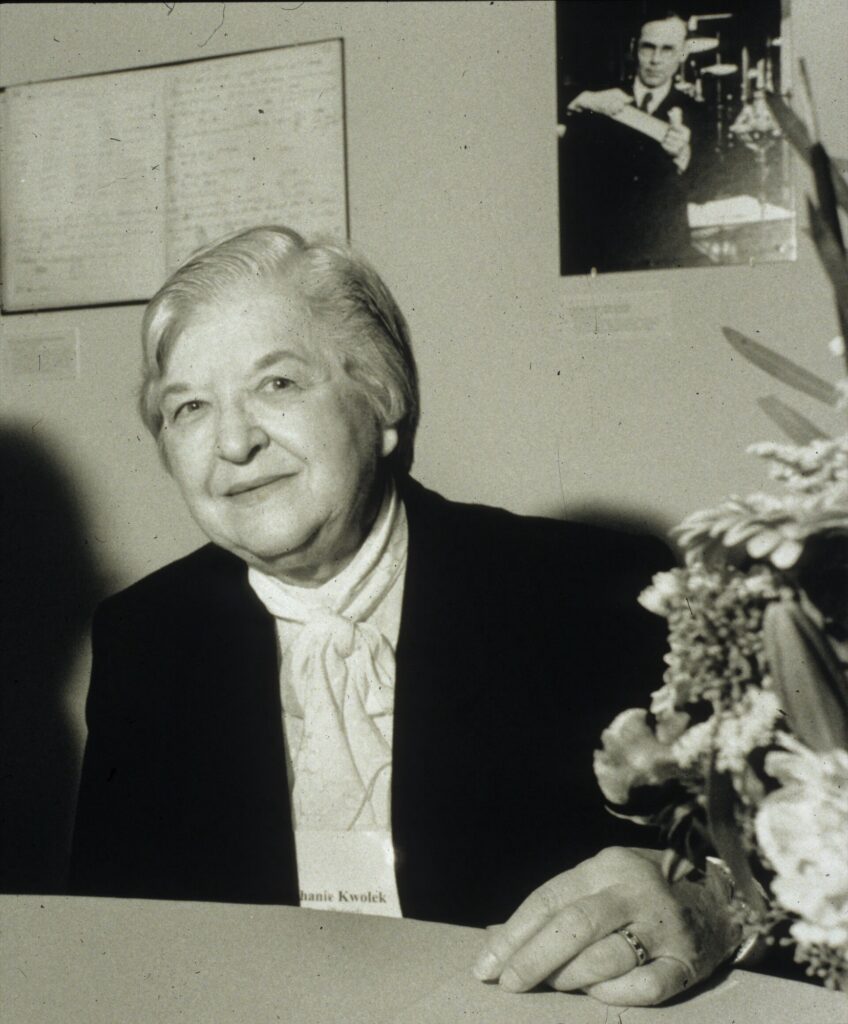
The fiber that changed police armor was made for tires. In 1965 Stephanie Kwolek, a DuPont chemist, found that certain rod-like polyamides formed cloudy liquid crystalline solutions that could be spun into fibers of great strength and stiffness. The Science History Institute says the most famous of these “was commercialized as Kevlar.” The Lemelson-MIT program dates its first marketing to 1971. Kwolek’s fiber patent, No. 3,819,587 of 1974, names its uses as “reinforcing agent for plastics, tire cord, V-belts, etc.” A 1976 federal report says: “Kevlar is the result of a search for a new tire cord material.”
Police needed it. NIJ’s 2001 guide to personal body armor says officers killed in the line of duty each year rose from 57 in 1966 to 129 in 1971. Police armor of the day was built for barricade jobs. In January 1971 the new Law Enforcement Standards Laboratory had 23 commercial vests from 12 makers tested at the Naval Research Laboratory. A typical model, from Davis Aircraft Products of Northport, New York, combined Hadfield steel plate with 12 layers of ballistic nylon and weighed 13 pounds.
The NIJ guide tells how the change began. Lester Shubin of the National Institute of Law Enforcement and Criminal Justice and Nicholas Montanarelli, an Army Land Warfare Laboratory specialist, “took a piece of Kevlar to a gun range, folded it over a couple of times, and shot at it. The bullets did not go through.” A 1973 Land Warfare Laboratory report on garments for public officials found DuPont’s fiber, then called PRD-49-IV, “superior to all other materials tested.” Five plies stopped .22 and .38 handgun bullets at 800 feet per second. NIJ put more than $3 million into the program between 1971 and 1976.
The design goal, in the words of the 1976 program report, was that an officer “should be able to walk from the site of the shooting after being hit in the chest, back, or abdomen.” In 1975 some 5,000 vests went to 15 city police departments for a year of field testing. On December 23, 1975, Seattle Patrolman Raymond T. Johnson was shot twice in the chest during a store robbery. The NIJ Journal calls him “the first law enforcement officer saved in a field test.” Seventeen more officers were saved during the test year. NIJ also notes an earlier documented save outside the test, in Detroit in May 1973.
Richard Davis and Second Chance
Industry moved as fast as the government. Richard Davis filed a patent on May 8, 1972, titled “Bullet-proof protective armor and method of making same.” It described armor light enough for police officers to wear “during even normal, as well as dangerous assignments.” His design was a pad of loose sheets of woven nylon in a cloth envelope, about five pounds for full protection. Davis founded Second Chance Body Armor of Michigan, which became the country’s top maker of soft concealable police armor. NIJ’s guide notes that soft armor was “commercially available in quantity even before the NIJ demonstration program.”
The standards followed the vests. The first, NILECJ-STD-0101.00, was dated March 1972, according to the cover of its 1978 successor. Compliance testing began in 1978, and the revisions came in December 1978, 1985, 1987, 2000 and 2008, with interim requirements in 2005. The current pair, NIJ 0101.07 and 0123.00, is dated October 2023. What each level means is set out in our body armor levels explainer.
PASGT, Ranger Body Armor and Interceptor
The Army adopted Kevlar for its own vest at the same time. A 1976 Army test plan records that the requirement for a Personnel Armor System for Ground Troops (PASGT) was approved in January 1973, using “a new polyamide textile material, known commercially as ‘kevlar’.” The prototype vest weighed 9 pounds. Veritas dates the PASGT vest’s introduction to 1983.
Rifle plates for infantry returned in the 1990s. Natick delivered Ranger Body Armor in September 1992. Veritas describes it as the PASGT’s Kevlar plus an eight-pound aluminum oxide plate over the front of the torso. The Rangers wore it at Mogadishu on October 3 and 4, 1993. The Army’s account of the battle credits the Natick team that built it in eleven months. A 2000 medical study of the battle found that “body armor seems to have reduced mortality from injuries to the chest.”
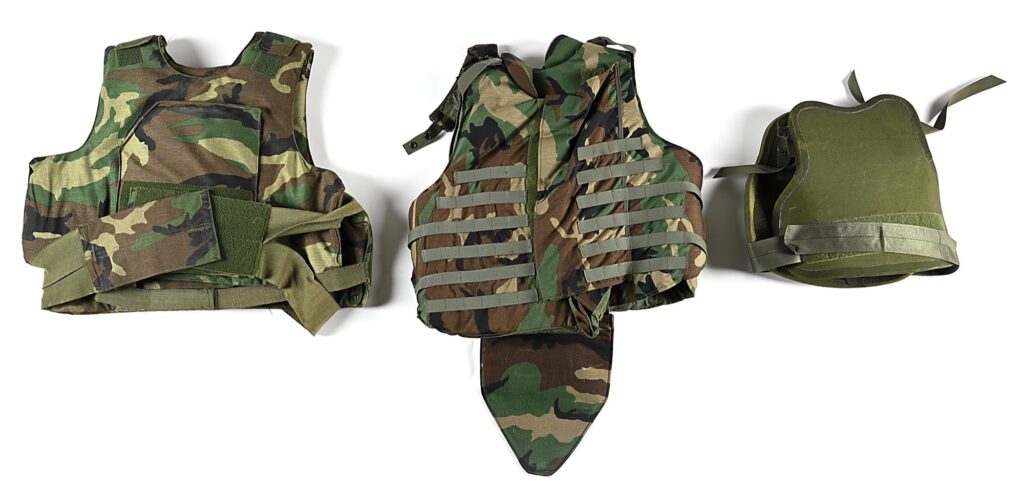
Interceptor Body Armor made plates standard. The Defense Department Inspector General dates the start of Army fielding to June 1999. Interceptor paired an outer tactical vest with small arms protective inserts (SAPI), plates of boron carbide. In October 2003 Central Command required a set for every service member in theater. By June 2006 the Army had fielded 953,079 vests and 896,069 sets of plates. A line for the enhanced plate, ESAPI, was added to an Army plate contract on August 15, 2005, rated against .30 caliber armor-piercing bullets.
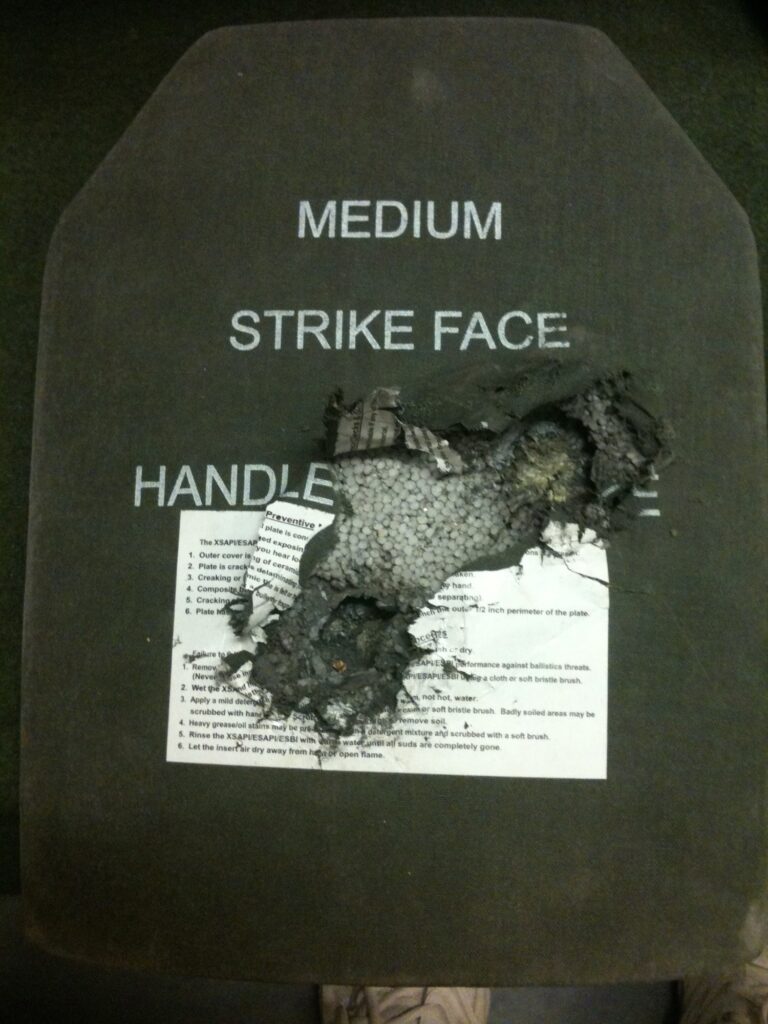
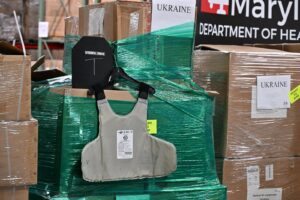
The war brought recalls as well. The Government Accountability Office reported that the Marine Corps recalled armor in May 2005 that failed contract specifications, and that in November 2005 the Army and Marine Corps recalled 14 lots that had failed their first ballistic tests. The Army’s Improved Outer Tactical Vest arrived in 2007 by the Veritas account (an army.mil article says 2008) and the lighter Soldier Plate Carrier System in 2010. In October 2017 soldiers at Fort Carson field-tested the Modular Scalable Vest, 25 pounds fully configured and five pounds lighter than the IOTV.
The Zylon Failures, 2003 to 2005
The first reported failure of NIJ-compliant armor came in 2003. On June 23, 2003, in Forest Hills, Pennsylvania, Officer Edward Limbacher was hit in the abdomen by a .40 caliber bullet that went through his Second Chance vest, made primarily of a fiber called Zylon. He survived. The NIJ Journal calls it “the first case ever reported to NIJ in which body armor compliant with the NIJ standard failed to prevent penetration from a bullet it was designed to defeat.” Ten days earlier, Officer Tony Zeppetella of Oceanside, California, had been shot 13 times and killed while wearing a Zylon vest he had bought as an upgrade with his own money. Whether his vest failed was never settled.
In November 2003 Attorney General John Ashcroft called on NIJ to examine Zylon vests. The Justice Department reported in August 2005 that of 103 used Zylon vests, “60 (58 percent) were penetrated by at least one round during a six-shot test series.” Only four met every requirement for new armor, and “age and appearance of used Zylon-based vests were ineffective predictors” of performance. NIJ’s preliminary work pointed to the fiber breaking down with moisture and light. Second Chance recalled some Zylon vests in late 2003 and filed for bankruptcy in 2004. NIJ ruled that Zylon vests would no longer count as compliant unless their makers could show the armor would hold up. By 2018 the Justice Department could say that Zylon “is no longer used in ballistic vests.”
The courts took years. In 2006 a San Diego County jury found that Second Chance and the fiber maker, Toyobo, had failed to warn Officer Zeppetella, and deadlocked on whether a design defect let the fatal bullet through. The Justice Department’s False Claims Act cases ran until 2022. Toyobo agreed to pay $66 million in 2018, and Richard Davis settled the same year. The final settlement brought the total over $136 million. The 2008 standard, NIJ 0101.06, added a round of tests on armor first put through heat, moisture and wear.
Polyethylene and Body Armor Today
The other modern armor fiber is ultra-high-molecular-weight polyethylene. DSM of the Netherlands first filed the gel-spinning patent for it in 1979, naming the chemists Paul Smith and Pieter Lemstra. Allied Corporation’s patent for its own fiber, sold as Spectra, was granted in 1983. DSM sold its fiber as Dyneema. A NIST study notes that the fibers can lose strength through “a thermooxidative mechanism of degradation.”
Police armor is now tested to NIJ 0101.07, and NIJ expects to keep the older 0101.06 list through at least 2029. Our body armor levels guide covers what each rating was tested against, and our guide to body armor for civilians turns the ratings into picks.
Record and Legend in the History of Body Armor
Popular accounts of body armor repeat a number of stories. Each is set below against the record.
- “The dents in old armor are battle damage.” Some are. Dean wrote that the bullet dents on armor of 1560 to 1750 “are usually testing marks,” made before the armor was finished.
- “Goodfellow invented the silk vest.” His 1887 paper reports wound cases and concludes that silk stops bullets. It proposes no vest.
- “Zeglen’s vest was pure silk.” His 1897 patents describe canvas, Angora hair and silk cord stitched together. The press described pure silk cloth by 1902.
- “Zeglen sold vests to the crowned heads of Europe.” The claim appears in an interview piece of 1902, and no independent record of it is known. Dean documents Russian steel plates covered in his fabric in 1904 and 1905.
- “A silk vest would have saved McKinley.” That claim was a sales pitch. In October 1901 the Vienna inventor Jan Szczepanik told a correspondent that his cloth “would have rendered the bullet of that Buffalo anarchist entirely harmless” (Washington Bee). No published record from the time shows that anyone offered McKinley a vest.
- “Franz Ferdinand owned a Zeglen vest.” On June 29, 1914, The Sun of New York ran the headline “Francis Ferdinand Wore a Bullet Proof Coat,” relaying a Daily Mail report from Vienna of “a coat of silk strings.” It named no maker, and no published inventory or order is known.
- “Brewster’s armor stopped machine-gun fire.” It did, at an angle of 35 to 45 degrees, in armor of about forty pounds. The Army never adopted it.
- “Flak jackets were bulletproof.” The Quartermaster Corps said in 1952 that “no military service has developed a practical ‘bullet-proof’ vest.” The Korean vests stopped about three fragments in four and about one small-arms bullet in four.
- “Kevlar was invented for body armor.” It came out of a search for tire cord. Shubin and Montanarelli found its use against bullets on a range.
- “Richard Davis invented the Kevlar vest.” His 1972 patent is for woven nylon. The federal Kevlar program ran at the same time.
- “Every save is a stopped bullet.” NIJ counted 2,500 saves through January 1, 2001. Forty-two percent were accidents, such as car crashes.
- “Zylon killed Officer Zeppetella.” The jury found a failure to warn and deadlocked on the design defect. The defense argued the fatal shot came at an angle no vest could stop.
- “There was an NIJ 0101.05.” The 2005 Interim Requirements filled the gap between 0101.04 and 0101.06.
Sources
- Bashford Dean, Helmets and Body Armor in Modern Warfare (Yale University Press, 1920).
- The Metropolitan Museum of Art, Cuirassier Armor, 2002.130a-p, Shot-Proof Cuirass, 2005.445a, b and Reinforcing Breastplate, 14.25.867.
- Library of Congress, Chronicling America: Worcester Daily Spy, December 20, 1861; Dollar Weekly Mirror, February 1, 1862; Springfield Republican, February 15 and June 14, 1862; Daily Richmond Whig, March 27, 1862; New York Herald, September 8, 1862; Indianapolis Journal, April 18, 1897; New-York Tribune, July 4, 1897; New York Journal, July 11, 1897; Washington Bee, October 26, 1901; Irish Standard, September 13, 1902; The Sun, June 29, 1914.
- G. E. Goodfellow, “Notes on the Impenetrability of Silk to Bullets,” Southern California Practitioner 2, no. 3 (March 1887).
- U.S. Patents 577,999, 578,000 and 604,870 (Zeglen); 1,350,062 and 1,348,204 (Brewster); 3,819,587 (Kwolek); 3,783,449 (Davis); 4,344,908 (Smith, DSM); 4,413,110 (Kavesh, Allied).
- National Army Museum, German body armour, NAM. 2001-04-162-1.
- Medical Department, U.S. Army, Wound Ballistics (Office of the Surgeon General, 1962), chapter XI and chapter XII.
- Mae M. Link and Hubert A. Coleman, Medical Support of the Army Air Forces in World War II (1955), chapter VIII.
- Office of the Quartermaster General, “Armored Vest Fact Sheet”, December 23, 1952 (U.S. Army Quartermaster Museum).
- Edward R. Barron, Anthony L. Alesi and Alice F. Park, Body Armor for Aircrewmen, U.S. Army Natick Laboratories Technical Report 69-43-CE (January 1969).
- Christopher E. Howard, “This Vest May Save Your Life! U.S. Army Body Armor from World War II to Present”, Veritas (USASOC History Office).
- Science History Institute, “Stephanie L. Kwolek”; Lemelson-MIT, “Stephanie Kwolek”.
- Leonard C. Miller, Police Body Armor (IACP for NILECJ, 1971); N. Montanarelli and others, Protective Garments for Public Officials (U.S. Army Land Warfare Laboratory, August 1973); N. Montanarelli, C. Hawkins and L. Shubin, Lightweight Body Armor for Law Enforcement Officers (NILECJ, 1976).
- National Institute of Justice, Selection and Application Guide to Personal Body Armor, NIJ Guide 100-01 (2001); NILECJ-STD-0101.01 (1978); NIJ Standard-0101.06 (2008); Dan Tompkins, “Body Armor Safety Initiative: To Protect and Serve… Better”, NIJ Journal 254 (2006); OJP, “OJP body armor programs keep officers safe on the front lines” (2026).
- TECOM, Developmental Test II of PASGT, Test Plan (1976); army.mil on Ranger Body Armor at Mogadishu (2018); Mabry and others, “United States Army Rangers in Somalia”, Journal of Trauma 49 (2000); DoD Inspector General, Report D-2008-067 (2008); GAO-07-662R (2007); army.mil on the Modular Scalable Vest (2017).
- U.S. Department of Justice, body armor safety findings (August 24, 2005) and settlement releases of 2018 (Toyobo, Davis) and 2022 (Honeywell); San Diego Union-Tribune, “Cop’s widow wins lawsuit over vest” (September 8, 2006).
- A. Forster and others, “Long-Term Stability of UHMWPE Fibers”, Polymer Degradation and Stability 114 (2015).
If you know of any forums or sites that should be referenced on this listing, please let us know here.